Information Forestry, December 2009

pinewood nematode, photo by L.D. Dwinell, USDA Forest Service

International sanctions by countries in Europe and Asia target the trade and transport of North American wood that may be infected with pinewood nematode, the cause of pine wilt disease.

A new molecular diagnostics method developed by Natural Resources Canada to detect live pinewood nematode in wood caught the attention of forest health officials from around the world.

“Scientists from countries with forests infested by pinewood nematode expressed a great deal of interest, as did those who are developing phytosanitary treatments,” says Canadian Forest Service Research Scientist Eric Allen, who presented the method’s preliminary results at the 2009 International Symposium on Pine Wilt Disease in Nanjing.

Pinewood nematode is the microscopic roundworm that causes pine wilt disease. Native to North America, pinewood nematode rarely, if ever, affects North American tree species. However, it has caused serious damage in Asia and Portugal prompting quarantine regulations by concerned countries. In 1993, Europe banned imports of untreated softwood commodities from North America, resulting in significant decreases in markets.

The new detection method, developed by Canadian Forest Service Molecular Biologist Isabel Leal and colleagues, allows forest health officials to analyse wood samples for messenger-RNA associated with pinewood nematode heat-shock proteins. Unlike DNA, which can survive in dead tissues for years, mRNA degrades after an organism dies. Its absence indicates lack of viable nematodes in a sample.

“It’s important to have a method to differentiate between deal and live nematodes, because only live nematodes are a risk to forest health,” says Leal.

Many major wood-importing countries, including China, Korea and Europe, require all softwood commodities exported from countries where pinewood nematode is found be treated prior to export with heat according to international standards. Leal and colleagues’ method will allow plant health officials to test and verify the effectiveness of treatments against the damaging nematode.

The method will also protect trade, by allowing exporters to demonstrate that their softwood lumber, chips, logs, prefabricated housing and wood packaging is free of living nematodes.

© Natural Resources Canada 2009

Information Forestry, December 2009

In 2009, Vancouver's renowned Stanley Park was discovered to be home to 31 invasive insect species.

In 2009, Vancouver’s renowned Stanley Park was discovered to be home to 31 invasive moth species, four of which were identified in British Columbia for the first time. Photo by outdoor PDK.

Emerging DNA-screening technologies can play a vital role in detecting and identifying potentially problematic pest insects in Canadian forests, according to a recent insect survey conducted in Vancouver’s Stanley Park by Natural Resources Canada, the University of British Columbia and other agencies. In the survey, DNA screening uncovered 31 non-native moth species established in the 120-year-old urban park.

Four of the non-native species were not previously known to be established in British Columbia; three of those four are new records for North America.

“These are phenomenal results, considering only 190 species were collected,” says Natural Resources Canada Research Scientist Lee Humble. “The DNA analyses helped us zero in on species identities.”

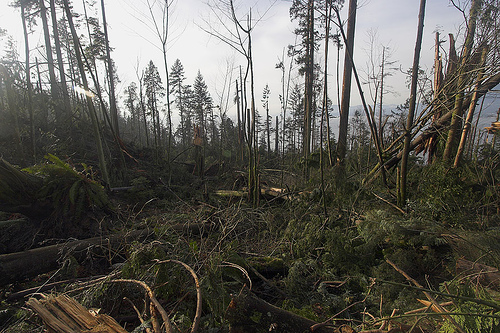
Humble has been conducting surveys for alien insects in forested areas throughout British Columbia’s lower mainland for 14 years. In 2007, in cooperation with the University of British Columbia forestry department, the Metro Vancouver Parks Board and the Canadian Food Inspection Agency, he extended his research to include Stanley Park. Humble supplied light traps for the university-led insect inventory and developed protocols for collecting moths using light at sampling locations in the 400-hectare urban park. The park survey was initiated after the December 2006 windstorm toppled old-growth trees and caused more than $12 Million of damage to the park’s forests.

The 2006 windstorm toppled thousands of trees throughout Stanley Park's old-growth groves. Photo by Jenny Lee Silver

Damage by wind storm to the old-growth forests of Vancouver’s Stanley Park in 2007 prompted a survey for insects, which were identified using DNA-barcode screening. Photo by Jenny Lee Silver

Humble and Ph.D. candidate Jeremy deWaard used the survey to populate the DNA database of Canadian Lepidoptera for the Canadian Barcode of Life project, an initiative based out of the University of Guelph, in Ontario. Like the universal product codes on supermarket goods, the DNA segments that are analysed serve as species-specific identification tags that eventually could be cross referenced between the database and new samples collected in the field to assist with species detection and identification, track movement of species around the globe, and study evolution and biodiversity.

“The Stanley Park experience highlights many advantages to using barcoding in biodiversity inventories,” says deWaard, who contributed to development of DNA-barcoding methodology during his undergraduate and masters studies at Guelph.

DNA-barcode screening increased the accuracy of species identifications and speeded up the identification process to a matter hours per specimen compared to days or weeks using traditional methods. It also flagged specimens requiring further attention, thereby allowing trained taxonomists to focus on problematic identifications while non-specialists were able to confirm identities of the common, routine specimens.

“It allowed us to identify cryptic species, new species, species that don’t belong here, and species for which only single specimens were collected.”

For instance, DNA analysis of one lone specimen collected in the park indicated the moth closely matched the genus Prays from Eurasia.

Prays fraxinella, an invasive moth from Eurasia, found in Vancouver's Stanley Park, thanks to DNA barcoding.

Prays fraxinella, an invasive moth from Eurasia, found in Vancouver’s Stanley Park, thanks to DNA barcoding. Photo by oldbilluk.

“So right away we knew the family and had an indication of genus,” deWaard says. “In a quick discussion with colleagues, we learned of one specimen that had been collected in Newfoundland in the 1970s that was also a member of Prays, so we pieced it together, looked at the literature and examined our single Stanley Park specimen, and that’s how we arrived at the i.d.”

Prays fraxinella is one of the four survey identifications that represent new non-native moth records for British Columbia.

“The Stanley Park results demonstrate clearly how DNA screening can save time and resources, and provide reliable, accurate identification,” says Humble. “As the technology becomes more accessible and cost-effective, we’re going to see DNA screening become a regular part of the pest detection and monitoring toolkit.”

© Natural Resources Canada 2009


On the evening before we left our rental near Mirepoix, as Gaston and I had supper on the terrace in front of the cottage, I watched the clouds drift from west to east across the southern horizon, picking up the blues and violets from the forest-shrouded hills. We hadn’t seen the Pyrenees since the evening we arrived: first the tramontane-driven rain socked in the valleys, and once that passed and the sun shone, humidity veiled the mountains. Occasionally you could make out dim outlines.

We got nice ganders at the midi-Pyrénées the morning we were in Tarascon-sur-Ariège. We were visiting the Grotte de Niaux, the only cave in France with Magdelena-era cave paintings (12,000 to 14,000 years) that the public is still permitted to see in the original. There are about 10 caves with artifacts or traces in the Tarascon area. The entrance to the Grotte de Niaux is at ~1000 feet above the valley, with views to the west. Sheer white limestone cliffs studded with conifers and hardwoods. And the air there: crisp and clear at mid-morning.

The cave paintings included some impressive, expressive bison, but were not nearly the colourful works of art that images from Lascaux in the Dordogne have created expectations of. The guide mystified us more than enlightened us: she had a canned talk and any questions from the group that delved deeper and required that she explain her statements—well, forget it: you were just going to be even more confused. The bison were nice though. And that the guide had the waxen, transparently pallid appearance of one who rarely sees daylight also led to some entertaining but quiet speculation. We decided, given our disappointing experiences in getting more information from her on other questions about cave dwellers, that we wouldn’t bring the subject up.

Perhaps she had been coated with her own layer of limestone slip. Mineral-based physical sunblocks are the new thing, after all. And certainly the water here in le sud de France contains sufficient lime to scale anybody nicely after a few weeks. The water at St-Gély was the hardest we’ve encountered: I couldn’t even get a lather up with that. It was less hard at Mirepoix. In Nézignan-l’Evèque, soap lathered, but more sediment was left behind. Paris leaves its own special imprint after a couple of showers. I suppose if we lived in southern Alberta, we wouldn’t even notice, but – oh – for the dulcet washes of west coast water.


(From October 2009)

I had visions of a scene of scarcely controlled panic; gendarmes racing into the Gare de Lyon, dressed in black, with bullet-proof face guards and helmets, barricading platform H (“’ashe”) with a phalanx of machine-gun–toting, shorn-haired, black-clad toughs legitimized solely by badges of state-approved authority and the smell of café espresse and camembert on their breath. La Sécurité (avec deux accents égouts) sending in a bomb team with dogs and defusers, and the entire station being placed under arrest. Everything brought to a standstill. Just like Paris under a transit strike. Or a health-care workers’ strike. Or a container-truckers’ strike. Or a taxi-drivers’ strike.

That, at least, might explain the utter dearth of taxis in all of Paris when we disembarked and most needed one.

But Gaston assures me that, no, the discerning French nose does not need a dog trained to explosives to recognize fine cheese, finer olives, and the other fine points and opportunities in life.

+++++++

Gaston, being a guy, is stoic and never cries—at least in any way that would be readily recognizable by a normal and normally sensitive human being or other mammal or even by an alien or reptile or microorganism.

But the result of our trip from Montpellier to Paris, even now, a full month after that fateful day, brings a suspicious mistiness to Gaston’s eyes and a tell-tale cherry-red runniness to his nose. And it’s not H1N1.

No.

Gaston likes his olives. Every Friday at home, charged with acquiring the week’s groceries as his contribution to household expenses, he returns from the local grocery store with a tubful of green-olives-stuffed-with-hot-pimentos or -whatever. ‘Whatever,” because I’m not especially into olives, so experience his weekly pickings only in how they take up valuable fridge space that could be used to house something far more essential—like humous or organic lettuces or home-made soup stock or ratatouille.

However, once or twice or thrice or more a day whilst it lasts, Gaston visits his fridge-stashed cache for an olive fix. He fills a specifically shaped bowl (not so large as to diminish their contents; not so small as to deprive him satisfaction of his craving) with the little green jewels and with pickled onions (another item of which I beg leave to have only a passing—a very passing by—olfactory experience), sits on the sofa and savours the flavours, smacking and snorting and chomping in his own private ritual of appreciation and appetite.

Thus, Gaston was very happy in France. Particularly so once we discovered the markets.

We would park our rental car in an unknown town listed as having a public “marché (accent égout) traditionnel” on the day in question and wander aimlessly until we spotted empty baskets moving ever further off ahead of us on the street on the arms of French madames and, eventually, full market baskets making their way towards us on the arms of other said French madames. In this way would we find our way to the town/village marketplace.

And, once in the environs of said marketplaces, Gaston’s finely tuned and highly sensitive olive detector would deploy, much in the way the Pentagon’s satellite dishes trackg terrorist cell-phone conversations, or a mule deer’s ears follow possible sounds-of-concern while it goes about its browsing-and-pooping business. Within moments, he would locate and plot the locations of the various and sometimes multitude local olive vendors…. And pass by, following in my wake, as I, a veritable French madame myself with my own woven-grass basket over my arm, beelined to the produce sellers and the cheese vendors and the sausage vendors, but looking archly out of the corner of his eye at the wares. (—Who am I kidding? That’s far too subtle for Gaston: he would rubber-neck and stare, imitating the aforementioned Pentagon satellite dishes and mule-deer ears—and drool!) We might pass by two or three times to compare prices of lettuce, of green beans, of fresh basil….

And then, bowing to the inevitable and the interests of maritable longevity, I would stop and turn to him: “How’s your supply?”

“I could do with a few more.”

And so it would begin, yet again, once again….

I ate more olives proffered by vendors in markets in France than cumulatively through the previous four decades: the latest year’s (meaning the year before’s, as the olive harvest occurs in November/December) own green olives preserved with fresh minced garlic—sure to ward off any popish, anti-paratge, anti-Cathar vampire; preserved with lemon—sure to preserve any vampire of any faith until… well, forever; preserved with hot pimento, sure to bring to mind every morning exactly where those pimentos originated after Christophe Colon’s discovery and explorations of the world’s ring of fire; preserved with sweet pimento, sure to… I’m not sure what; preserved with basil and bay; preserved with … whatever! And of course an entire selection of black olives, preserved in various and imaginative and surprisingly tasty ways…. Who knew?

We would stagger back to the car, the basket over my arm and a couple of plastic bags hanging from Gaston’s hands laden with vegetables, herbs, leafy greens, fresh bread, cheese, sausages and, to Gaston’s eager anticipation, at least four varieties of olives, and our stomachs laden with bits and pieces of almost all of the above.

Who needs lunch? Or supper, for that matter.

And, in the days following, we (read: I) would endure the familiar olive ritual, sometimes accompanied by the very fine local plonk fine du terroir or plonck finer de pays or plonck particularly vignoble (each and all for less than 5 euros per), sometimes by Belgian brew selected by Gaston at the local Carrefour or Super U, but always, always with a reverence not seen in Canada—ever.

He had a goodly supply remaining when we left the south for Paris. It was packed individually in a bag with a supply of brie, camembert and a couple of chèvres intended for lunch on the train and days of enjoyment thereafter.

And we did enjoy our lunch, leisurely, because what else were we going to do on the train? Other than watch the landscape unfold, 16th-century chateau upon chateau, 12th-century fortress upon fortress, field upon field, vineyard upon vineyard, wood upon wood, hilltop bastide upon hilltop bastide. Gaston especially reveled in his oleai europaeai and his stinky cheeses. When he had finally finished (“had finished,” as in the French—not “was finished,” meaning dead; “had full,” not “was full,” meaning preggies), he folded them back into the bag, which he then carefully and reverentially placed in the rack above our seats.

“That was a very enjoyable repast.”

Then: “Remind me not to forget these.”

The last time Gaston said, “Remind me not to forget…” to me when we were traveling was en route from Surabaya to Kuta in Indonesia. He had written notes in his journal (isn’t that quaint?) not particularly complimentary about some of the people and situations we had recently encountered and stuck it in the pocket in the seat ahead of him on the airplane, on which we were flying instead of taking the bus and ferry that sank with 600-some overloaded passengers aboard that same day.

And, frankly, I—and it is all about me, after all—don’t see why he doesn’t just learn to put things away where they belong right away, because he always, always forgets, and I have other things on my mind than to remind him to gather up his toys, journals, whatever (“whatever!”), and so we experience unnecessary pain/regret/apologies and a complete waste of emotion and energy. I have, finally after two decades years, come to accept that what Gaston does/says/thinks/doesn’t do/say/think is entirely his responsibility and nothing whatsoever (“whatsoever,” not “whatever!”) to do with me (even though everything else is, of course, all about me).

And so the train pulls into the Gare de Lyon—finally and after the scheduled, but still too long (if you regret leaving where you’re leaving and have difficulty sitting still for 1.5 hours, let along for), 3.5 hours—and we gather our suitcases and backpacks and our market basket full of preciously fragile (“L’argile, c’est fragile,”) Provencal pottery unlike any other you’ve ever seen anywhere—anywhere!,—and disembark among the hordes to take a taxi to our appointed (definitely not anointed) apartment, and find no taxis in service in all of Paris and so have to walk \six kilometres with wine bottle-stuffed luggage and basket of pottery through crowded, cobbled, disgustingly smelly, litter-scattered, people-clogged (did I mention crowded? Let me repeat: storefront-to-storefront-packed), sunny, gloriously warm, late-afternoon-Saturday streets (especially once we entered the Marais, the recently funkified fashion district where our apartment was located).

It wasn’t until the evening following, as I tried to prepare our evening meal in a ridiculously small kitchen with no counterspace whatsoever and refrigerator one-quarter the size of the average North American bar fridge, that the tragedy made itself unescapably, undeniably, and oh-so-heartbreakingly (to Gaston) known.

“This is going to take a while,” I said, pushing sweaty hair out of my eyes, trying to salvage a Spanish risotto burnt on the gas burner that operated at only very high or barely on, stirring the reduced tomato sauce on the one burner that did work, and trying not to shriek in frustration, rage and … whatever! “Why don’t you have some cheese and olives while I get this under control?”

“I can’t find them.”

“???”

“I think we left them on the train.”

“——. We?!”

“I could cry.”

“——”

“——”

“You left them on the train?!!”

“I’ve looked all over and through everything for them.”

“I did, too. Actually. I thought you might have them stashed somewhere”

“I wish. But I’m afraid the worst has come to pass: They were left behind. And I could just weep.”

And me, ever sympathetic in moment of crisis: “My god. An unidentifiable package on the TGV. After the Metro bombings and Spain and 9/11, they’d declare a national state of emergency…”

And so Gaston held forth, in the strong, masculine, stoic Way of the Guy, on his theory of the discerning nose of the SNCF-employed Frenchman, capable of sniffing out quality cheese and excellent olives whenever any of those presented themselves.

And, all the while, something suspiciously like a tear trembled and caught the light in the corner of his eye.


Disclaimer:

Events in this report may appear larger than they actually were in reality.



In France, bathtubs are standard facilities, but many older hotels are being retrofitted with showers to meet demands by North Americans who simply cannot do without their morning top–down slosh, which of course with hard water and dry climate (as anyone who has lived in S. Alberta knows) means dry, dry skin.

The retrofits into hotel rooms also mean that the facilities are bijoux. In the shower in the Paris hotel room we’d booked into during our Victoria–south France transit, you couldn’t bend or crouch down to pick up your shampoo bottle from the floor of the shower without having your head, knees or your butt untuck the shower curtain from the stall. You’d have to be some tai chi expert or Chinese acrobat and be able to lower your body along only vertical planes, or just be short, to avoid that. And then, of course, the curtain would stick to you, compounding the out-of-shower water experience.

Ah well, after 12 hours of airplaning, 1.5 hours of transiting from airport to city, and three hours walking aimlessly and dazedly while awaiting your hotel room to be made available, any shower feels great.


And last week, I hauled Gaston on a 15.5-kilometre circuit of four picturesque villages and settlements around where we’re staying.

The hiking guide I picked up at the tourist office in Mirepoix is without question the worst I have ever encountered. And we made route finding on this day even more challenging by going in the direction opposite from how the route was described. We did this because, after 40 minutes wandering through our 17-house village, looking for trailmarkers and way finders, that was the only trail route out of the village we could find.

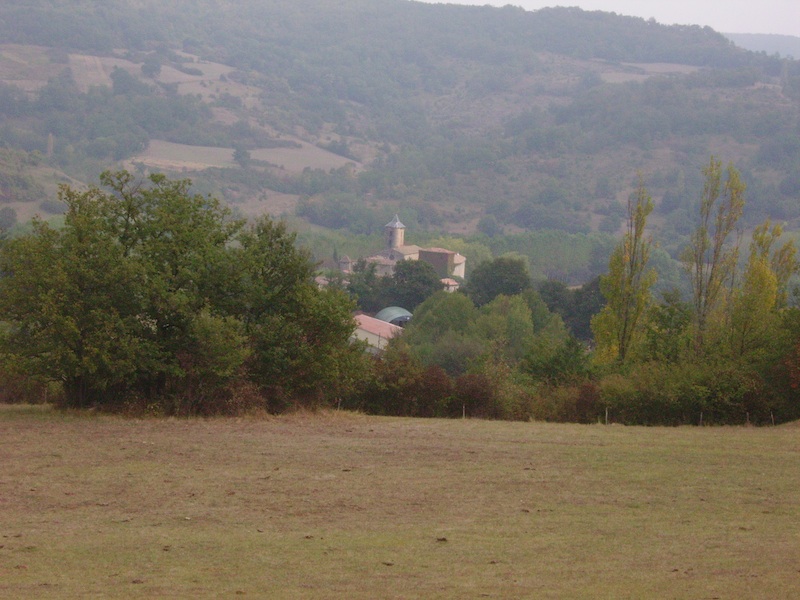
View of Camon

Looking down on Camon and its former Benedictine abbey

We made it to Camon—yet another of France’s prettiest villages (yawn?), and covered in rose bushes abloom—where we had lunch outside the former abbey and next to the graveyard. And the route from Camon to Lagarde was straightforward once I insisted to Gaston that the rails-to-trail route we were supposed to take didn’t follow the river Hers, but crossed it on that many-arched stone bridge.

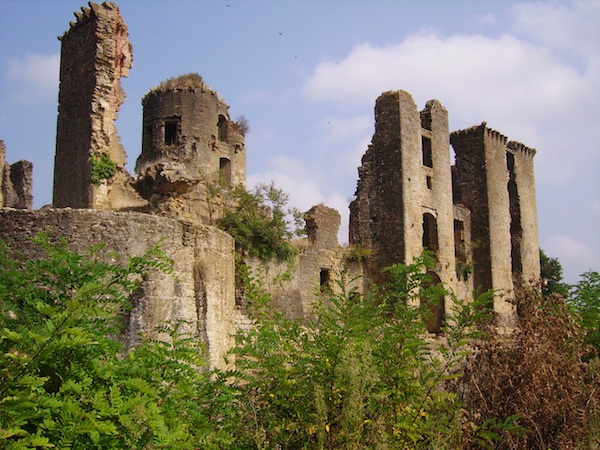
chateau Lagarde

Ruins of chateau Lagarde, once the Versailles of southwest France

But getting out of the Lagarde was a trial.

First because Gaston had an attack of the crabbies as soon as we ducked back out through the chained chateau gates. Okay, it was hot. The cool weather had passed, and a misty morning had given away to the full blaze of the Mediterranean sun. And the trail out of Lagarde in the direction of home was, as mentioned, not clear. The only blazes we could find there for the Grand Route 7, which would lead us to Mirepoix, 8 km away.

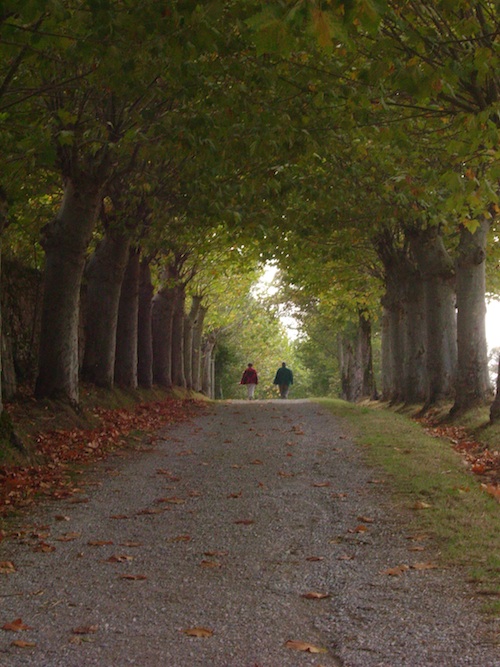
Road to the chateau Lagarde

Plane-tree–lined road to Chateau Lagarde

But when you’re at the halfway point in a loop, options are limited. Retrace every footstep you’ve taken; forge ahead in the spirit of adventure (at that moment at an ebb); or brave the narrow, shoulderless road that twists along the valley bottoms and the trucks and cars traveling at 90 kph along it.

“Which would you prefer, Gaston?”

“I just don’t want a 4-km detour that we have to retrace because we’ve gone the wrong way.”

“I don’t want that either. You hated the rail-trail: do you really want to go back that way. It’ll be even hotter now.”

“I don’t want to go that way.”

“Then there’s the road or forward. Which would you prefer?”

”They’re equally long. Which do you want to do?”

”What I want isn’t the issue. I’m in better shape than you. We have to get you home.”

“I’ll go whatever way you want, but I’m not going on a wild goose chase. If you want to go forward, we’ll go forward. Is that what you want to do?”

Response not uttered.

“Do you want to take the trail?”

“Let’s see if this person can help us find the route.”

Fortunately midi was well past, and people were out and about. Un gentilhomme was passing by. I asked him for directions.

We were way off.

Vous voulez l’autre chateau, pas celui-ci,” he said. “Il y a un autre a l’autre cote du grand chemin. Vous le verriez du village.” And he gave us step-by-step directions on how to get through Lagarde and to the grand chemin to the other chateau (Sibra)—most details of which I forgot by the time I turned to Scott and started to translate. However, I had enough—or would have if the trial signage in Lagarde made any sense. So, about 1 km from our encounter with le gentilhomme, j’ai demande encore des directionsof two ladies sitting beside the boules pitch. That got us to the next route direction-change,

Bovine gals, Belloc

Moo, mui bellas, a Belloc

where another madame taking her garden waste to the dechets bin directed us around one more corner, and then all of a sudden the directions given by le gentilhomme, les deux dame au boulodrome, and la jardinière made sense.

The route from Sibra (with a minor detour around the estate’s entire curtain wall—pregnant silence from Gaston…) to Belloc was the nicest part of the route. Well, except for the last kilometer above Belloc, a road through the middle of in intensive cattle-farm operation. But the ladies there mooed us along.

We both appreciated long hot soaks that evening.


Now, in case you were thinking Gaston is having a really unpleasant time on his vacation:

Gaston, post-Olympian hike

The long-suffering Gaston continues to have a hard time.

Other than in Paris—where I suppose if you want to stay somewhere really nice, you just have to put up for paying correspondingly for it—we really lucked out on our rentals for the trip. We’ve determined from this experience that we prefer comfortable country living, with dark night skies, and quiet if any neighbours.

Living in small villages does mean limited privacy: you quickly get to know (by sight anyway) your neighbours on the street, what their daily patterns are, what music they listen to, and even what topics they discuss at the dinner table. In Nézignan, Gaston got in touch with his inner nosy Parker. He’s worse than madame next door. He would perch himself at the table by the window on the second floor and every time there was noise or movement on the street, he would stick his head out and find out what was going on: “Ah, madame’s domestic aid has arrived precisely on time this morning: I wonder what radio station she will be listening to this afternoon?”; “Madame down the street with the baby has just stepped out for her third smoke this morning: she doesn’t look happy today;” “Monsieur across the way slept in this morning: did you hear his big yawn? Oh, and there, you can see him through his second floor window in his PJs, scratching his belly;” “Monsieur, husband of madame with the baby, is out walking their pug. He went to the bakery and is bringing back today’s pain.” For more details on our Nézignan neighbours’ lives and habits, please contact Gaston directly.

Villages also mean church bells. Now, that sounds like it should be a charming and desirable thing to have where you’re vacationing. Well, in Nézignan, the bell would ring each hour twice: once on the hour, and then after a 30-second pause, again—just in case you had missed the dissonate, high-decibel, cracked-bell series of kuh-LANGs the first time round. Fortunately the dead of night also corresponds to the small-numbered hours, so the overall number of kuh-LANGS while you are trying to sleep in the bedroom at the very stuffy back of the 500-year-old, formerly part of the local St-John’s hospice, townhouse that continuously sheds stone dandruff from its walls and ceilings is less than during the day.

The apartment we rented in Paris partly shared a courtyard with a chapel, but they rang the bells only for service on Sunday morning, at a reasonable hour. Gaston who was determinedly sleeping in that day didn’t even hear them. However, the other courtyard that the apartment overlooked was also overlooked by tenants who had a big, noisy party on the Tuesday night/Wednesday A.M., and a dinner party above that part of the apartment on the Monday night. (Dinner starts at 9 A.M. at the earliest in Paris, so this event went on ‘til the wee hours.) That courtyard was also undergoing repairs to its ancient stucco as a result of wet damage, so at 7:30 every weekday morning, the clattering and pounding began. Fortunately, our bedroom, with its mattress that had never been flipped and that had been peed on by previous renters once too often was overlooking the chapel courtyard, so we had sleeping arrangement options: the folded up futon in the living room was far more comfortable, and I usually camped out there at some point during the night—unless the noise quotient was too high.


From October 2009

Gaston and I have had further, positive revelations on the question of la nourriture: French public markets. Les marchés are nothing like Granville Island’s sanitized vegetable warehouse outlet. Here, local or at least regional producers selling their specialties of the season predominate.

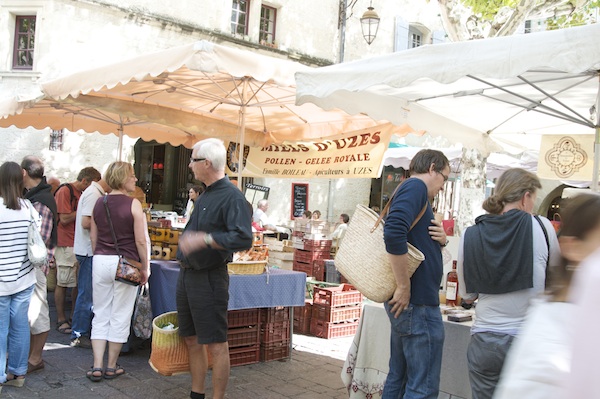
Our first market was on a rainy day in Gourdagues. It didn’t really prepare us, as there were only maybe eight vendors, and we were still leery of unidentifiable animal bits stuffed inside retained bowels and of course the overwhelming question of cheese (i.e., where to start?). Then, a few days later we visited Uzès during their mega Saturday market: the usual food suspects × 20, produce, wines of the region and spirits made by little old monks and nuns, honey, jam, candy, crafts, toys, clothing (made in N. Africa or SE Asia), carpets, tableware and bedroom linen, fabric, notions, lotions and potions. There was so much market we couldn’t see the town’s bastide at all. I’m told Uzès is a jewel of a town, but who could tell? There were so many people, we country colts just whinnied and shied away, thinking, “What’s so great about these French marchés anyway?”

Uzes marché

Then we encountered the Monday market at Mirepoix: enough vendors and purveyors to keep it interesting and varied; not so crazy you have to keep your hand on your wallet.

That’s when Gaston and I discovered that would never survive as trout in a fishing stream: give us a nibble and you’ve hooked us. Some stinky goat cheese made high in the Pyrenees: hmm, yum—nous voudrions 250 milligrams, svp. Oh, you must try the same thing made with cow’s milk—much milder. D’accord, some of that, too.

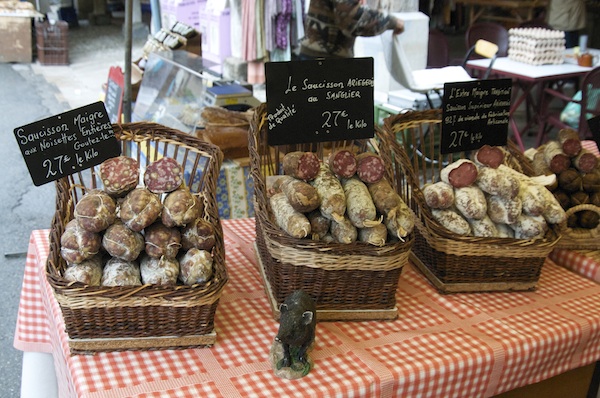
saucissons, Mirepoix marché Some saucisson made with herbes de provence? Oh, also try this, avec cèpes (a mushroom), and oh, this, avec tomates secs: and before you know it, we’re proud parents of a lumpy ring that looks uncomfortably like a third of a metre of stuffed intestine. Mm-mmm. And that’s the one we bring home.

Today, with me translating between him and the vender at the market in Bessans, Gaston bought some green olives in fresh minced and whole garlic, some new kalamatas, and a couple of big fistfuls of green olives pickled with pimentos. This was after he sampled all of the eight varieties on offer, so obviously he was exercising restraint.

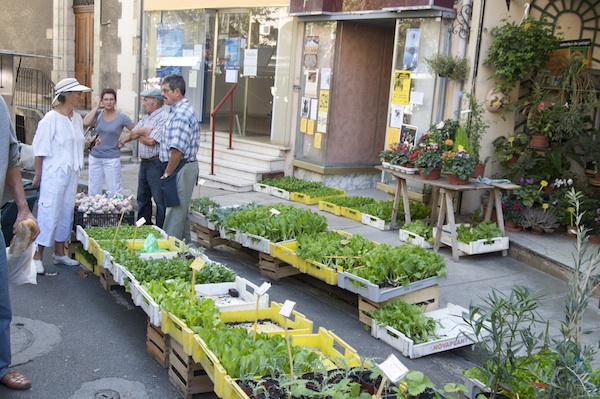
marché
The nice thing about mid-size markets (50–100 vendors) is that it’s big enough to have all the good stuff from miles around, but neither are you so busy keeping track of each other that you miss the local characters.

Now we’re on our way to becoming market junkies. When we come into a strange village/town on market day, with no idea where to find the goods, now we know to look for and follow the people with empty baskets and to go against the flow through the streets of people with full baskets. It’s a sure way to find market-central anywhere.

It’s just possible that if you planned your week around visiting the larger food markets in a region, you could just maybe get away without buying any groceries for the week. But what’s the fun in that?

Besides, how could you possibly pass up bringing home enough seductively-scented paella, scooped fresh from the cooking pot, for lunch? Or maybe you should have the couscous with sauce instead? Or the bouillabaisse, loaded with fresh seafood from Perpignan. And then, for supper, the roast farm chicken, with roasted potatoes and green peppers, with a nice green salad on the side for your own sausage-making mechanism.

Bon appetit,