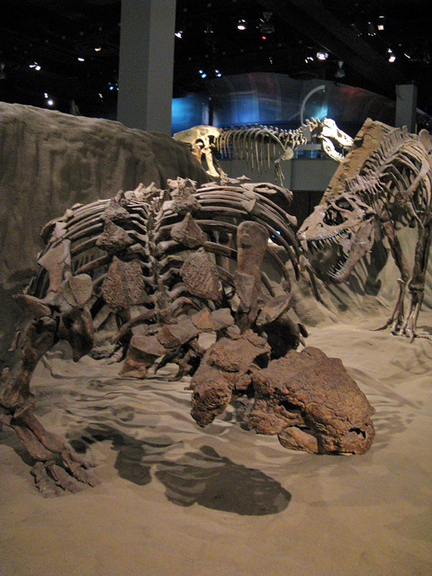
Royal Tyrrell Museum ankylosaur. Photo by Travis S.

A cast of an armoured-dinosaur ankylosaur skeleton takes a tail-swing at an albertosaur at the Royal Tyrrell Museum of Palaeontology.

Trackways #15, Fall 1998—In the world of palaeontology, ankylosaurs remain one of the Big Mysteries. The enigma stems from a lack of specimens to provide answers. Especially rare are good fossils from Alberta—that is, until this past season, the summer of ankylosaurs.

This year, researchers found eight specimens of the elusive armoured dinosaurs at Dinosaur Provincial Park. In just three months, the Tyrrell acquired the world’s most extensive fossil collection of these strange-looking, tank-like animals.

Among the finds are five skulls, raising the number of ankylosaur skulls in the museum’s collection to 14. These represent three known species, while one skull has yet to be identified. A skull provides the most information about the dinosaur it belongs to—its species, age, diet, and size. Since the first fossils were collected in Dinosaur Provincial Park more than a century ago, only 24 ankylosaur skulls have been discovered.

Now more than half of them rest in the Tyrrell’s care.

The ankylosaur windfall will help museum palaeontologists better understand how these unusual animals lived and how the different species were related to one another and to other dinosaurs. The new materials will also provide data on ankylosaur diversity, populations, and what roles ankylosaurs played within their Late Cretaceous ecosystems.

Ankylosaur armour. Photo by S. Mair.

Cobbles of bone lining its back provided the basis of ankylosaur armour.

© Royal Tyrrell Museum of Palaeontology 1998
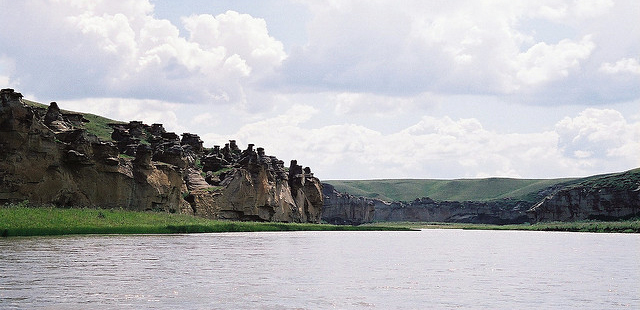
Alberta's Milk River, by James Bremner

The cliffs above Alberta's Milk River yielded the remains of a young hadrosaur in 1997.

Trackways #12, Fall 1997—When Lethbridge writer Shanan Timmers went for walk on the banks of the North Milk River west of Del Bonita, Alberta, earlier this summer, he stumbled across a find important to the world of palaeontology.

Jutting out from the overhanging river cutbank, far from where palaeontologists would have thought to look, were dinosaur bones.

It turns out the bones belong to a sub-adult hadrosaur, one of only a few half-grown hadrosaur skeletons ever recovered. When it was alive, the animal measured about three metres long and about two metres high at the hip.

The specimen may be the first dinosaur found in the St. Mary’s River rock formation. That, and its isolation from other know hadrosaur skeletons increase the possibility of it being a new species.

The pelvis, femur and base of the tail sticking ouf of the rock are beautifully articulated, suggesting that the from part of the animal may continue into the bank. However, until the animal is in the lab and prepared, scientists won’t know exactly how much of the animal is in place.

Before that can happen, collecting crews from the Royal Tyrrell Museum and Devil’s Coulee Interpretive Centre must remove the specimen from the overhang six metres above the river—without having bones fall and break in the riverbed. A heavy sandstone layer covering the fossil and access to the site only from above further complicate the excavation.

© Royal Tyrrell Museum of Palaeontology 1997