In France, bathtubs are standard facilities, but many older hotels are being retrofitted with showers to meet demands by North Americans who simply cannot do without their morning top–down slosh, which of course with hard water and dry climate (as anyone who has lived in S. Alberta knows) means dry, dry skin.

The retrofits into hotel rooms also mean that the facilities are bijoux. In the shower in the Paris hotel room we’d booked into during our Victoria–south France transit, you couldn’t bend or crouch down to pick up your shampoo bottle from the floor of the shower without having your head, knees or your butt untuck the shower curtain from the stall. You’d have to be some tai chi expert or Chinese acrobat and be able to lower your body along only vertical planes, or just be short, to avoid that. And then, of course, the curtain would stick to you, compounding the out-of-shower water experience.

Ah well, after 12 hours of airplaning, 1.5 hours of transiting from airport to city, and three hours walking aimlessly and dazedly while awaiting your hotel room to be made available, any shower feels great.


And last week, I hauled Gaston on a 15.5-kilometre circuit of four picturesque villages and settlements around where we’re staying.

The hiking guide I picked up at the tourist office in Mirepoix is without question the worst I have ever encountered. And we made route finding on this day even more challenging by going in the direction opposite from how the route was described. We did this because, after 40 minutes wandering through our 17-house village, looking for trailmarkers and way finders, that was the only trail route out of the village we could find.
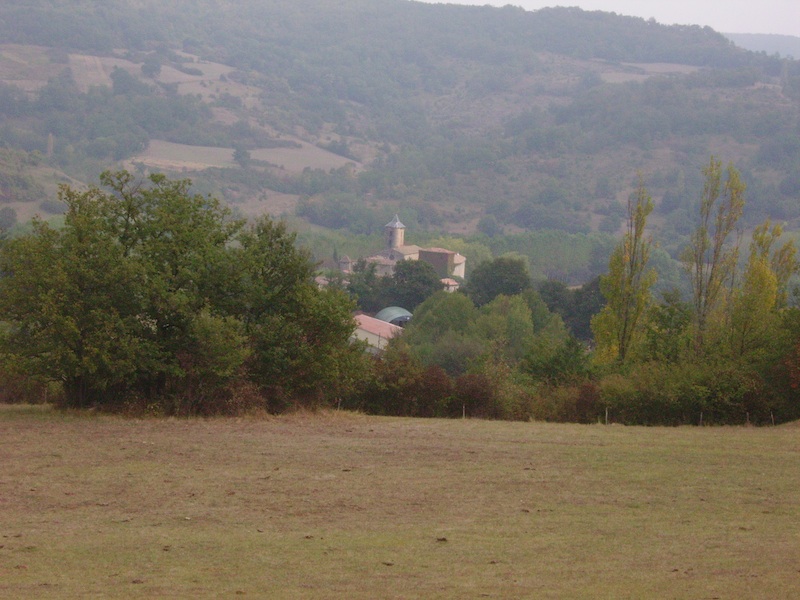
View of Camon

Looking down on Camon and its former Benedictine abbey

We made it to Camon—yet another of France’s prettiest villages (yawn?), and covered in rose bushes abloom—where we had lunch outside the former abbey and next to the graveyard. And the route from Camon to Lagarde was straightforward once I insisted to Gaston that the rails-to-trail route we were supposed to take didn’t follow the river Hers, but crossed it on that many-arched stone bridge.
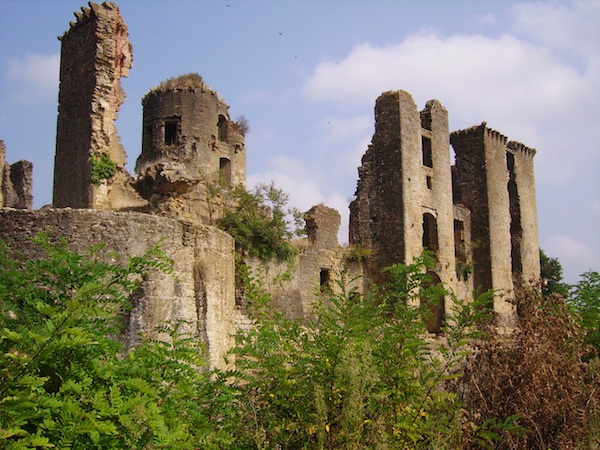
chateau Lagarde

Ruins of chateau Lagarde, once the Versailles of southwest France

But getting out of the Lagarde was a trial.

First because Gaston had an attack of the crabbies as soon as we ducked back out through the chained chateau gates. Okay, it was hot. The cool weather had passed, and a misty morning had given away to the full blaze of the Mediterranean sun. And the trail out of Lagarde in the direction of home was, as mentioned, not clear. The only blazes we could find there for the Grand Route 7, which would lead us to Mirepoix, 8 km away.
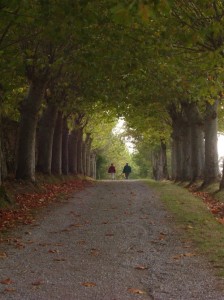
Road to the chateau Lagarde

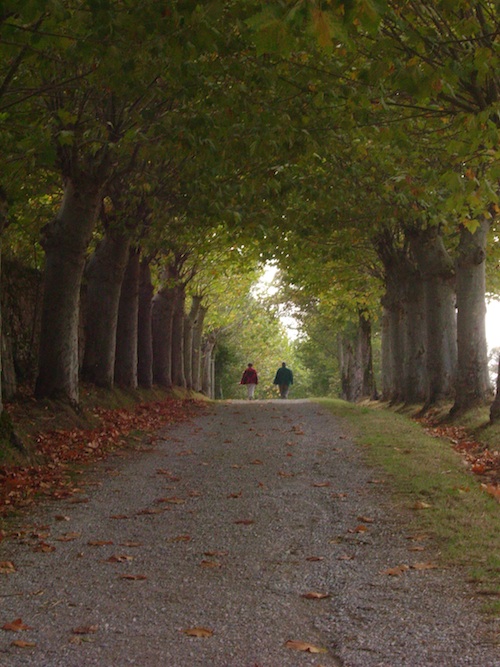
Plane-tree–lined road to Chateau Lagarde

But when you’re at the halfway point in a loop, options are limited. Retrace every footstep you’ve taken; forge ahead in the spirit of adventure (at that moment at an ebb); or brave the narrow, shoulderless road that twists along the valley bottoms and the trucks and cars traveling at 90 kph along it.

“Which would you prefer, Gaston?”

“I just don’t want a 4-km detour that we have to retrace because we’ve gone the wrong way.”

“I don’t want that either. You hated the rail-trail: do you really want to go back that way. It’ll be even hotter now.”

“I don’t want to go that way.”

“Then there’s the road or forward. Which would you prefer?”

”They’re equally long. Which do you want to do?”

”What I want isn’t the issue. I’m in better shape than you. We have to get you home.”

“I’ll go whatever way you want, but I’m not going on a wild goose chase. If you want to go forward, we’ll go forward. Is that what you want to do?”

Response not uttered.

“Do you want to take the trail?”

“Let’s see if this person can help us find the route.”

Fortunately midi was well past, and people were out and about. Un gentilhomme was passing by. I asked him for directions.

We were way off.

Vous voulez l’autre chateau, pas celui-ci,” he said. “Il y a un autre a l’autre cote du grand chemin. Vous le verriez du village.” And he gave us step-by-step directions on how to get through Lagarde and to the grand chemin to the other chateau (Sibra)—most details of which I forgot by the time I turned to Scott and started to translate. However, I had enough—or would have if the trial signage in Lagarde made any sense. So, about 1 km from our encounter with le gentilhomme, j’ai demande encore des directionsof two ladies sitting beside the boules pitch. That got us to the next route direction-change,
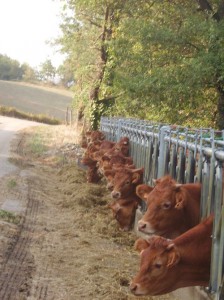
Bovine gals, Belloc

Moo, mui bellas, a Belloc

where another madame taking her garden waste to the dechets bin directed us around one more corner, and then all of a sudden the directions given by le gentilhomme, les deux dame au boulodrome, and la jardinière made sense.

The route from Sibra (with a minor detour around the estate’s entire curtain wall—pregnant silence from Gaston…) to Belloc was the nicest part of the route. Well, except for the last kilometer above Belloc, a road through the middle of in intensive cattle-farm operation. But the ladies there mooed us along.

We both appreciated long hot soaks that evening.


Now, in case you were thinking Gaston is having a really unpleasant time on his vacation:
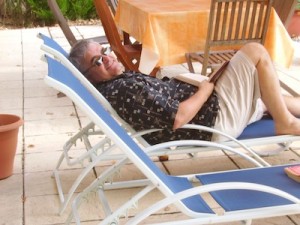
Gaston, post-Olympian hike

The long-suffering Gaston continues to have a hard time.
Other than in Paris—where I suppose if you want to stay somewhere really nice, you just have to put up for paying correspondingly for it—we really lucked out on our rentals for the trip. We’ve determined from this experience that we prefer comfortable country living, with dark night skies, and quiet if any neighbours.

Living in small villages does mean limited privacy: you quickly get to know (by sight anyway) your neighbours on the street, what their daily patterns are, what music they listen to, and even what topics they discuss at the dinner table. In Nézignan, Gaston got in touch with his inner nosy Parker. He’s worse than madame next door. He would perch himself at the table by the window on the second floor and every time there was noise or movement on the street, he would stick his head out and find out what was going on: “Ah, madame’s domestic aid has arrived precisely on time this morning: I wonder what radio station she will be listening to this afternoon?”; “Madame down the street with the baby has just stepped out for her third smoke this morning: she doesn’t look happy today;” “Monsieur across the way slept in this morning: did you hear his big yawn? Oh, and there, you can see him through his second floor window in his PJs, scratching his belly;” “Monsieur, husband of madame with the baby, is out walking their pug. He went to the bakery and is bringing back today’s pain.” For more details on our Nézignan neighbours’ lives and habits, please contact Gaston directly.

Villages also mean church bells. Now, that sounds like it should be a charming and desirable thing to have where you’re vacationing. Well, in Nézignan, the bell would ring each hour twice: once on the hour, and then after a 30-second pause, again—just in case you had missed the dissonate, high-decibel, cracked-bell series of kuh-LANGs the first time round. Fortunately the dead of night also corresponds to the small-numbered hours, so the overall number of kuh-LANGS while you are trying to sleep in the bedroom at the very stuffy back of the 500-year-old, formerly part of the local St-John’s hospice, townhouse that continuously sheds stone dandruff from its walls and ceilings is less than during the day.

The apartment we rented in Paris partly shared a courtyard with a chapel, but they rang the bells only for service on Sunday morning, at a reasonable hour. Gaston who was determinedly sleeping in that day didn’t even hear them. However, the other courtyard that the apartment overlooked was also overlooked by tenants who had a big, noisy party on the Tuesday night/Wednesday A.M., and a dinner party above that part of the apartment on the Monday night. (Dinner starts at 9 A.M. at the earliest in Paris, so this event went on ‘til the wee hours.) That courtyard was also undergoing repairs to its ancient stucco as a result of wet damage, so at 7:30 every weekday morning, the clattering and pounding began. Fortunately, our bedroom, with its mattress that had never been flipped and that had been peed on by previous renters once too often was overlooking the chapel courtyard, so we had sleeping arrangement options: the folded up futon in the living room was far more comfortable, and I usually camped out there at some point during the night—unless the noise quotient was too high.


From October 2009

Gaston and I have had further, positive revelations on the question of la nourriture: French public markets. Les marchés are nothing like Granville Island’s sanitized vegetable warehouse outlet. Here, local or at least regional producers selling their specialties of the season predominate.

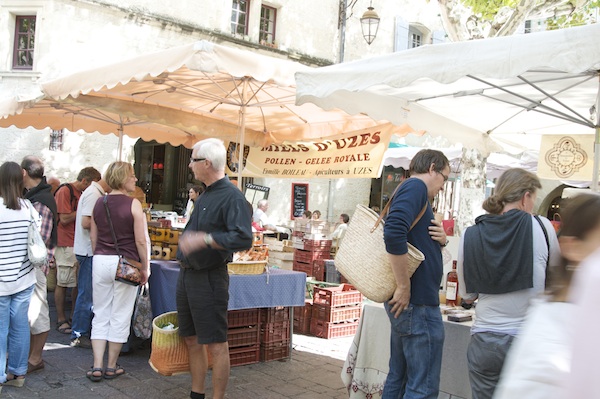
Our first market was on a rainy day in Gourdagues. It didn’t really prepare us, as there were only maybe eight vendors, and we were still leery of unidentifiable animal bits stuffed inside retained bowels and of course the overwhelming question of cheese (i.e., where to start?). Then, a few days later we visited Uzès during their mega Saturday market: the usual food suspects × 20, produce, wines of the region and spirits made by little old monks and nuns, honey, jam, candy, crafts, toys, clothing (made in N. Africa or SE Asia), carpets, tableware and bedroom linen, fabric, notions, lotions and potions. There was so much market we couldn’t see the town’s bastide at all. I’m told Uzès is a jewel of a town, but who could tell? There were so many people, we country colts just whinnied and shied away, thinking, “What’s so great about these French marchés anyway?”

Uzes marché

Then we encountered the Monday market at Mirepoix: enough vendors and purveyors to keep it interesting and varied; not so crazy you have to keep your hand on your wallet.

That’s when Gaston and I discovered that would never survive as trout in a fishing stream: give us a nibble and you’ve hooked us. Some stinky goat cheese made high in the Pyrenees: hmm, yum—nous voudrions 250 milligrams, svp. Oh, you must try the same thing made with cow’s milk—much milder. D’accord, some of that, too.

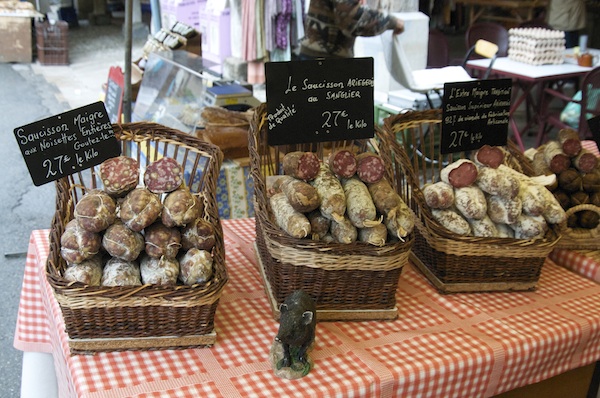
saucissons, Mirepoix marché Some saucisson made with herbes de provence? Oh, also try this, avec cèpes (a mushroom), and oh, this, avec tomates secs: and before you know it, we’re proud parents of a lumpy ring that looks uncomfortably like a third of a metre of stuffed intestine. Mm-mmm. And that’s the one we bring home.

Today, with me translating between him and the vender at the market in Bessans, Gaston bought some green olives in fresh minced and whole garlic, some new kalamatas, and a couple of big fistfuls of green olives pickled with pimentos. This was after he sampled all of the eight varieties on offer, so obviously he was exercising restraint.

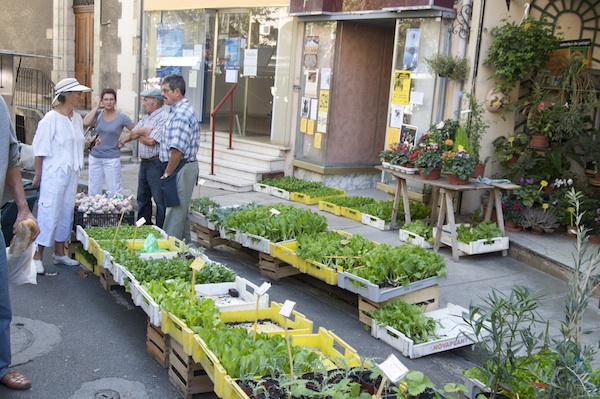
marché
The nice thing about mid-size markets (50–100 vendors) is that it’s big enough to have all the good stuff from miles around, but neither are you so busy keeping track of each other that you miss the local characters.

Now we’re on our way to becoming market junkies. When we come into a strange village/town on market day, with no idea where to find the goods, now we know to look for and follow the people with empty baskets and to go against the flow through the streets of people with full baskets. It’s a sure way to find market-central anywhere.

It’s just possible that if you planned your week around visiting the larger food markets in a region, you could just maybe get away without buying any groceries for the week. But what’s the fun in that?

Besides, how could you possibly pass up bringing home enough seductively-scented paella, scooped fresh from the cooking pot, for lunch? Or maybe you should have the couscous with sauce instead? Or the bouillabaisse, loaded with fresh seafood from Perpignan. And then, for supper, the roast farm chicken, with roasted potatoes and green peppers, with a nice green salad on the side for your own sausage-making mechanism.

Bon appetit,

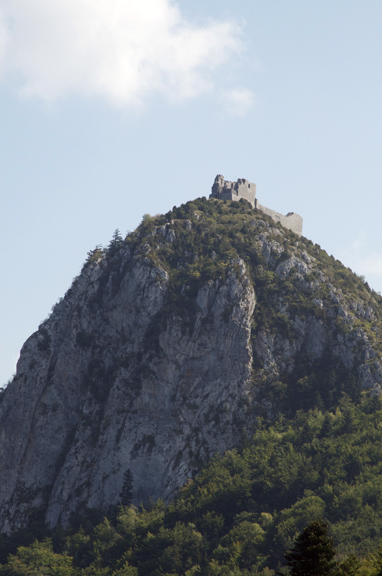
montsegur pog, France, by SMair

Montségur fortress sits atop the mountain pog. It’s a steep climb up to see the remains.

When you greet people here in the deep south of France, they reply to your “Bonjour” with what sounds like “Bonjeu.” Good game. Not the Sorbonne-approved elocution Mme Abdel-Kadar required of me and my classmates those many years ago, but an appropriate greeting to a person on vacation.

We’ve been seeing a fair amount of bilingual signage lately: The regular French, and also the Occitan equivalent. For instance, in Belloc, a village near our country rental, the blue sign at the turn to the Mairie says rue de l’Occitane; the red sign right below says roux de l’Occitanie. The name Belloc is also Occitan; in French—and apparently 700 years ago after the French overran the region—it was Beaulieu. In fact, any village name you encounter in the south that ends in oc or ac or ec has Occitan origins. Including Lautrec or Salazac…

The word for peak—as in mountain peak—is the delightful sounding pog.

A few days ago, Gaston and I slogged up the pog at Montségur (translation: Mount Secure) to look at what’s left of the fortress. Not much: the lower bit of the original keep, some walls where the medieval village had clung to the slope, and the curtain walls (called pregnant walls in French: murs enceinte—which rerouted my translating neurons to “retaining walls” for a number of days, for the obvious symptom connection. Pregnant pause… okay, never mind.). Hard to believe 600 people lived there—even if there had been multiple floors on which to stack them all.

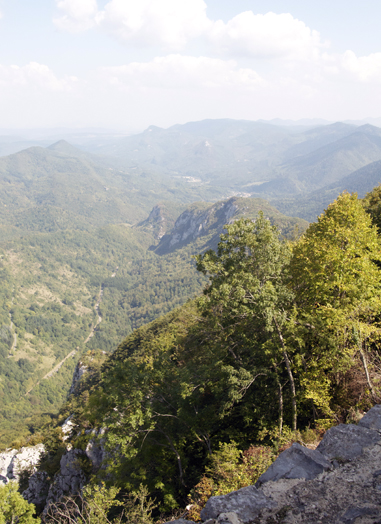
view from Montsegur, France

The Cathars would have seen French troops approach from miles away.

And a long way to go for fresh water.

But the view is spectacular: they would have seen those Catholic hordes coming from miles up the valleys around.

On the way down (“Bonjour,” “Bonjour;” “Bonjeu;” “Bonjeu”), we passed the tortured faces going uphill of all those French people who supposedly never formally exercise, doing their patrimoinic duty.

The site is close to the pilgrim way through the south to Santiago di Compostela, and is something of a pilgrim site in its own right. The last Cathar fortress to stand against the Catholic and French hordes, it withstood a months-long siege by some 10,000 troops. In March 1244, the Cathars surrendered. Approximately 220 were burned en masse in a bonfire at the foot of the peak when they refused to renounce their faith.

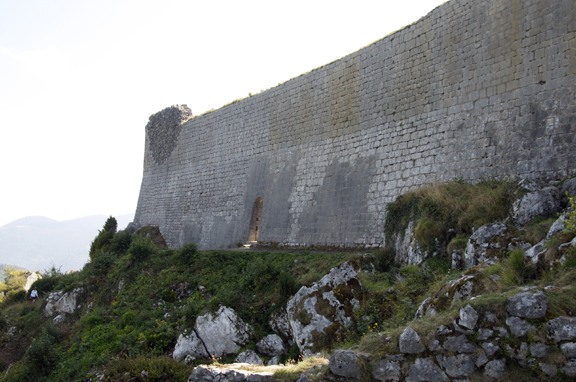
Approaching the fortress of Montsegur, France

The forbidding final approach to the fortress.

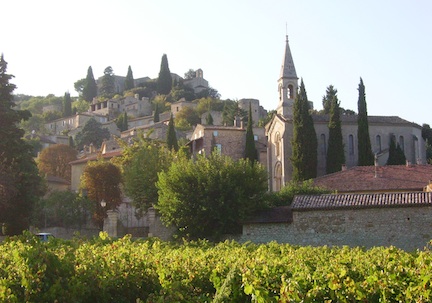
La Roque-sur-CezeWe’ve found the prettiest village in France. Officially, it’s only one of the prettiest this year and only for the past six years.

At the top of the hill is a real medieval chateau in which lives a real (presumably French, as they don’t like to sell significant symbols of their patrimony) family. I don’t know if they are of the same line of seigneurs de la Roque-sur-Cèze as the one who lived there in the 12th century, and set off to rescue the princess of Verfeuille (another picturesque walled town, about 15 minutes away driving) when he heard she was abducted.

He was successful, by the way, but on the return to the-Rock-on-the-Cèze-River (and why he was bringing her there, when he should have been bringing her home to the bosom of her loving family is a question only modern cynics would ask), she fainted at the chapel of Saint Sauveur. He awoke her with a kiss (the panacea for all damsels in distress at the time…. Or maybe it was the “kiss” that was the problem) and asked her to marry him. I’m sure that made her feel much better.

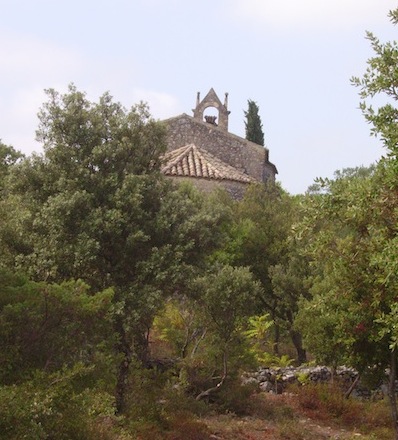
St-Sauveur Chapel

St-Sauveur Chapel, above St-Gély

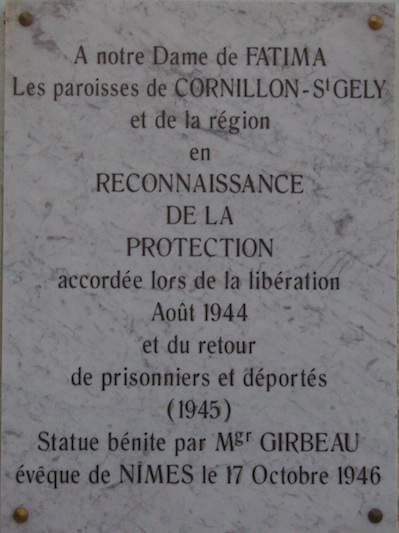
Because of this legend, the chapel has a reputation of bringing happy-ever-after to all lovers. The chapel hill is also where the monument to lost and deported victims of WWII stands, so some of the ecclesiastic ruins display graffiti from those who fought in the war.

WWII memorial, St-GelyHope and grief, on one hilltop.


La Roque-sur-Cèze is one river valley and one hill away from the chapel. Judging from the names on the post boxes, the former-seigneur’s village owns its recent renaissance to an infestation of Brits. Brits with loads of moulah. Even the streets are cobbled. Ce n’est pas typique.

For instance, in another picturesque bastide (medieval walled fortress town) on a hilltop across the Cèze valley in the other direction (west) from St-Gély, Cornillon has asphalted over the cobblestones of its twisty, windy, narrow streets. I can only presume this is why the last time it was officially named “one of the prettiest villages in France” was in 2006.

It’s so darn picturesque here. Medieval buildings, “perched” villages, cafes with awnings and abrupt waiters perfunctorily serving you café ou vin (but who also remember exactly what you ordered the first time in when you wander in again two days later), and field upon field of vines.

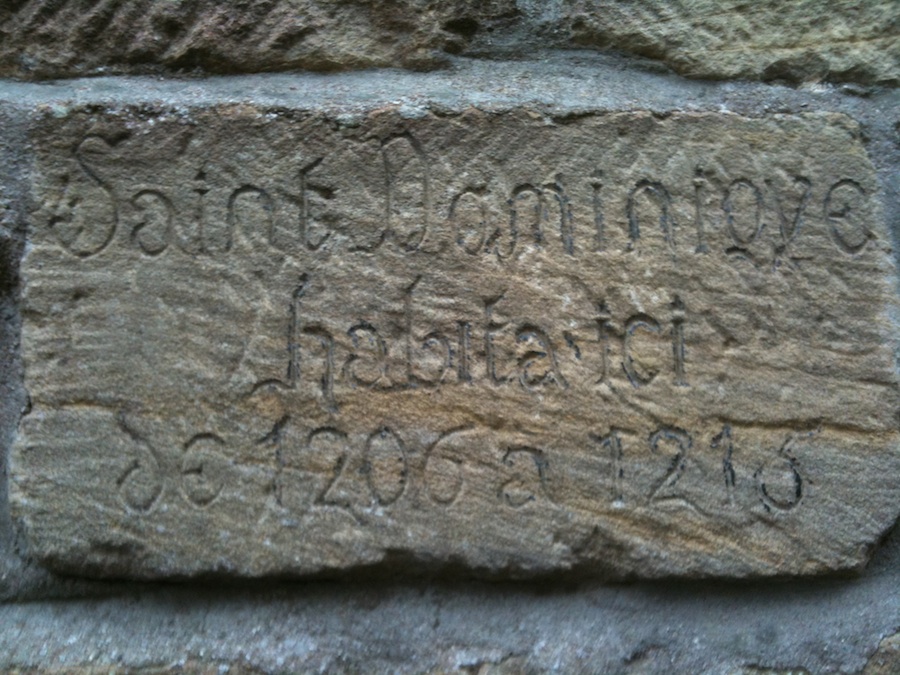
St-Dominique sign Fanjeaux

Saint Dominque habita ici de 1206 a 1215

Carved into the wall beside the front door of Fanjeaux’s abbey is the announcement: St-Dominique habita ici de 1206 à 1215. Dominic (or Domenge, if you prefer the Occitan language) came to tour the region at the behest of the pope, bringing his warm and personal touch to interrogating and torturing Cathar heretics as part of the Inquisition—initiated when the military end of the Albigensian Crusade seemed to French king and RC pope to be taking too long. With the good saint’s assistance, the process quickened significantly, and the Cathars disappeared: through a combination of being forcefully converted to Rome-approved doctrine, slaughtered, burned alive at the stake, or made to take part in other block-party events arranged specially for them.

Ah, yes, the good ol’ days, when personal belief and expression were mandated by politics. (Oh, wait, that’s today, too!)

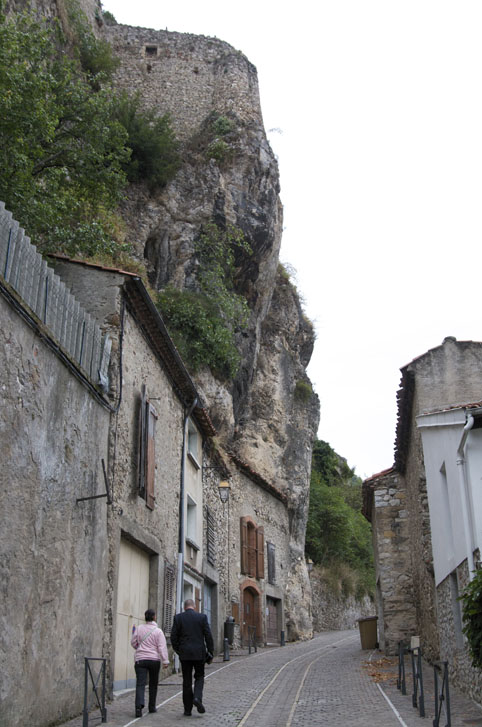
Walking up the rue du Chateau, in Foix, France

Walking up the rue du Château, Foix, France

Historically significant persons are frequently commemorated this way in France. Small signs may appear on the corners of buildings in Paris, alerting those who stop and read that such-and-such a member of the Resistance was shot by German authorities in the vicinity, or that some painterly bon vivant or other starved in the garrett there, or that a particular literary sage wrote his first poems/essays/novel at the corner table in that cafe.

Contrast those announcements with the plaque on a house on Foix’s rue du Château: Ici, Gaston Fébus n’habitait pas. Gaston Fébus did not live here.

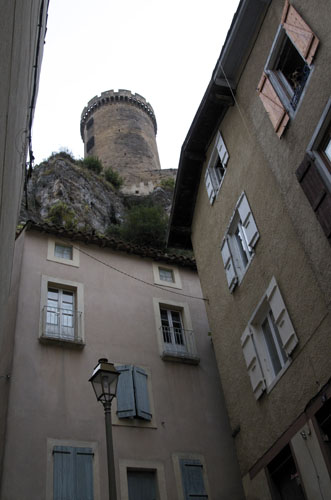
Instead, Gaston Phoebus—or more to the point—Gaston the FABULOUS!, comte of Foix and Béarn, lived for a short time up the hill in the chateau—a curious, imposing, three-towered pile of stone looming over the town.

Foix chateau looms

It would have been difficult to escape the feeling of being watched in the town of Foix when the chateau was occupied.

The old boy had quite an opinion of himself, fancied himself a poet and musician, as well as God’s gift in the physical looks department. Think Hank VIII with fewer wives. In keeping with the commemoration theme, one would think good ol’ Gasser would have personally placed a commemorative plaque on the exterior wall of his own chateau, at the very least. But, as with so many people who have to resort to PR personnel and marketing specialists to convince the world of their superior personal qualities (something St-Dominic didn’t bother with, but then he had all of Rome, a couple of armies and – oh, yes – a few burning stakes behind him to convince the populace of his charms), Mr. FABULOUS! was a tad insecure. He may not have had Hank VIII’s marital problems, but he did have his own share of family issues. These, he resolved as Henry would do 150 years later—simply by doing away with them: brothers, sons, etc. (Alas, my love, you do me wrong…)

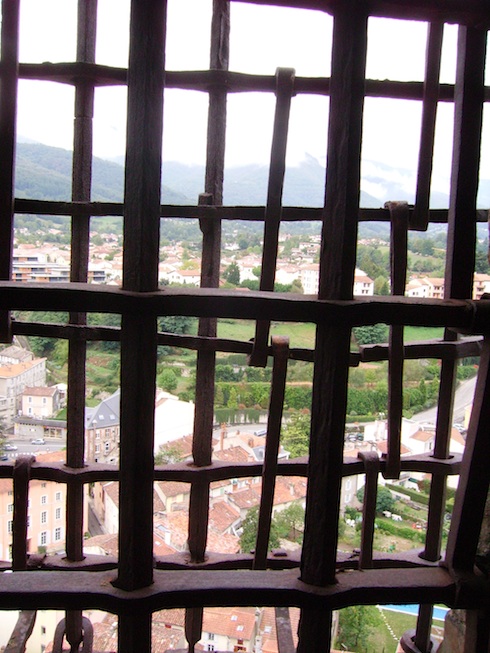
Mr FABULOUS! and his surviving relatives decamped from Foix, part of the kingdom of France since the Albigensian crusade, to Béarn, then still an independent state, to pretend they too were still independent of the various French kings Louis. His fancy castle on the hill became a prison at about the time of the French Revolution. This is why the buildings and towers survived, with new wall decorations in the form of graffiti, and stylish grillwork over the windows to keep the burglars out—or in, as the case may be.

Antique window grills to keep prisoners in, Foix chateau, France

The castle became a prison after the French Revolution. Security was a problem even then.

We’ve had a few busy days exploring the Ariège/Hers region. We’ve climbed many, many spiral staircases up towers—always corkscrewing to the right: apparently built that way to disadvantage attackers, who most likely would be right handed and therefore unable to maneuver swords effectively around the tight bends—slipped up and down rain-slicked cobble streets, gazed out at rolling, wooded foothills, and eaten both good and not-so-good meals.