Information Forestry, August 2006 —Budworms are among the most destructive forest insects in North America. During outbreaks, eastern spruce budworm, western spruce budworm, jack pine budworm and their relatives strip foliage from tens of thousands of hectares of susceptible conifers across the continent.
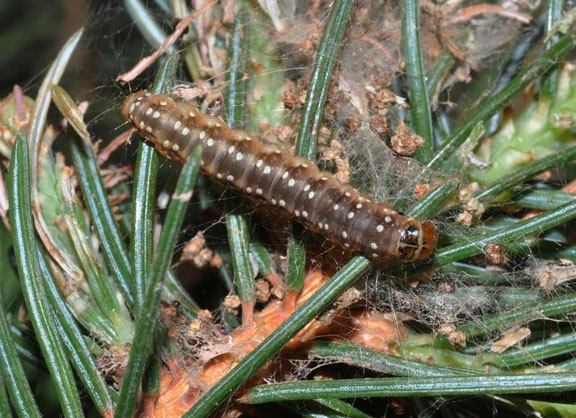
Western spruce budworm. Photo by William M. Ciesla, Forest Health Management International

Western spruce budworm is one of several budworm species that eat evergreen needles in Canada's conifer forests.

Now, thanks to indicators identified by Canadian Forest Service scientists, forest managers may be able to use simple chemical analyses to identify areas at particular risk to budworm outbreaks. Insect Ecologist Vince Nealis and Research Scientist Jason Nault plotted changing chemistry within developing Douglas-fir needles against the ability of western spruce budworms to feed successfully on the trees’ buds. From that, they determined that the same molecular compounds that give evergreens their distinctive smell also indicate the potential success of budworms in a given year.

“An important part of the life history of the budworm has to do with how well it is synchronized with the flush of new buds in the spring,” says Nealis. “We wanted to quantify the relationship between emergence of western spruce budworm and development of the insect’s preferred food, Douglas-fir buds.”

Key to the prediction method is a mixture of complex, aromatic hydrocarbon molecules, called terpenes, found in all evergreen needles. The proportions of different terpenes in the mixture within buds change rapidly, but predictably, as buds develop in the spring. The rate of progression from one dominant terpene to another is closely tied to site temperature. In cooler places or during cooler years, the progression—and bud development—occurs more slowly. This can upset the timing of budworm emergence to bud suitability, with consequences to outbreak risk.

According to retired, now-volunteer U.S. Forest Service Research Entomologist Karen Clancy, who studies resistance in Douglas-fir to western spruce budworm, budworm population success depends on that timing. “Phenology of bud break is probably the most important factor driving resistance in individual trees to western spruce budworm damage, and driving budworm population dynamics.”

Western spruce budworm emerges from its winter shelters in early spring and subsists on older Douglas-fir needles and pollen cones until its preferred food—tender, developing buds—comes into season. If larvae emerge too early or if bud development is delayed, greater numbers of budworms die, and that particular forest stand may benefit from a year without an outbreak.

By measuring the terpene profiles of developing buds using gas chromatography, Nealis and Nault found they can pinpoint where and when host trees would be most suitable for budworm outbreak in a given year and where the risk of damage is greatest. Knowing this allows forest managers to better plan and implement pest management options, and better manage forests in their care.

“They appear to have found a good, reliable, relatively easy way to measure the bud break phenology of individual trees and populations of trees,” says Clancy. “Measuring bud break phenology with other methods like going out and collecting samples and visually assessing each of the buds is very time consuming. If you can clip just one branch from a tree and analyze its foliar terpenes, that’s a phenomenal result.”

Although Nealis and Nault identified the correlation between terpene profile and bud suitability for budworm by performing linked biological and chemical assays on western spruce budworm and its host, Douglas-fir, Nealis suspects “the method can be applied to jack pine budworm or eastern spruce budworm or any of the other budworms.”
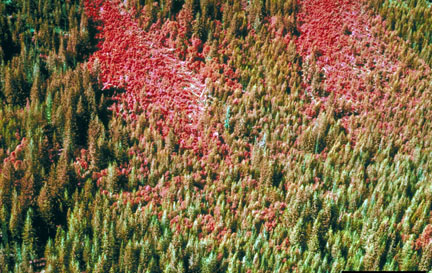
Conifer forest damaged by western spruce budworm. Photo by USDA, David McComb.


Scents of suitability

Terpenes, the molecules that give conifers their distinct smell, indicate tree-bud suitability to budworm attack. In linked chemical and biological assays of foliage from test trees at eight sites in British Columbia’s interior, Canadian Forest Service researchers identified terpene profiles that can be used to predict host suitability for the insect, severity of defoliation, and identify tree resistance to budworm damage.


© Natural Resources Canada 2006
Information Forestry, April 2004 — A sliver of road remains—a narrow strip of asphalt running from bridge to barren clearing at river’s edge. Pavement once covered that, too, when it had served as loading area for the island’s dock. To the north and south, thickets of Douglas-fir, Sitka spruce and western redcedar grow. Along the waterfront, terraces built into banks support willows and other species that stabilize the shore and provide shade and shelter to sensitive salmon spawning grounds.

The greenery belies the island’s recent past: for almost 50 years, a sawmill and a cedar-shake mill operated on Baikie Island, in the Campbell River estuary, on the east coast of Vancouver Island. Sloughs separating the island from the foreshore were dredged for log booming and storage. Trucks lumbered on and off the island; tugboats herded log booms from upriver; the island bustled and roared.

The Nature Conservancy of Canada bought the island in 2000, and turned it over to the District of Campbell River to be restored and managed as a nature reserve and park. Sign of industry has been slowly disappearing from the island.

“Some things are coming back on their own,” says District of Campbell River Parks & Recreation Supervisor Susan Simson. “We’re helping other things along. There are places where we’d removed pavement that needed a lot of site preparation. Nothing grows there—not even broom or alder, and they’ll grow just about anywhere.”

This summer, volunteers dug up hard-packed ground once covered by industry, carted away industrial-grade fill, brought in tonnes of soil and compost, and planted the beginnings of a new forest. While local citizens provided most of the labour, part of a $27,000 grant given to the district government by Natural Resources Canada for new forest plantings helps pay for equipment, materials, and hundreds of seedlings still to be planted.

Fast-growing Forest 2020

The funding comes from a $20-million national pilot called Forest 2020 Plantation Demonstration and Assessment, part of the federal government’s $1-billion Climate Change Plan for Canada. Administered by the Canadian Forest Service, Forest 2020 encourages industry, local governments, First Nations, and other landowners to establish plantations of fast-growing trees on unforested land. By late 2007, new plantations of trees producing more than 13.6 centimetres of growth per hectare per year—eight times the national tree-growth average—will be growing on 10,000 hectares across the country. To date, 38 projects under the program are underway or planned in British Columbia.

In most of Canada, fast-growing trees mean hybrid poplars, larch, and Norway and white spruce. On the west coast, with its long growing season, many species—including Douglas-fir, Sitka spruce, cedar, maple, alder—super-produce fibre and quickly store carbon.

This enables west coast program participants such as the District of Campbell River to quickly rehabilitate and convert open areas back to green cover.

“We’re putting back what was originally there,” says Simson, of Baikie Island. “A conifer mix, with some other trees—native maples, willows, maybe some more cottonwoods along the estuary.”

The primary goal of Forest 2020 is long-term carbon sequestration, says Dean Mills (dmills@pfc.cfs.nrcan.gc.ca), who administers the program in British Columbia. Carbon dioxide is a greenhouse gas, and must be accounted for under the Kyoto Protocol for Climate Change, which Canada endorses. Trees take carbon dioxide from the air, and transform the carbon into wood: fast-growing trees do it faster. Carbon eventually stored within Forest 2020 plantations will be tallied in Canada’s accounting of the country’s greenhouse gas emissions, as required under the protocol.

“Forest 2020 allows for a shift in how we view the forest plantations,” says Mills. “Plantations and forests have many functions and can be used for more than just fibre. As long as Forest 2020 plantations sequester carbon at the prescribed rate, they can address other values such as quality of life or wildlife or economic development or other community objectives.”

Although wildlife, fisheries and local citizens benefit directly from the Baikie Island restoration, there are indirect payoffs. Campbell River is slated to become a stop on the cruiseline route to Alaska in 2005: new forests on nearby Baikie Island and other riverside lands will provide an inviting introduction to the town for shipboard visitors. In recognition of that, the district recently passed bylaws limiting development along the estuary to light-industrial or commercial use: existing heavy industry will gradually phase out, leaving the estuary to birds, fish, deer and people using pathways and picnic areas.

“Baikie Island is really a high-profile project within this community,” Simson says. “Support has been amazing. The Campbell River Noon-Hour Rotary Club built trails and pedestrian bridges. The Discovery Coast Greenways Land Trust brings in many volunteers every spring to remove broom and blackberries and other invasive species. The Nature Conservancy is involved, the Department of Fisheries and Oceans, BC Hydro… a lot of people and organizations are making things happen.”

The ultimate waste-recycling loop

Baikie Island is one of two Campbell River projects benefiting from Forest 2020 funding. Further inland, the district government invested the rest of the federal grant in a hybrid-poplar plantation that will eventually provide pulp fibre.

The plantation will not only bring in cash to help pay for itself, it saves the region money. Instead of paying to store and ship biosolids from the region’s 10-year-old waste-treatment plant for re-use elsewhere, engineers use the material to fertilize the plantation, which is located next to the treatment plant.

“This project had great potential because we owned a large piece of land around the plant, which eliminates transportation costs altogether,” says District of Campbell River Engineering Supervisor Ron Neufeld. “It turned out, after we’d done all the necessary field tests of the site, the project was not only a good match financially, but had all the right check marks in terms of soil, groundwater and other environmental conditions.”

The province’s regulations for recycling organic matter Recycling require a number of processes and conditions, including public consultation, site security and site preparation, to be met before a project like this can proceed. At two public meetings hosted by the district to discuss the project, the only concern raised by local residents was the possibility of odour, a problem the district has effectively minimized through appropriate application techniques. Following the public process, the site was fenced and cleared of bushes, and surrounded by a buffer zone and perimeter ditches.

After an initial spring application of biosolids in May, poplar whips were planted at four-metre intervals in rows covering 10 hectares of the site.

The trees received one more application of biosolids fertilizer during the summer months. “The number of applications and the rate of application depends on demand,” Neufeld says. “As the trees grow, demand will increase.”

Plantations are a cost-effective way to deal with Campbell River’s biosolid waste and improve the environment.

“We anticipate that the poplar crop will be ready for market in 10-13 years,” Neufeld says. “Once mature, the trees would likely be used for production of paper – maybe even toilet paper, which would really create an appropriate re-use cycle for this project.”


Caption: Ten hectares surrounding Campbell River’s waste-treatment plant were prepared and planted with hybrid poplars this spring, which will recycle biosolids from the plant into wood fibre.


Caption: Fragments of rare riparian forest communities survived Baikie Island’s industrial past, and are being augmented by Forest 2020 seedlings planted by volunteers.

Sidebar: Under Forest 2020, 10,000 hectares…

of non-forested land will be converted to fast-growing tree plantations by 2007.

of fast-growing trees planted by 2007 could sequester as much as 0.4 Megatonnes of carbon each year by 2012, the end of the Kyoto Protocol’s first commitment period.

IF April 2004. p6-7


Trackways #19, Winter 1999–A nearly complete Cretaceous-aged turtle has found its way to the Royal Tyrrell Museum. Not only are its skull, skeleton and shell intact, but its body cavity contains additional treasure: turtle eggs.

“The preservation of this specimen is remarkable,” says Museum palaeontologist Don Brinkman, who studies Cretaceous turtles. “Of all the turtle specimens found all over the world, there is only one other I’ve heard of that may also contain eggs.”

Found by Museum technician Wendy Sloboda in the remains of an ancient mud-filled channel, the turtle’s bones escaped reworking and scattering by scavengers and water currents. The specimen is Adocus, an extinct relative of today’s soft-shelled turtles. Seventy million years ago, it swam in freshwater streams and ponds, ate fish, frogs and salamanders, and likely came ashore to lay its eggs on warm, sandy beaches. However, this individual died before laying its eggs: its body is filled with dozens of eggs compressed by burial.

“We have more research to do before we learn all this specimen can tell us,” Brinkman says. “At the very least, we now know for sure that Adocus laid eggs and what Adocus eggshell looks like. This will help us identify in the future when we find shell fragments in the field.”

© Royal Tyrrell Museum of Palaeontology 1999

Trackways #19, Winter 1999: For years, when Royal Tyrrell Museum of Palaeontology technician Darren Tanke prospected in Dinosaur Provincial Park, he searched only for fossil bone eroding out of the ground. But, for a period in the late-1990s, he also looked for less likely treasure: old newspaper, dried clumps of plaster, tin cans and burlap… traces left by palaeontologists who collected fossils in the park during the 1920s and earlier.

Tanke was trying to locate historic quarries. From 1995, when he started his quest, to 1999, he had verified eight mystery quarries, using old garbage, archival photographs, field notes, and old letters to date excavation, identify who did the collecting, and what was collected.

“We found the quarry-location map made in 1950 is incomplete and somewhat inaccurate,” he says. “On top of that, palaeontologists started quarry-staking excavation sites in the park only in 1935, and locations excavated earlier are poorly described: ’10 miles below Steveville’ is a lot of territory in the badlands.”

Quarries are staked when palaeontologists cement a steel pipe into the floor of their quarries. A disk welded to the rod identified who collected what and when. In 1999, there were about 230 staked quarries in the park, leaving Tanke with the task of trying to find and identify another 150 to 2000 unmarked quarries.

Apart from their historical significance, accurate quarry records help today’s palaeontologists determine what dinosaurs are associated with which layers of rock. They also help scientists match new fossil material discovered in old quarries to incomplete specimens collected years ago.

Click Dinosaur trading cards to view a sample of dinosaur trading cards, with interpretive text by Monique Keiran.

The three trading cards form part of a 12-card series published by the Royal Tyrrell Museum Cooperating Society.

Yes Mag: Canada’s Science Magazine for Kids, Winter 1998/1999—If a group of animals died together, there’s a good chance they lived together, says Philip Currie, dinosaur palaeontologist at the Royal Tyrrell Museum in Drumheller, Alberta.

Currie is studying a recently re-opened bonebed, located 60 kilometres up the Red Deer River from the museum. It contains the jumbled remains of Albertosaurus—a large, meat-eating dinosaur related to Tyrannosaurus rex.

Material from the site is changing scientists’ views on how the animals lived. Tyrannosaurs were though to be solitary creatures, but the Albertosaurus bonebed points to social behaviour. It appears that at some point in their lives the large carnivores were living in packs—possibly to hunt migrating herds of duckbilled and horned dinosaurs.

Although material from this site is giving scientists new ideas, this is not the first time the bonebed is being explored. In the 1910s, American palaeontologist Barnum Brown spent four summers collecting fossils from this area. Among the boxcar loads of bones he shipped to New York’s American Museum of Natural History were the remains of nine specimens from the Albertosaurus bonebed.

Brown’s field notes were sketchy, however. It wasn’t until Currie studied the New York specimens in 1996 that he realized the albertosaurs came from one quarry.

The following year, with only Brown’s notes and four archival photographs for direction, Currie searched for the site.

“We were trying to match landscapes with those in the photographs and were having no luck,” he says. “Another photograph was of the camp, taken from across the river. I sent someone over and they found the spot right away—it was that obvious. Now, it makes sense the quarry would close to the camp….”

After many more hours of searching, Currie found the quarry. “All that was left was a sinkhole, but there was lots of material. Pieces of skulls, toe bones, and bits of rib. It turns out Brown had excavated less than 25 percent of the site.”

Currie’s 1998 survey of the bonebed turned up pieces of a tenth individual dinosaur. What scientists find especially exciting is the diversity in the specimens’ ages.

“We found young guys. We found old guys. We found sub-adults,” says Stewart Wright, a palaeontology technician who works with Currie.

Scientists are still not sure why these dinosaurs died together. Charcoal in the rocks near the bonebed suggests a forest fire, but the evidence is inconclusive. Currie and his crew will return to the site next summer to look for answers.

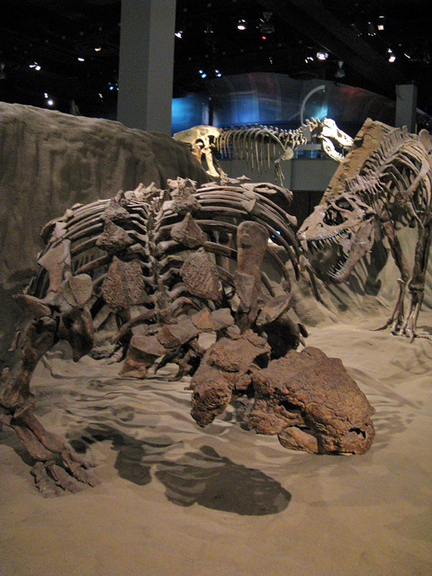
Royal Tyrrell Museum ankylosaur. Photo by Travis S.

A cast of an armoured-dinosaur ankylosaur skeleton takes a tail-swing at an albertosaur at the Royal Tyrrell Museum of Palaeontology.

Trackways #15, Fall 1998—In the world of palaeontology, ankylosaurs remain one of the Big Mysteries. The enigma stems from a lack of specimens to provide answers. Especially rare are good fossils from Alberta—that is, until this past season, the summer of ankylosaurs.

This year, researchers found eight specimens of the elusive armoured dinosaurs at Dinosaur Provincial Park. In just three months, the Tyrrell acquired the world’s most extensive fossil collection of these strange-looking, tank-like animals.

Among the finds are five skulls, raising the number of ankylosaur skulls in the museum’s collection to 14. These represent three known species, while one skull has yet to be identified. A skull provides the most information about the dinosaur it belongs to—its species, age, diet, and size. Since the first fossils were collected in Dinosaur Provincial Park more than a century ago, only 24 ankylosaur skulls have been discovered.

Now more than half of them rest in the Tyrrell’s care.

The ankylosaur windfall will help museum palaeontologists better understand how these unusual animals lived and how the different species were related to one another and to other dinosaurs. The new materials will also provide data on ankylosaur diversity, populations, and what roles ankylosaurs played within their Late Cretaceous ecosystems.

Ankylosaur armour. Photo by S. Mair.

Cobbles of bone lining its back provided the basis of ankylosaur armour.

© Royal Tyrrell Museum of Palaeontology 1998

Trackways #14, Spring 1998—When Walt Disney World opened Dinoland earlier this year, a little bit of Alberta shone beneath the Florida sun. As part of the attraction, Disney performers play palaeontologists explore the world of the dinosaurs. When looking for ways to immerse staff in dinosaur palaeontology, Disney looked north to the Royal Tyrrell Museum.

For five days in late winter, 10 performers learned to cast and prepare fossils, examined the spectacular specimens Museum staff are preparing, and toured the Museum from top to bottom. They also prospected for fossils in Dinosaur Provincial Park.

On the slopes of a park hoodoo, with dinosaur bones poking through the snow all around him, director Mark Renfrow couldn’t contain his excitement: he pulled out his cell phone and called his boss in Florida to rave about the experience.

Dinosaur Provincial Park, by Peter Hoven

Water and wind created the badlands in Dinosaur Provincial Park. Photo by Peter Hoven.

© Royal Tyrrell Museum of Palaeontology 1997