Alberta's Milk River, by James Bremner

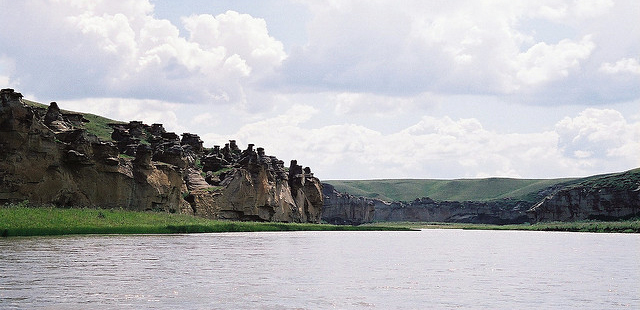
The cliffs above Alberta's Milk River yielded the remains of a young hadrosaur in 1997.

Trackways #12, Fall 1997—When Lethbridge writer Shanan Timmers went for walk on the banks of the North Milk River west of Del Bonita, Alberta, earlier this summer, he stumbled across a find important to the world of palaeontology.

Jutting out from the overhanging river cutbank, far from where palaeontologists would have thought to look, were dinosaur bones.

It turns out the bones belong to a sub-adult hadrosaur, one of only a few half-grown hadrosaur skeletons ever recovered. When it was alive, the animal measured about three metres long and about two metres high at the hip.

The specimen may be the first dinosaur found in the St. Mary’s River rock formation. That, and its isolation from other know hadrosaur skeletons increase the possibility of it being a new species.

The pelvis, femur and base of the tail sticking ouf of the rock are beautifully articulated, suggesting that the from part of the animal may continue into the bank. However, until the animal is in the lab and prepared, scientists won’t know exactly how much of the animal is in place.

Before that can happen, collecting crews from the Royal Tyrrell Museum and Devil’s Coulee Interpretive Centre must remove the specimen from the overhang six metres above the river—without having bones fall and break in the riverbed. A heavy sandstone layer covering the fossil and access to the site only from above further complicate the excavation.

© Royal Tyrrell Museum of Palaeontology 1997

Explore Kananaskis, Summer/Fall 1997—Tiny pink elephants. Flesh-eating plants. Thieving flowers. They sound like characters in a fantastical Arabian Nights story, but in Kananaskis Country, these characters act out these roles under our noses every summer. The wildflowers of Kananaskis have no 1,001 nights in which to bloom and fade: if they’re lucky, they’ll get a mere 60 to 90 frost-free days in which to tell their stories.

Only the hardy and the strong survive this rugged environment. The plants and flowers found in Kananaskis Country have spent many generations adapting to harsh temperatures and poor soil conditions. No shrinking violets, here, if you please.

Cool nights mean flowers last longer and shine brighter. A chemical reaction within the colour molecules of a flower occurs during warm nights, when the plant isn’t photosynthesizing. The reaction breaks down the pigments, causing the flowers to fade.

An abbreviated growing season also means a riot of wildflowers blooming in a very short period. For flowering plants, a short summer is a frantic flurry. A plant must accomplish a year’s worth of activity in just two or three months. Not only must it flower, produce nectar and pollen to attract pollinators, be pollinated, and produce seeds, it must grow enough green stuff to make sufficient food to supply the energy for all of that flowering, pollination, and seed production—and store enough food to survive the winter and early days of the following spring.

As hard as life may be for a plant in Kananaskis Country, they aren’t passive victims. Each species possesses its own mechanisms for survival, honed and passed down through generations. Click on the gallery images for a glimpse at the lives of some of Kananaskis Country’s summer beauties.