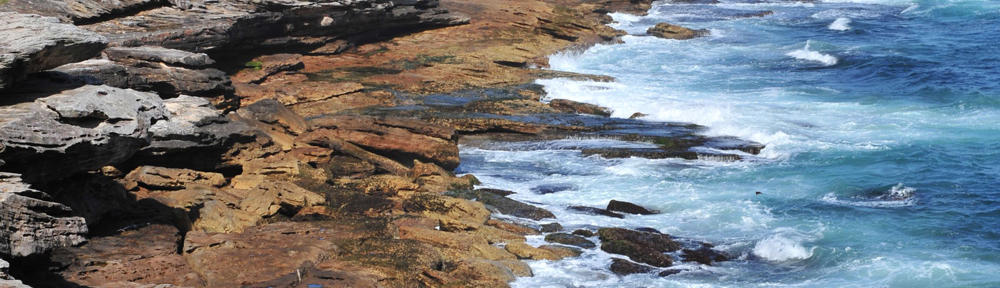
bread and thyme. Photo © Moyan Brenn Berkut82@hotmail.it
If you ask Gaston what he considers to be the defining qualities of good French bread, his eyes lose focus and a dreamy expression comes over his face.

You may prompt him: “Crusty? Fluffy?”

That snaps him back into the moment. “No! Absolutely not.”

I agree with his disagreement.

The best French bread bears little resemblance to the loaves and sticks we find in most North American supermarkets.

Good French bread has a slightly tough, crunchy, chewy crust. The bread’s flesh is very springy and slightly chewy—with substance, yet also with measurable, sometimes even large-ish air pockets. The texture tells you whether the dough was adequately worked before set to rise, activating and harnessing the long protein chains of gluten in the wheat, or wheat, rye, even barley or oat, flour combination.

The French take their bread seriously. No fluff-puffs or tasteless roll-into-doughballs for them. Bread, after all, is part of French heritage, and figures prominently in the history of the country. For instance, when told that peasants and workers were marching on Paris in 1789 because they had no bread to eat, Marie Antoinettes is said to have suggested, “Let them eat cake” (or brioche, more likely, given what she ate instead of peasant bread). The story is apocryphal; regardless, a lack of flour for bread was a trigger for the storming of the Bastille in July, 1789.
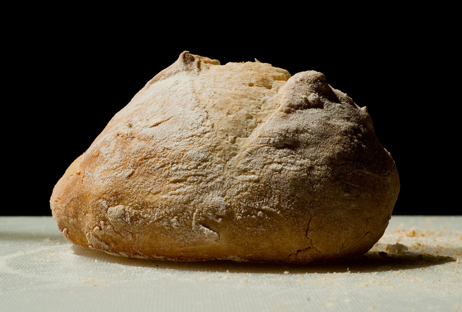
boule of country bread. Photo © by Brett Neilson

And we all know where that led.

Yet, in recent years, bakeries across France have been closing. And, yes, it is now possible to get a baguette or loaf in France that just doesn’t measure up.

A baker’s life is difficult, and the returns are low. A baker’s long hours preclude much of a social or even family life. Working conditions are uncomfortable, and rents and fuel costs are high.

Then there are the regulations. These regulations dictate, on one hand, staff wages and hours, and require immense amounts of paperwork. The regulations also limit how much a baguette can be sold for and how much time a baker and his family can take for vacation each year.

Further, the French are eating less bread in a collective effort to reduce waistline creep. Unfortunately, this also reduces bakers’ profit margins.

It’s little wonder few young people choose the trade.

Syndicates and corporations have stepped up over the last few decades to provide solutions. These organizations source and negotiate  lower prices for flour and other essential ingredients. The buying power comes with being able to purchase in bulk for thousands of member–bakers directly from producers. The syndicates and corporations also handle warehousing and shipping of ingredients across France, reducing individual bakers’ hassles immeasurably.

As you drive through towns and villages, bakeries display signs and logos for these organizations. They announce to passersby which of the organizations enables a baker to continue working his trade. Few independent bakeries now exist in France, although rare exceptions continue.

The organizations have changed baking in France in other ways, providing a number of optional services their member–bakers can subscribe to. One of these services is regular provision of ready-made starter, or leavening, for more traditional, sour-dough-type bread recipes.

The corporations can also supply bakers with factory-made pre-mixes or even frozen dough shaped into loaves, buns, sticks, and even croissants and sweet breakfast pastries. Bakers need only order a month’s supply. They can keep the goods frozen until needed, defrost the number of items needed for a morning’s bake, then pop them into the ovens.

These options have improved bakers’ lives considerably, but  at a cost to bread quality.

The pre-made loaves are sold as basic, or regular, baguettes or loaves. The state sets the price of these basic offerings, ensuring that the French will always be able to afford bread for breakfast, lunch and supper.

These baguettes and loaves are usually disappointing, with crusts that explode into crumbs as soon as you break the loaf, and a light, disappear-into-nothing crumb inside. That said, it’s still better than most supermarket bread we find at home.

Many French bakers, fortunately, provide alternatives. A 1998 law prevents businesses that use only pre-mixed dough and frozen-ready loaves from calling themselves “bakers.” As a result, any baker who wishes to be recognized as a baker must provide some product made from scratch. Some are true craftspeople. I recommend you bypass regular bread in all French bakeries except those on the Best Baguette of the Year list, and choose instead traditional options—called traditionnela l’ancien or d’antan. These are made more in the old-fashioned way, with sour-dough starter and blends of flour the baker can adjust.

Truly artisanal bakers create and nurture their own starter over months and years, imparting a distinct (and very satisfying) taste to their loaves and sticks. Some create taste–art by incorporating seasonal fruits or produce into specialty breads. I remember enjoying baker Cédric Diant’s exceptional pain aux figues (fig bread) and pain aux noix (walnut bread) during one fall vacation to the Mirepoix area. Both loaves were heavier than Diant’s traditional pain or boules, but they were so, so good.

French artisan bakers are becoming a rarity. When you stumble across one, return often, and buy from them. Help keep them in business, and enjoy the bread they clearly are passionate about making.
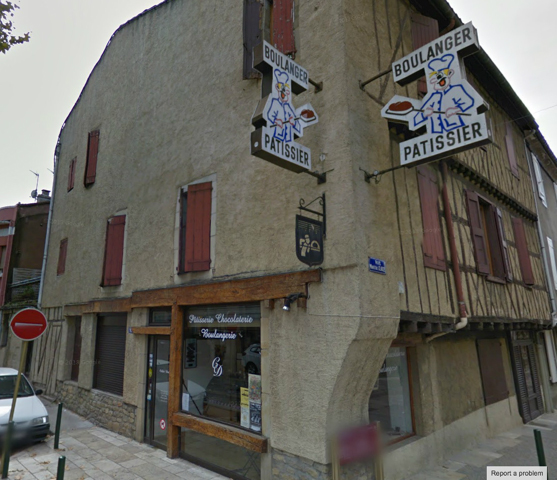
Boulangerie/Patissierie de Cédric Diant, Mirepoix. Photo © Scott Mair 2012
It took Gaston and I a week to find Diant’s bakery in Mirepoix. Now it is one of the many reasons why we keep returning to the region. Sadly, the rigours of running a bakery has changed even Diant’s business. He no longer offers the range of bread available even a few years ago. The menu is usually whittled down to everyday varieties sure to sell.

He was also closed for the first three weeks of this visit. Given that two bakeries on the town’s more-frequented central square have closed since we last visited, Gaston and I feel fortunate that the door to Diant’s establishment was locked only temporarily.

For his bread remains outstanding—the best bread in the region.

A French bread glossary

Baguette: a long, very thin loaf of bread

Pain: a loaf that is similar in shape and size to what North Americans call French bread

Boule: a round loaf of bread.

Pain traditionnel: country bread—often sourdough and made with rye, barley and even oat flour, in addition to wheat flour.
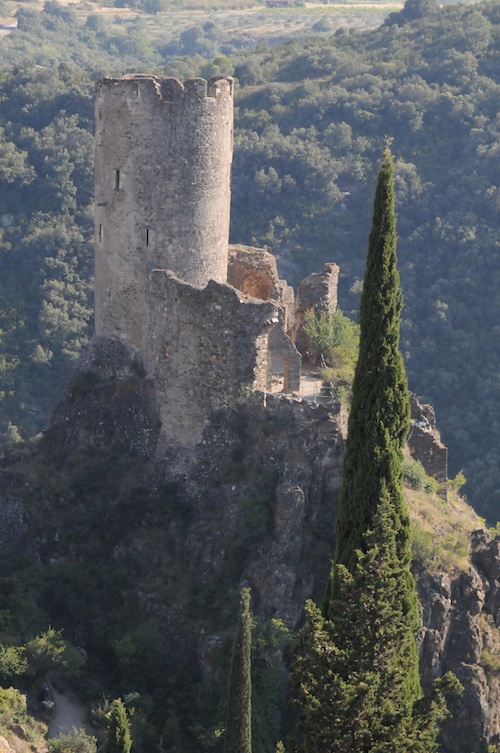
Chateaux Lastours

This was our first big hike of the vacation. It occurred towards the end of the day, after a visit to our favourite vigneron (and accompanying wine tasting—by Mimi. Gaston abstained from more than a few slurps, as he was DD), lunch below the troglodyte village of Minerve (two stars on the Michelin road map), and a winding journey across the southern slopes of the Black Mountain.

It was one of the first days of 35° temperatures, and the climb almost did Gaston in.

chateau régine, at one of the four lastours castles

Chateau Aguilar

Aguilar chateau

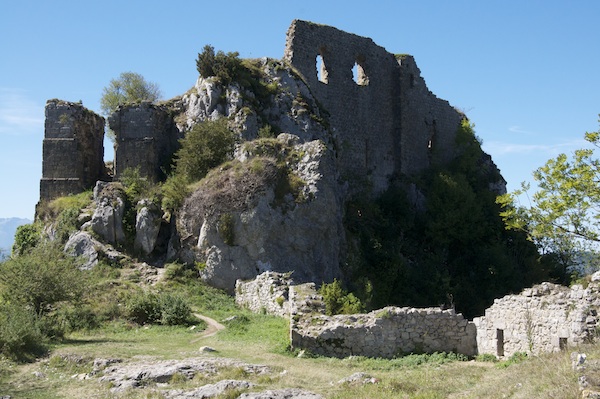
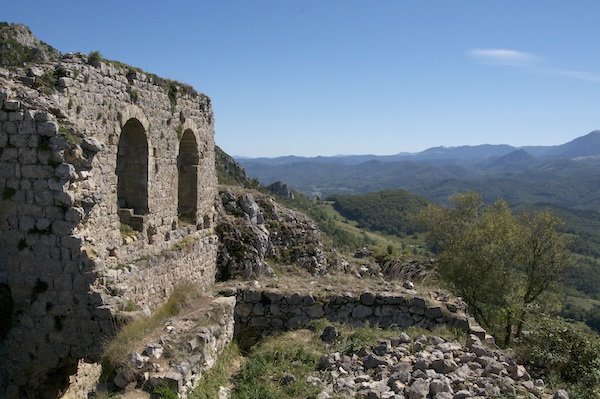
One of the “National Monument” ruined Cathar castles in the Aude.

Aguilar chateau

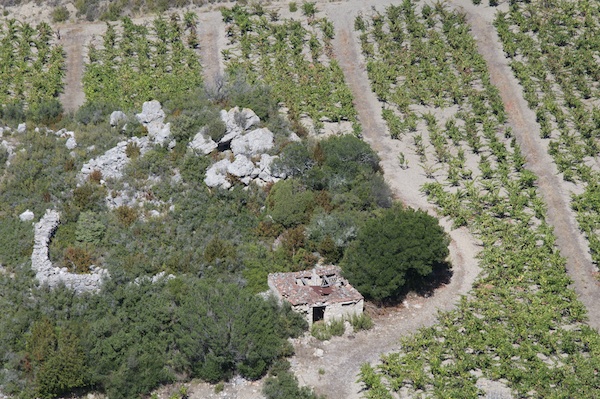
Looking down on the vineyards below chateau Aguilar.

Chateau Roquefixade

Gaston and I caught the Friday market in Foix, took a heap of photos as the light was crystal clear—that would have been the first day of Autumn light—then departed to conquer Roquefixade.

We’d been intimidated by this chateau on previous visits. The approach appears vertiginous.

The pog of Chateau Roquefixade

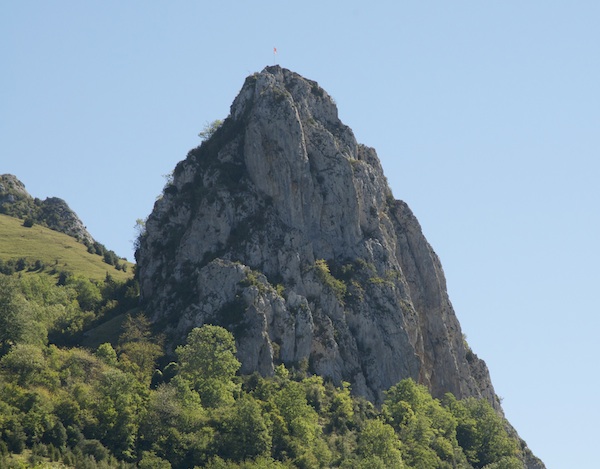
Chateau Roquefixade: the wee red flag at the top of the peak marks the ruins of this Cathar stronghold.

First visit to the area, which encompassed only six days, we gazed at it from Montségur and noted the cathar-cross flag flying at the top of the peak. On visit #2, we explored the town at the base of the cliff, climbed to the rock face, then decided, “Another day.” I believe a mild case of food poisoning or airplane stomach-bug played a role in that choice.

Even this time ’round, as we drove towards it from the west and saw how steep the outcrop on which the ruins are perched, Gaston and I were each dreading the endeavour. But, of course, we didn’t say anything. Which I think is mighty big of Gaston, who has confessed to me that, actually, he really doesn’t care for hiking, and especially doesn’t care for hiking up steep inclines, especially when it is warm out.

Does this mean he was humouring me? Who cares!

It turns out the hike to the chateau is deceptive: it isn’t nearly as rigorous as it appears from up the valley or from the village.

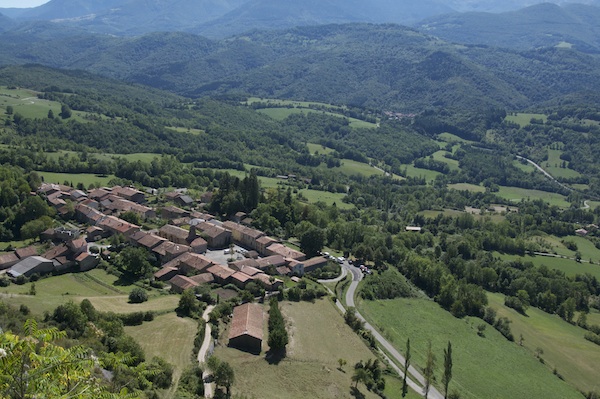
Roquefixade village

At the base of the village, overlooking the valley to the southwest, was a small “villa” (modern house) with a million-dollar view and cracks so large in the walls, you can see into the interior. Said house is for sale “on condition of unbuilding.” The edge of the hill beneath the house is subsiding. What a heartbreak for the owner who invested.

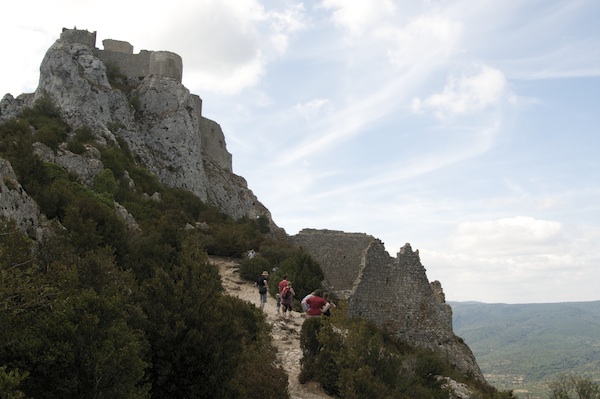
Don’t believe me? The trail winds around the base of the rock to the back side of the pog, then ascends at fairly reasonable, albeit still steepish, incline to the back of the fortress.

And we saw our first Griffin vulture whilst lounging at the top: a freaking HUGE, black bird that was riding the thermals off the crest.


Chateau Peyrepertuse

01. October 2012 · Write a comment · Categories: France · Tags: ,

Next to the entrance to the local supermarket, the owners have parked a spiffy trailer-wagon that has caught Gaston’s eye.

It’s small enough and light enough to tow behind a gutless Yaris. It has collapsible side bars that can be raised or lowered, together or separately. It would be the perfect alternative to Gaston folding the seats of his Toyota down, lining the back with a tarp and stuffing the works with the bi-weekly batch of garden waste en route to the municipal compost facility.

This being Europe, where they made peace with the ridiculous price of fuel back in the ’70s by embracing small, energy-efficient cars, accessories suitable to such vehicles exist here.

Watching the covetous gleam in his eye everytime we walked by, I suggested to Gaston that he get an import license and set up a business bringing items like this into Canada. That won’t be going anywhere.

Instead, he will be keeping that eye out for the time when wagons for wee cars become available on our home turf.

The word la peyre is a derivation of la pierre, or stone. We have encountered a number of places whose names incorporated “peyre.

La Peyre

La Peyre

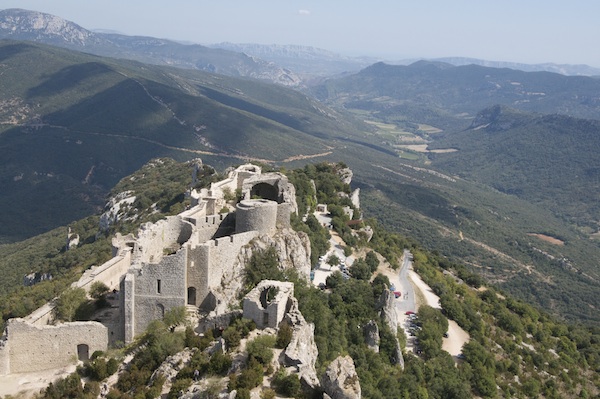
Chateau Peyrepertuse, which translates roughly into (tee hee) Stone-Whooping cough Castle—the spectacular mountaintop ruin of a former Cathar fortress, then French-border fortress and chapel to Saint-Louis/Louis IX, north of the town of Maury, in the Aude.

Peyrefitte-du-Razès—a farming village in the Razès region of the Aude, where we’ve hiked.

The double-hitter Peyrie-et-Peyrols—a hamlet near Mirepoix.

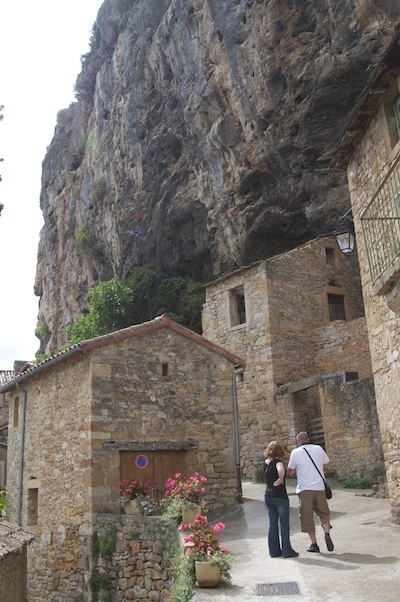
La Peyre—a village built into the cliff, close the the Millau Viaduct in the upper Tarn. These kinds of places, in which past architects and builders took advantage of how rivers now far below had eroded overhangs, caves and natural shelters out of their former banks to erect shelters, Anasazi-style, are called villages des troglodytes, or villages of the cave dwellers. The original church in La Peyre, now a private residence and art gallery, is once of the cave dwellings.

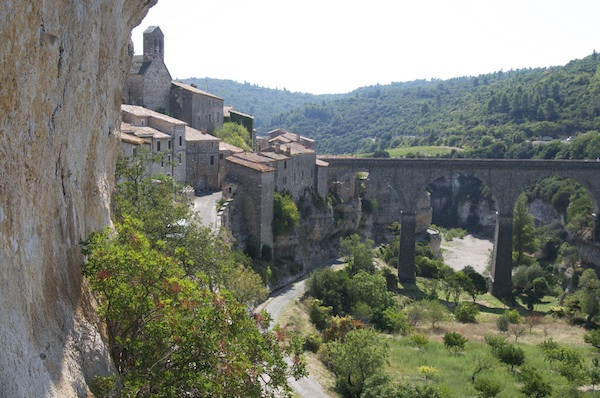
One of the most renowned troglodyte villages in southwest France is Minèrve (in the Minèrvois region of Languedoc, funnily enough). Alerted to its potential by the two stars the Michelin road map marking its name, we visited this cliff-village after we picked up our month’s supply of wine from our favourite winery just to the south. We had lunch in the riverbed, the river flowing underground for most of the year.

Minerve

Minerve

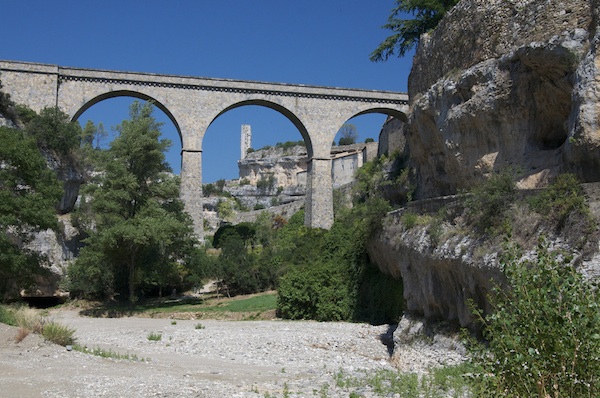
Minerve bridge and fortress gate

The tower of rock is all that is left of Minerve’s former defensive wall


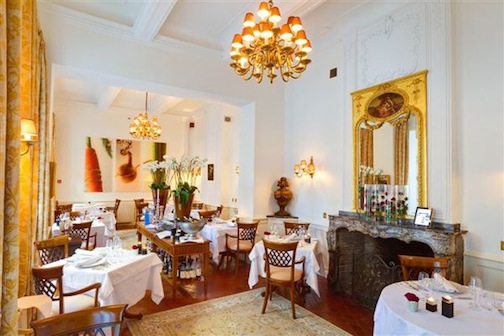
The dining room of le Ciel d'Or restaurant, Mirepoix, FranceI’ve frequently enjoyed soups and sauces made from mirepoix stock, but this was the first time I’d had the actual mixture of chopped celery, carrots and onion that is called mirepoix explicitly showcased on my plate.

Gaston and I were enjoying the Friday fixed lunch at le Ciel d’Or, the restaurant at the Relais Royal hotel in Mirepoix, France. Chef Rogier van den Biggelaar, here in Mirepoix-the-town, clearly is proud of his position’s occupational, geographic and historical connections to mirepoix-the-food. The aromatic mixture, which forms the flavour base of many stocks, soups, stews and sauces, is named for Charles-Pierre-Gaston François de Lévis, duke of Lévis-Mirepoix, whose family had ruled the area since the 11th century. Mirepoix-the-lord employed the cook credited with establishing and codifying mirepoix-the-cooking-technique within the canon of French cuisine in the 18th century.

Our meal in present-day Mirepoix-the-town was both simple and simply delightful.

It started with a salad featuring a few leaves of crisp oak-leaf lettuce that cupped a generous spoonful of pink foam redolent of tomato roasted just long enough to concentrate the fruit’s sugars. Slices of vine-ripened cherry tomatoes, a drizzle of bright olive oil, and a lick of balsamic reduction lifted the dish into art, both visually and gastronomically.

But the main course was, of course, the main attraction. The menu provided just one offering: roast pork with brunoise.

Brunoise consists of a small-dice mirepoix cooked with diced ham or pork belly.

In other words, we were going to lunch on mirepoix in Mirepoix.

The chef had highlighted the natural flavours within the mirepoix, and as soon as the plates were brought into the dining room, the aromatics filled the high-ceilinged room. Steeped in a rich, savoury sauce made from the reduced juices of the pork and the vegetables, this mirepoix consisted of orange, and translucent green and golden flavour jewels that seduced the senses and silenced Gaston and I. The tiny cubes had cooked only briefly and remained satisfyingly firm in texture. This dish, so commonly relegated to the background of everyday cooking, was both revelatory and familiar, pleasantly astounding us with the fullness of its flavour on the one hand and soothing us with the comfort of an old friend on the other.

The four generous slices of roasted pork loin we were each served were tender, flavorful, and moist, with a thin, slightly chewy, slightly caramelized crust, and were perfectly set off by the brunoise.

We both would have been content if the meal had ended with this main course. Being a weekday in September, the restaurant was quiet. The staff allowed us time to sip our wine and appreciate the lingering taste-memories before presenting the sweet course—a trio of small taste treats that pleased the palate without burdening the belly. Gaston particularly enjoyed the berry smoothie that was served in a shot glass, while I appreciated the tiny tiramisu.

Coffee, of course, completed the meal.