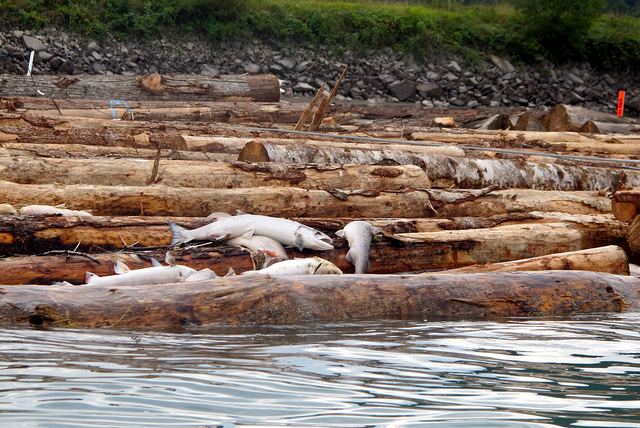
dead salmon, by Christopher Porter

Victoria Times Colonist, November 17, 2012—October’s turn in weather, bringing rain after months of sun and heat, has at last raised water levels  on the Cowichan River and cleared the way for the salmon.

How nice that something can enjoy the end to the glorious summer we had.

Just six weeks ago, the river nearly ran dry along some reaches. Salmon returning to the river found their passage upstream blocked by low water.

. Volunteers started rescuing the salmon. They trapped the fish, trucked them upstream, and released them at Sandy Pools and Skutz Falls.

But a month of rain has replenished river levels. I visited Skutz Falls a few weeks ago. There was still insufficient water to fill the fish ladders around the rapids, but Coho and Chinook were flinging themselves up the river’s natural white-water channels.

They are once again fulfilling their biological destinies by returning to their birthplace to reproduce.

And die.

The salmon’s instinctual call to destiny is a strange and wonderful thing. It places greater value on the interests of future generations than on any individual fish’s survival.

We could learn from that.

The problems on the Cowichan River stem from too much water being released via the Cowichan Lake weir earlier this year, leaving too little to buffer the river from severe drought six months later. But what happened here reflects river-flow problems across North America.

In Prince Edward Island, rivers were so low and warm this fall, fish became scarce. In the U.S., 160-kilometres of Nebraska’s Platte River dried up completely, and the mighty Mississippi fell by more than six metres.

Closer to home, below-average winter snowpack and months of dry, warm weather caused sections of rivers in the Peace Region to turn to mud and gravel. And on the Columbia River, annual flow has declined by more than 14 percent since 1950. One-third of the Columbia’s water originates in here in B.C.

What happens to the Columbia, the Kiskatinaw, the Moberly, the Beatton and the Cowichan can happen to the Fraser, the Skeena and, yes, the Goldstream and the Sooke.

After all, geologists report that Ontario’s Niagara and St. Clair rivers dried up completely 7000 years ago. A 25 to 40 percent decrease in annual precipitation and a 5o C rise in average temperatures caused water to evaporate faster from the Great Lakes than it was replaced. Lake levels dropped 20 metres, cutting off the rivers, shutting off Niagara Falls.

The study’s authors say similar temperatures and precipitation are within the range predicted for the region by 2100.

That is, what happened under climate change once can happen again.

Simon Fraser University researchers say we can expect a 20 percent drop in precipitation in B.C. by mid-century. Under climate change, spring and summer rains will decrease, and annual snow and ice accumulation in the province’s mountains and glaciers will decline. Glaciers store water in winter and release it slowly to rivers in summer. As glaciers disappear, late-summer river levels will fall drastically, right when demand for freshwater for agriculture, fisheries, industry and urban use increases.

Clearly, if these climate scenarios occur, B.C. rivers will experience increasingly difficult years.

British Columbians have always considered freshwater a renewable resource—one that falls from the sky like pennies from heaven. But when it ceases to splash down abundantly where and when it is needed, freshwater may become scarily scarce even here on the Wet Coast.

Kudos to the Capital Regional District for encouraging responsible water use. Despite a 14 percent increase in regional population, the CRD water board reports in its 2012 strategic plan that water use in the region has actually decreased by 11 percent since 2001. Seasonal watering restrictions, metering, rebates on water-efficient fixtures and appliances, and voluntary efficiency audits by businesses have brought about the gains, and will help extend our water supply.

However, more needs to be done by each of us.

It is time, while freshwater remains plentiful here, to learn from this year’s Cowichan River salmon, and reconsider how we each use and manage this resource now, so enough remains for future needs.

And for future generations of salmon.

–30–
A version of this column appeared in the Victoria Times Colonist.

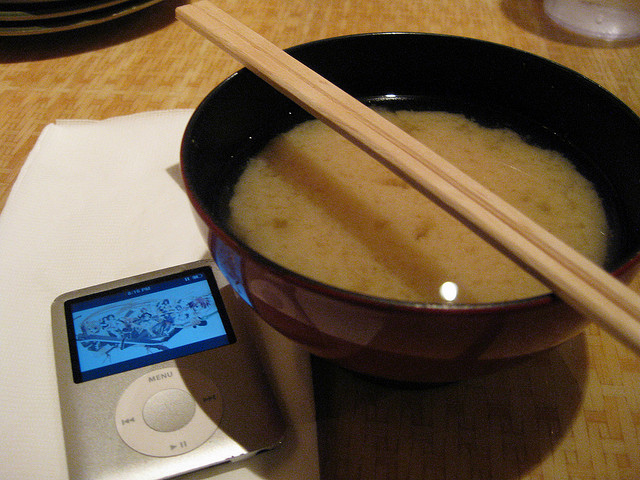
miso soup, by Michael Ocampo: www.facebook.com/coolmikeolntwk

  Nov 10, 2012

There’s a ritual we go through every time we eat at a Japanese restaurant.

It starts when the miso soup is brought to the table. Nature Boy gives his a swirl with his chopsticks. Then he reverently bows his head over the bowl in silent contemplation.

This is no memorial ceremony for Japan’s recent natural and nuclear disasters. The ritual predates those events.

No misguided adaptation of the Japanese tea ceremony.

Nor is this grace.

No, this prayer-like pause is Nature Boy’s version of veneration for the geologic forces that shape our planet.

So it does, in a way, relate to the earthquake in Japan, and the ties between this coast and that coast. Ties that extend far beyond and deep beneath the more than two dozen Japanese restaurants that operate downtown and the hundreds of students who cross the Pacific every year to study English here. Ties that physically bind this island to those islands in the form of massive crustal plates underlying the ocean floor.

It also relates to the recent earthquake in Haida Gwaii.

For, as I have been informed—repeatedly—in every bowl of miso soup, the same thermodynamic forces that churn Earth’s interior and move continents across the surface of the planet convect clouds of soybean paste and shift shredded wakame and chopped scallions.

In every bowl of soup, a demonstration of plate tectonics.

Those same forces caused the Haida Gwaii trembler, and the recent earthquakes in Japan, Mexico, New Zealand, Chile, Alaska, off the coast of Indonesia, around the Pacific Ring of Fire and elsewhere.

The soup itself represents Earth’s mantle, the region of the planet’s liquid interior between solid crust and solid core. The micro-curd miso suspended in the liquid enables The Interested Observer (a.k.a. Nature Boy) to identify convection currents within the soup. Soup at the surface, exposed to restaurant air, cools more rapidly than soup deeper within the bowl. Cool fluid is denser than hot fluid, so it sinks—gravity having its inexorable way. Hot fluid is less dense, so as the cooler liquid sinks, the hot stuff rises to the surface, where it subsequently cools, densifies, and sinks. And so on.

The cycling fluid creates troughs and wells, and pushes the soup’s floaty bits around the surface. Nature Boy gets particularly excited when a piece of seaweed wedges beneath some chopped scallion. He is sure to point out—yet again—the similarities to the Juan de Fuca Plate being driven under the North America Plate in the Cascadia Subduction Zone beneath Vancouver Island.

And I point out the similarities to how my cornea subduct under my eyelids when I roll my eyes.

“That,” he says, “is not at all the same.”

Pause.

“Okay, it is sort of the same.”

But a soup bowl is no crystal ball. No way to foretell a trembler’s timing, location, scale, or scope of impact exists. The October 27 earthquake caught Haida Gwaii residents by surprise. Tsunami alerts followed. Fortunately, despite the earthquake’s 7.7 magnitude, minimal damage occurred and only small ocean waves materialized.

Better to issue a warning when you’re uncertain than to wish you had afterwards.

New technology may provide some predictive potential. The seafloor-sensor network operated by NEPTUNE Canada, the Victoria-based underwater ocean observatory, and the instruments the Woods Hole Oceanographic Institute installed this year above the Cascadia fault monitor seafloor deformations. The sensors will provide minute-by-minute information about what is happening beneath our feet and off our shores.

If the data are analyzed quickly, they just might enable some warning of The Big One when it comes. Measurements of the fault zone where Japan’s earthquake happened revealed slow, small slip occurring two days before that quake. Seafloor monitors also detected movement. Unfortunately, the data weren’t analyzed in time to provide notice. Nor could anyone have known slow, small slip foretold a 9.0-magnitude shakedown in that case, or the size of the subsequent tsunami.

Greater warning might have made tremendous difference. It might mean all the difference for us.

Perhaps—just perhaps—we’ll have enough warning to gulp our soup and dash for stable, high ground.


A version of this article appeared in the  Victoria Times Colonist.

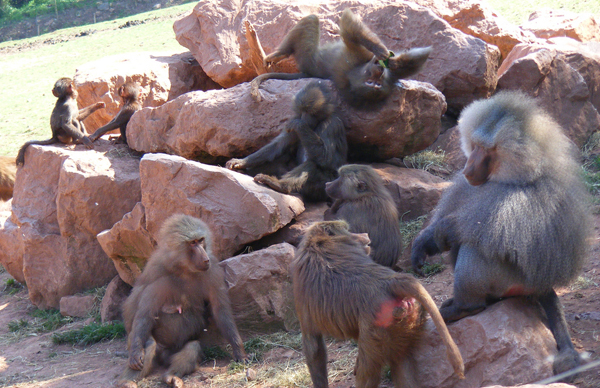
Baboons. Photo by Marie Hale.

Baboons are more like humans than we may like to think. They are as nasty to each other as we are. Photo by Marie Hale.

Victoria Times Colonist, November 2, 2012—Within less than 24 hours on October 9–10, 2012, two 15-year-old girls made newspaper headlines.

Amanda Todd and Malala Yousafzai lived worlds apart, separated by language, history, culture, and geography. Their stories, however, share tragic similarities.

Todd, as we know, committed suicide after being bullied online and at school. Yousafzai was shot in the head and neck by Taliban terrorists, which in my opinion, are nothing more than organized bullies with guns and grenades.

Todd and Yousafzai were targeted for abuse because—according to the narrow strictures of each group of bullies’ codes of conduct—these two young women had crossed moral lines—lines defined and marked and defended by the bullies themselves.

Todd and Yousafzai were targeted because they were women. Todd was fighting to move beyond a painful series of incidents that had started when she was sexually exploited by a cyber-stalker/blackmailer. Yousafzai spoke out for the rights of girls and women to attend school in a country where they had, very recently, been forbidden education.

I’m not saying bullies pick only on girls. Of course not. Bullies single out anyone whom they can get away with picking on. Some choose weaker and more vulnerable targets. Like Amanda, who lacked a supportive peer network that could help her and intervene on her behalf. Like Reena Virk, Dawn-Marie Wesley, Hamed Nastoh, Ashkan Sultani and all other teens—female or male—who have been bullied to death in B.C.

Bullies also prey on those who are strong or successful in some way because of the threat this poses to the bullies’ positions, worldviews or self esteem. Yousefzai, in advocating for women’s education and in blogging about her life under the Taliban for the BBC, fits this category.

We know bullying isn’t unique to humans. Stanford University neuroscientist and stress researcher Robert Sapolsky details his work studying baboons in Kenya’s Serengeti in many of his books. In A Primate’s Memoir, he writes, “Baboons live in big, complex social groups, and the population I went to study lived like kings…. The baboons work maybe four hours a day to feed themselves; hardly anyone is likely to eat them. Basically, baboons have about a half dozen solid hours of sunlight a day to devote to being rotten to each other. Just like our society….”

Typical baboon bullying goes something like this: A troop’s alpha male appropriates a subordinate’s hard-earned lunch of tubers. The subordinate, smarting, slashes the next guy down the pecking order, who bites a female, who smacks a juvenile, who thumps the newest kid on the block….

All within seconds.

Disturbingly like some families, schoolyards and online chatrooms.

And so the hurt in Sapolsky’s baboon troops cascades down and around. Then, one year in the 1980s, animals from one troop feasted on meat they found in the garbage dump behind a nearby tourist lodge. Many of the troop partook of the feast; the most aggressive partook the most.

Alas, the meat was diseased. Many in the troop perished, including all the aggressive males.

Females suddenly outnumbered guys. The males that survived were more interested in grooming and being groomed—in connecting socially with members of the troop—than in terrorizing others. And when aggressive adolescent males wandered in off the savannah to become troop members, they were quickly made to leave bullying behaviors at the door.

A kinder, gentler baboon society was born. According to Sapolsky, that society continues to thrive today, some 25 years later.

Sapolsky’s tale provides hope for us so-called higher primates. Of course, we humans are not permitted to feed tainted meat to or otherwise dispatch bullies, sociopaths, anti-social jerks and others who make our lives miserable. But those in charge and those below and those around and those online can connect and support and stand up for each other. We can each refuse to tolerate language and actions meant to hurt or intimidate, whether directed at us or at others. We can each intervene when hurt happens. We can each say, “No. Not on my watch.”

After all, if baboons can do it, surely we can, too.

Can’t we?

—30—


A version of this article appears in the Victoria Times Colonist