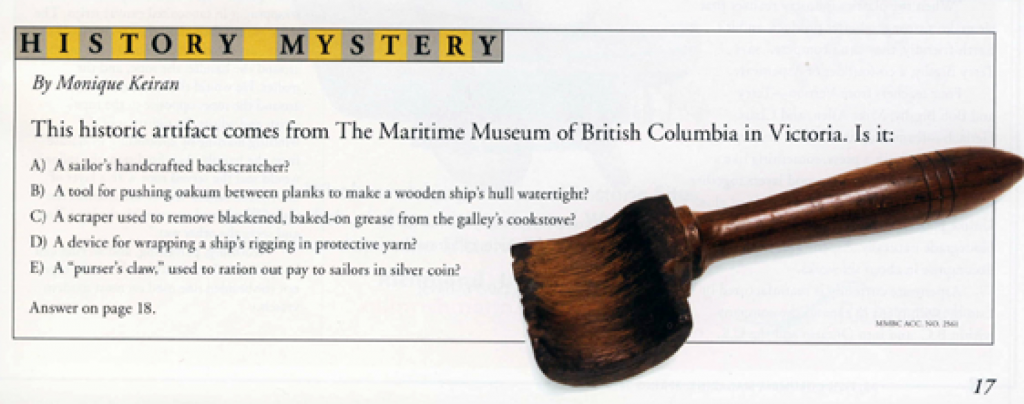
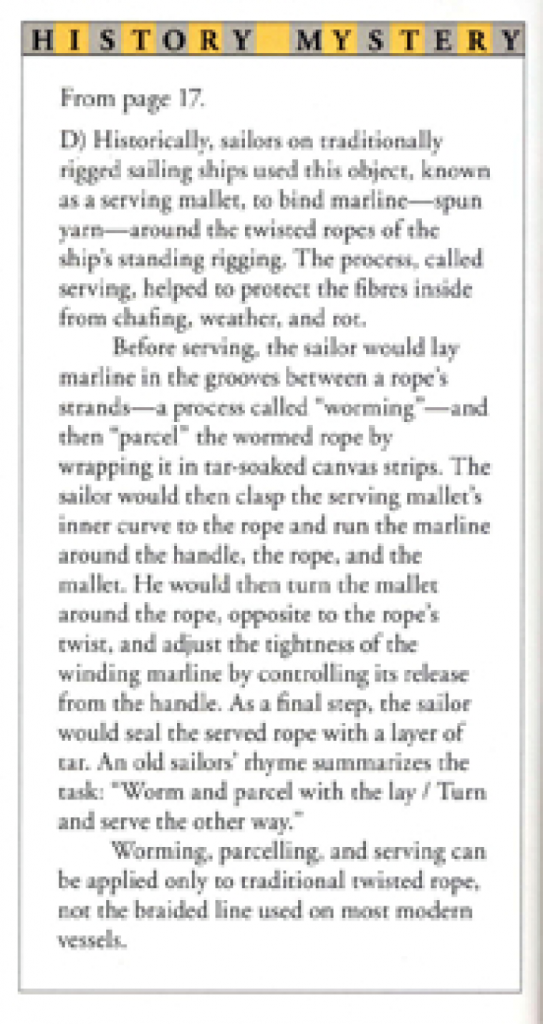
From 2004–2010, I edited the Maritime Museum of B.C.’s member newsletter, Waterlines, and annual journal, Resolution. B.C. Magazine approached me at that time to submit a piece about any strange and unlikely artifact from the museum’s collection for the magazine’s History Mystery quiz column.
Information Forestry, August 2008—Orbiting the Earth more than 700 kilometres above Canada’s forests, a set of satellite-borne sensors collects data from the light reflecting off the planet’s surface.
Beneath the canopy of an eastern Ontario woodland, a Blackburnian Warbler prepares to fly south for the winter.
Linking these two phenomena is Biodiversity Monitoring from Space, or BioSpace, a Natural Resources Canada-led project that uses satellite-derived data to track key indicators of biological diversity over time.
BioSpace is the first system of its kind in Canada to use Earth observation data to monitor biodiversity over large areas in a systematic and repeatable manner. Its developers hope it will come to serve as an early warning system to alert governments and resource managers to critical habitat losses and areas with potential species at risk in even the most remote, inaccessible regions of the country.
“Most of the current work used to characterize biodiversity in Canada is very detailed and locally specific, and usually involves someone going out into the field and inventorying specific species,” says project leader Mike Wulder, a research scientist with Natural Resources Canada. “With BioSpace, we’re exploring the big picture: can we use Earth observation data from space to characterize national trends in biodiversity and identify locations where changes in certain conditions may indicate changes in biodiversity?”
BioSpace monitors four key indicators of biodiversity on the landscape, at one-kilometre spatial resolution. Topography drives climate. Land cover indicates types of cover (both vegetated and non-vegetated) and their spatial arrangement. The dynamic habitat index incorporates measures of annual vegetation productivity or greenness, amount of snow cover in winter, and seasonal variation in landscape greenness (an indication of when food is available). The fourth indicator is disturbance of land cover over time.
The BioSpace team recently compared indicator-based predictions of biodiversity to field data collected for birds, such as the Blackburnian Warbler, by the Ontario Breeding Bird Survey and on butterflies in the northeastern U.S.
“Land cover and seasonality are the two remotely sensed indicators that explain most variations in species richness for these two groups,” says Nicholas Coops, University of British Columbia Associate Professor of Forest Resources Management, Canada Research Chair in Remote Sensing, and a member of the BioSpace team. “Birds and butterflies like edge environments: they might live in one habitat, breed in another, and feed in a third. If you’re interested in using BioSpace to monitor the status of bird populations, you would focus on these two indices.”
“It’s very expensive to go out and monitor every single species at risk,” says Natural Resources Canada Biodiversity Science Advisor Brenda McAfee. “We don’t have the resources to do that even in the regions that have roads and easy access, let alone in remote regions of the country that have no roads or transportation infrastructure.” BioSpace, she says, would permit her group to report on biodiversity on an ecosystem or landscape level anywhere in Canada. Agreements requiring reports on biodiversity include the Convention on Biological Diversity, the Montreal Protocol’s Criteria and Indicators of Sustainable Forest Management, the Canadian Biodiversity Strategy, and the National Forest Inventory.
In addition, information generated from BioSpace allows researchers and natural resource managers to prioritize field sampling. “BioSpace is not a substitute for field sampling,” says Wulder. “You have to have boots on the ground in order to actually inventory the species and conditions.” BioSpace may facilitate allocation of scarce resources for detailed field studies and species-at-risk conservation.
BioSpace is supported by the Government Related Initiatives Program (GRIP) of the Canadian Space Agency.
“The development of a Canadian dynamic habitat index using multi-temporal satellite estimates of canopy light absorbance” and “Development of a large area biodiversity monitoring system drive by remote sensing” can be ordered from the Canadian Forest Service online bookstore.
Captions:
From the Cover: ist2_3765025-blackburnian-warbler-with-insect: Fragmented forests and woodlands make for important bird and butterfly habitat, according to a recent comparison of indicator-based predictions of biodiversity to field data. credit: © Paul Tessier, istock 2007
© Natural Resources Canada
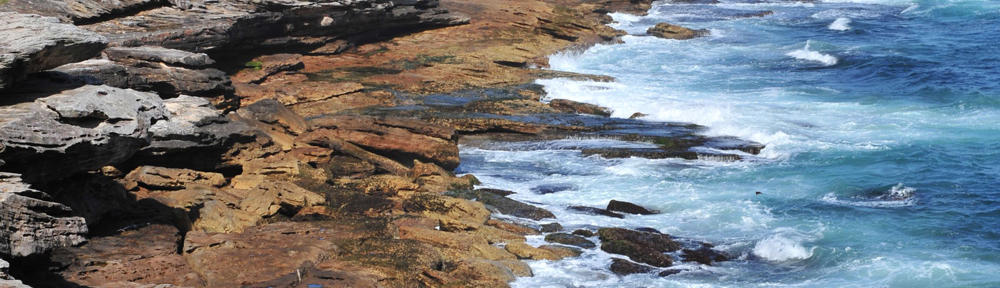
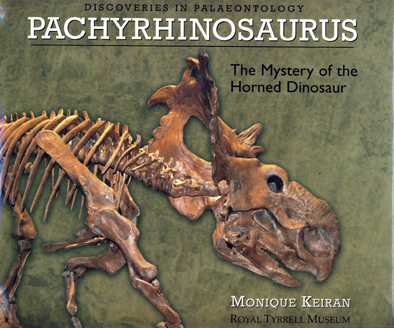
Sample pages from Ornithomimus: Pursuing the Bird-Mimic Dinosaur, by Monique Keiran. Published by the Royal Tyrrell Museum of Palaeontology and Raincoast Books, 2002.
Trackways #19, Winter 1999–A nearly complete Cretaceous-aged turtle has found its way to the Royal Tyrrell Museum. Not only are its skull, skeleton and shell intact, but its body cavity contains additional treasure: turtle eggs.
“The preservation of this specimen is remarkable,” says Museum palaeontologist Don Brinkman, who studies Cretaceous turtles. “Of all the turtle specimens found all over the world, there is only one other I’ve heard of that may also contain eggs.”
Found by Museum technician Wendy Sloboda in the remains of an ancient mud-filled channel, the turtle’s bones escaped reworking and scattering by scavengers and water currents. The specimen is Adocus, an extinct relative of today’s soft-shelled turtles. Seventy million years ago, it swam in freshwater streams and ponds, ate fish, frogs and salamanders, and likely came ashore to lay its eggs on warm, sandy beaches. However, this individual died before laying its eggs: its body is filled with dozens of eggs compressed by burial.
“We have more research to do before we learn all this specimen can tell us,” Brinkman says. “At the very least, we now know for sure that Adocus laid eggs and what Adocus eggshell looks like. This will help us identify in the future when we find shell fragments in the field.”
© Royal Tyrrell Museum of Palaeontology 1999
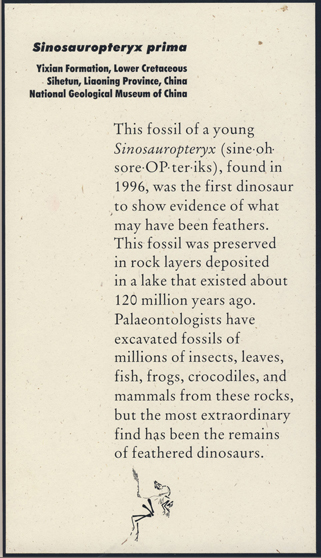
Compare these two interpretive display signs.

Monique Keiran wrote text for this sign for a Royal Tyrrell Museum display supplementing the licensed exhibit.
The license for the Yale Peabody Museum’s China’s Feathered Dinosaurs exhibit allowed host museums to add to the displays, but forbade them from changing any material provided by the Yale Peabody.
The Royal Tyrrell Museum faced a challenge: How to seamlessly fit its own specimens and interpretive panels and signs into the existing exhibit.
Explore Kananaskis, Summer/Fall 1997—Tiny pink elephants. Flesh-eating plants. Thieving flowers. They sound like characters in a fantastical Arabian Nights story, but in Kananaskis Country, these characters act out these roles under our noses every summer. The wildflowers of Kananaskis have no 1,001 nights in which to bloom and fade: if they’re lucky, they’ll get a mere 60 to 90 frost-free days in which to tell their stories.
Only the hardy and the strong survive this rugged environment. The plants and flowers found in Kananaskis Country have spent many generations adapting to harsh temperatures and poor soil conditions. No shrinking violets, here, if you please.
Cool nights mean flowers last longer and shine brighter. A chemical reaction within the colour molecules of a flower occurs during warm nights, when the plant isn’t photosynthesizing. The reaction breaks down the pigments, causing the flowers to fade.
An abbreviated growing season also means a riot of wildflowers blooming in a very short period. For flowering plants, a short summer is a frantic flurry. A plant must accomplish a year’s worth of activity in just two or three months. Not only must it flower, produce nectar and pollen to attract pollinators, be pollinated, and produce seeds, it must grow enough green stuff to make sufficient food to supply the energy for all of that flowering, pollination, and seed production—and store enough food to survive the winter and early days of the following spring.
As hard as life may be for a plant in Kananaskis Country, they aren’t passive victims. Each species possesses its own mechanisms for survival, honed and passed down through generations. Click on the gallery images for a glimpse at the lives of some of Kananaskis Country’s summer beauties.
Herds of elephanthead thrive in boggy alpine meadows.
Elephanthead is another Kananaskis wetland plant, but one that has better table manners than its butterwort neighbours. Its burgundy, fern-like leave are distinctive from a distance, but to see the elephants, you have to get close. Each flower on the long spiky stem resembles a tiny elephant head, with high forehead, big ears, upraised trunk, and tusks.
Photo by Jim Kravitz – http://www.flickr.com/photos/jimmypk/6036996432/
The western wood lily spreads its matching petals and sepals to catch the summer sun.
If you’re wandering open woodland in mid-August, the elegant western wood lily may catch your eye. The flower ranges from orange to orange-red, and consists of three petals and three sepals. Like most lilies, the wood lily grows from a bulbous root. It has little green material to convert sunlight into food: only a few whorls of narrow leaves surround the stately upright stalk.
Almost all the food energy stored in the bulb goes into making this big, bold flower. The flower will attract insects for pollination and produce seeds. Little energy remains.
The wood lily often falls prey to flower-snatchers. Such a large amount of the plants’ food-producing matter occurs in the stem. When flower-pickers take most of that, the plant usually dies.
To see wood lilies in Kananaskis Country, walk the Fullerton Loop Trail in the Elbow Valley, or go to Bow Valley Provincial Park.
Photo by Kate Ter Haar – http://www.flickr.com/photos/katerha/4721292001/
The yellow lady’s slipper orchid teases pollinators, but provides no nectar or edible pollen in return.
The tricksters of the flower world include the orchids—especially, the Lady’s Slipper orchids. They look beautiful. They smell lovely. They seem to keep a stash of nectar and pollen to make a closer look worth a pollinating insect’s while. They also provide a handy landing pad just below the nectar-and-pollen lunch counter.
But when Mr. Mosquito stops by Lady’s Slipper to dine and wanders up to place his order—whoops, down into her pouch he goes, pollinating the flower on his way down. As he struggles out of the pouch, his hairy antennae pick up her waxy pollen.
Mr. Mosquito isn’t too bright, because he keeps falling for this trick, over and over and…. But then, if he were smarter, he wouldn’t be pollinating orchids and making the world more beautiful.
Three varieties of lady’s slipper orchid grow in Kananaskis Country. Yellow Lady’s Slippers can be found along Many Springs Trail in Bow Valley Park. Venus Lady’s Slippers and Sparrow’s-Egg Lady’s Slippers can be found there and in Bragg Creek Provincial Park.
Orchids are under siege in Kananaskis. Everyone want to take them home. Please don’t. They won’t survive if you transplant them, and a whole generation of orchids ends if you pick them.
Photo by Dendroica cerulean – http://www.flickr.com/photos/dendroica/5698506662/
Happy to socialize, but self sufficient if need be, early blue violets have their own reproductive safeguards.
Early blue violets bloom first first in spring. You can find them in clusters in dry, sandy soil at lower elevations.
Like many violets, the early blue produces two types of flowers. Spring blossoms bloom large and showy to attract pollinating insects. However, if pollination doesn’t occur, the plant flowers a second time, during summer. Summer flowers never open, have no petals, and grow close to the ground. These flowers self pollinate. They form the plant’s insurance plan for reproduction. Taking no chances on bug romances, Violet’s no fool.
Photo by Miguel Vieira – http://www.flickr.com/photos/miguelvieira/4836616228/
Wad up yarrow leaves and shove them up your nose to stop nosebleeds.
Common yarrow’s Latin name, Achillea millefolium, was given in honour of Achilles, the Greek hero. Achilles made an ointment from yarrow to heal the wounds of his soldiers during the siege of Troy 3,000 years ago.
The plant’s healing properties are mythic. It may be diaphoretic, diuretic, stimulant, astringent, and tonic. It (apparently) reduces hair loss, helps with toothaches, cures spider bits, increases milk supply, reduces fever, and, if you roll the leaves up and stick the wad up your nose, stops nosebleeds.
The second part of its Latin name, millefolium, describes the plant’s leaves. These are long, lacy and much-divided. The plant looks like it has “1000 leaves.”
The flowers cluster on top of long stems. They dry well and their golden heads can be seen standing through the snow throughout the winter.
To see yarrow in profusion, stroll Campers Link ski trail next to Sandy McNabb campground in August.
Photo by orchid galore – http://www.flickr.com/photos/25609635@N03/2670694691/
Bug-blood-thirsty butterwort looks demure and innocent in its boggy habitat.
The single, funnel-shaped purple flower at the top of a long stalk seems harmless, but the Common Butterwort has a taste for blood—for bug blood.
The flower lures tiny insects to horrible deaths. The weapon sits near the ground: the leathery, yellow-green leaves around the base of the stem attract, trap, and digest insects. All that remains are black specks. These hard bits of exoskeleton provide evidence of bug murder.
Butterworts evolved this food-gathering strategy because they live in homes that lack the usual plant food. The bogs and wet, rocky banks where butterworts grow tend to be nutrient poor. What’s a plant to do?
Look for butterworts along Beaver Flats or Many Springs interpretive trails.
Photo by Sara Bjork – http://www.flickr.com/photos/aegishjalmur/778667568/