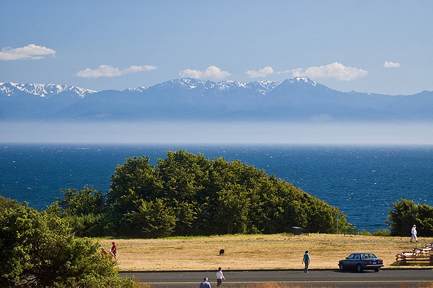
View of Olympic Range and Juan de Fuca Strait along Victoria's Dallas Road walkway. Photo © Stewart Butterfield via flickr and Creative Commons

View of Olympic Range and Juan de Fuca Strait along Victoria’s Dallas Road walkway. Photo © Stewart Butterfield via flickr and Creative Commons

The Coast Collective Arts Centre opened its summer show last week. Destination Victoria: Small Local Treasures features small works by Island artists and craftspeople. Each work celebrates the region, its land- and seascapes, and uniquely local experiences.

The show perfectly reflects the centre. Coast Collective resides in historic Pendray House on the shores of Esquimalt Lagoon, and combines a taste of the region’s history with a quietly spectacular setting. It is, itself, a local treasure. More »

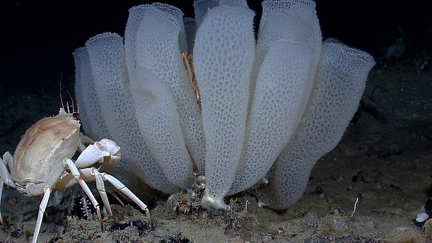
Glass sponge. Photo © NOAA

More than 500 species of glass sponge exist. Only some of them have the fused-glass skeletons that lead to the creation of reefs such as those found off B.C.’s coast. Photo: NOAA Okeanos Explorer Program, Gulf of Mexico 2012 Expedition

In recent decades, species of sponges thought to have gone extinct 100 million years ago have been found in B.C.’s coastal waters. They not only make these waters home, but they make homes for themselves and many other creatures.

Now the federal government is moving to safeguard these rare organisms and the unique underwater ecosystems they have created. In early June, Fisheries and Oceans Canada closed B.C’s glass-sponge reefs to all fishing.

In addition, proposed, new marine protected areas will prohibit all seafloor-disturbing activities on and immediately around three glass-sponge reefs in Hecate Strait and Queen Charlotte Sound.  The protection focuses on the reefs and small buffer zones, with various activities allowed beyond and in the water column above….

Read the rest of this editorial at the Victoria Times Colonist….

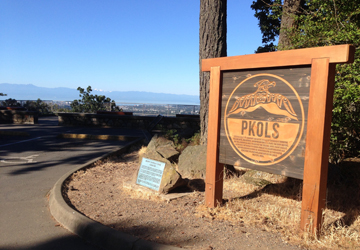
PKols sign-Mt Doug, Victoria, BC

Atop Mount Douglas—PKOLS—Victoria, BC.

When University of Victoria anthropology and computer science students joined forces in 2011 with the Hul’qumi’num Treaty Group out of Ladysmith and local Elders to develop a video game, they were furthering the concept that names confer power and presence.

In the game, players embark on a virtual journey through Coast Salish landscapes, and explore uses of the land, historic place names, and traditional knowledge through video, audio, maps and photographs. Based on an earlier board game developed by the treaty group, the game serves as a step towards reclaiming culture, history, and presence in the region.

It followed two significant events in which First Nations cultural geography on the coast was reclaimed. In 2009, B.C.’s Queen Charlotte Islands were officially renamed Haida Gwaii as part of a historic reconciliation agreement between the province and the Haida Nation, and in 2010, the coastal waters off the province’s south coast became known officially as the Salish Sea.

Last year, the progression towards reclamation took another step. Local First Nations publicly proclaimed PKOLS as the original name of Mount Douglas, a site of cultural significance. They held a ceremony on the mountain, and commemorated the mountain’s deep roots in their history with a carved cedar sign near the summit. They have submitted a formal request to B.C.’s Geographic Names Office to have the old name reinstated.

They also announced plans to reclaim Mount Newton within their historical and cultural geography of place names. The mountain, or ȽÁU,WELNEW (place of refuge) is sacred as the site where the Saanich people escaped a great flood about 10,000 years ago.

Names are much more than mere labels. They signify culture and history. They indicate relationships and responsibilities between people and provide glimpses into long-held knowledge. They denote connections between people and places.

Benign or otherwise, renaming causes what existed before to be filtered through a new lens. It can obscure prior relationships, and even erase them….

Read the rest of this editorial at the Victoria Times Colonist….
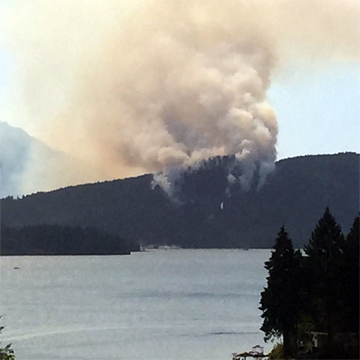
Dog Mountain Fire, Vancouver Island, July 2015. Photo © BCFLNR2015

Dog Mountain Fire, Vancouver Island, July 2015. Photo © BCFLNR2015

For a week, Nature Boy gasped and panted under dense skies. He flopped from sweaty seat to shade-enshrouded room in search of hints of coolness. He marveled at a sun that glowed orange throughout the day and lit everything with a buttery, evening light at midday.

The hot weather over the west coast sent many Victorians rushing to stake out blanket-sized patches of beach early in the morning. Others scurried into the welcome relief of air-conditioned offices. As for Nature Boy, he took to spending his afternoons in cool, dark cinemas.

The system that brought the weather also held Vancouver Island and the Lower Mainland in a form of hot smoker. It suffused the coast in the fumes of the region’s wildfires.

In Vancouver, the outlook was labelled “Martian skies.”

The recent Big Smoke gave us a taste and whiff of our own coastal rainforests going up in flames, here, in a place normally known for clean air and fresh ocean breezes. With our itchy eyes and scratchy throats, we felt the chemical and particulate ghosts of thousands of trees being partially cremated at Dog Mountain, Sechelt Inlet, Port Hardy, and in other wildfires in the region….

Read the rest of this editorial at the Victoria Times Colonist….
Pianist. Photo © Alan Cleaver, via flickr and Creative Commons; strangebritain@gmail.com

Hermann Neiweler loved jazz.

His jazz club, a cozy venue that has operated on View Street for 29 years, was a labour of love for him. It allowed him to host—and see—the likes of Wynton Marsalis, Dewey Redman, Loudon Wainwright III, Judy Collins and David Francey, and provided local musicians with a place to perform. It fed his desire to hear live jazz and to share the jazz experience with others.

Nieweler died last month, just as the Victoria International Jazz Festival was about to kick-off. He was 79.

Playing saxophone. Photo © woodleywonderworks, via flickr and Creative CommonsHis commitment to his club speaks of music’s power to enrich people’s lives.

We groove and move to music. We listen. We appreciate. And some of us make and play music. It seems simple enough on the outside, but inside the blackbox we call the brain, much more goes on when the music starts playing.

Brain scans show that listening to music engages a sweep of different areas within the noggin. And if just listening to tunes does that, playing those same tunes on an instrument is like sending your brain to bootcamp. Playing music exercises the parts of the brain that perceive and analyse sound, sight and touch. It drills the parts of the brain that control movement, behaviour, decision-making and expression, as well as memory, emotion and reward. It also stimulates neuron development between the brain’s regions, strengthening neural pathways and making those connections more efficient….

Read the rest of this editorial at the Victoria Times Colonist….
Sun. Photo © Chad Sparkes via flickr and creative commons, chadsparkesphotography.blogspot.com

The sunscreen supplies we purchase every summer usually last until the following August. But with all the winter sunshine Victoria enjoyed and a couple of trips to the sunny prairies, Nature Boy recently found himself squeezing the last molecules of sunblock from a flattened tube.

The timing means that we can act on the latest consumer-protection recommendations about sunscreen. We can arm our exposed surface areas not just with high sun protection factor but with pointy-headed research.

Oh, goody.

The point of using sunscreen is to avoid sunburns and other sun-caused skin damage, and lessen our chances of developing skin cancer. Science has repeatedly demonstrated the connection between sunlight, in the form of ultraviolet A and B radiation, and skin cancer.

Ultraviolet A rays penetrate deep into the skin and cause premature skin aging and wrinkles.Ultraviolet B radiation makes skin tan and burn, and is more dangerous than UVA. However, both contribute to skin cancers. Basal cell carcinomas occur when genes in cells in deep-skin layers go haywire, squamous cell carcinomas develop in cells near the surface of the skin, and that old bogey, melanoma,  occurs when genes within pigment cells in the skin or eyes become dysfunctional.

Cancer happens when wonky genes start whispering tales of conquest and power to their cell. They prompt the damaged cell to divide and divide and divide again, and its identical child cells to divide and divide and divide again, without end. It’s part of the genes’ attempt to shake off the bonds of communal, cellular citizenship and try for World Domination. Bwaa-ha-ha-ha.

Both UVA and UVB rays can kick start the cellular megalomania.

Sunscreen helps to filter some of those rays, protecting our delicate dermises. Naturally, if we’re putting our trust in sunscreen, we want it to work. We rely on the advertised sun protection factor level to decide which product to invest in, and go from there.

If only reality were so easy….

Read the rest of this editorial at the Victoria Times Colonist….
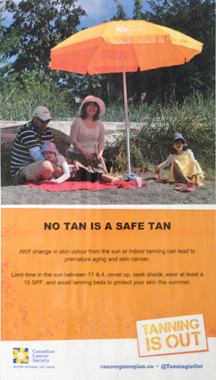
cancer society poster at Mount Douglas Park, Victoria, BC

Travel. Photo © MyBiggestFan via flickr and creative commons

Now that the school year has run its course, the exodus has begun. Those who seek to take advantage of the coming interrupted workweek have made their reservations, packed their bags, and made their escapes. Others are taking their time, planning the requisite excursions to visit family, see new sights, and experience new adventures later during the season.

It’s also around this time that the latest data and surveys on travel intentions and travel habits become known. Every June, BMO Financial Group releases its latest survey results about Canadians’ summer travel plans. This year, survey says, B.C. residents intend to take a mental vacation from worrying about money. We, apparently, each plan to spend more than $6,000 on vacations, summer outings and entertaining at home. We rank second in Canada in profligacy, although the report also says that more than 40% of Canadians have not yet set budgets for summertime expenses.

Statistics Canada indicates we like to travel abroad. Fewer B.C. residents traveled to the U.S. for spring break this year compared to last, while more of us travelled to other international destinations.

Another trend appeared earlier this year in the spring break BMO travel survey. Apparently, we British Columbians are a cautious lot. We rank third in Canada for worry about needing medical attention while abroad—even though our provincial worry quotient nips at the heels of the national average (41 per cent). We are also among the most likely of all Canadians to purchase travel health insurance for our excursions abroad….

Read the rest of this editorial at the Victoria Times Colonist….

Although many of the articles I researched and wrote for the Canadian Forest Service’s Pacific Forestry Centre are posted on this blog, the entire collection is published in the centre’s science and technology bulletin, Information Forestry.