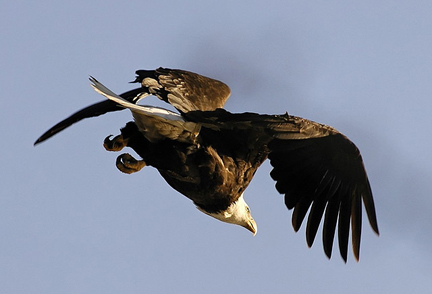
Bald eagle. Photo by Brendan Lally, www.brendanlallyphotography.com

Bald eagle. Photo by Brendan Lally, www.brendanlallyphotography.com

Bald eagles could be the bird world’s version of heavyweight-boxer Mike Tyson. The eagle is a big bruiser of a bird. It bullies other birds, steals meals, and scavenges whenever it can. Yet, during mating season, incongruously thin, soprano sweet nuthin’s emerge from predator’s curving yellow beak.

In addition to eagles’ springtime singing along the Gorge waterway, I’ve noticed local ravens pairing up and chortling amongst themselves. Robins now out-chirp each other thoughout the day, varied thrushes rend dawn with their off-key whistles, and towhees mimic hinges in need of oil. The chestnut-backed chickadee has changed its tune from “chickadee-dee” to “Hey, baby!” And the winter wren’s love-lorn performances make me wonder how these tiny avian opera singers can sustain so many trills and arpeggios with just one breath.

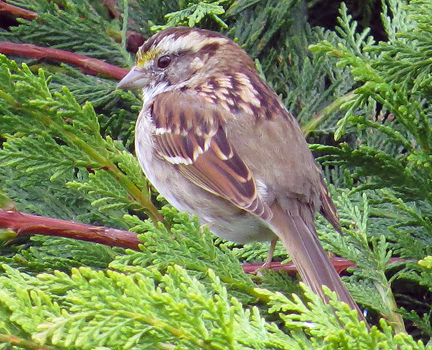
White-throated sparrow. Photo by leppyone

White-throated sparrow

It’s easy enough to guess what they’re singing about right now. Something along the lines of “Let’s make beautiful music together” to the ladies, and “Get off my beat or I’ll beat you up” to other guys. These themes play out in human songs as well, as Pacific Opera’s performance of Tosca demonstrates this month. They also cause many of the same emotional responses in both animals.

Apparently, breeding female white-throated sparrows—a songbird of Canadian forests—respond to the songs of male sparrows in the same way that humans respond to pleasant music. The reward centres in the sparrow brains light up just like ours do, say the researchers who scanned the birdbrains.

Read the rest of this editorial in the Victoria Times Colonist

Sources include:

How human language could have evolved from birdsong

Birdsong syntax

Some birds seem to have grammatical rules in their songs

Birds teach secret passwords to unhatched chicks

Birdsong: music to their ears (and hearts)

Thwarted child abduction, Toronto, March 2013

Waves breaking on the Ogden Point breakwater, Victoria, BC. Photo by Stewart Butterfield.

Someday, our hilltop house may be waterfront property. It won’t happen soon—certainly not this century, and maybe not even this millennium. However, if global warming continues, the surf may indeed break at the bottom of our driveway.

Nature Boy can’t wait.

When I point out the timelines don’t work with his schedule, he says, “Did you ever in a million years think we would live in a house that’s worth what our house is worth now?”

If he’s that excited about sea level rising in the next 200 to 1,000 years, it’s just as well he wasn’t around 11,000 to 13,000 years ago. Bison fossils on the San Juan islands and Vancouver Island suggest lower sea levels at the time created a landbridge from Victoria to the mainland. The link would have allowed plants, bison and other animals to spread here from the mainland at the end of the last ice age.

But the ice age is over, and climate is changing again. Last year marked the 36th year in a row in which global temperatures outpaced the 20th-century average. It was also the 10th warmest year since 1880, when people first started recording temperature.


Continue reading this editorial in Victoria’s Times Colonist newspaper….


Other sources include:

Sea-level rise in 21st Century

Sea-level rise and Vancouver flood protection upgrades

Canadian Arctic glaciers

Joint Victoria–Saanich–CRD meeting, November 21, 2012

Saanich Climate Change Adaptation Plan

Victoria Climate Change risk assessment

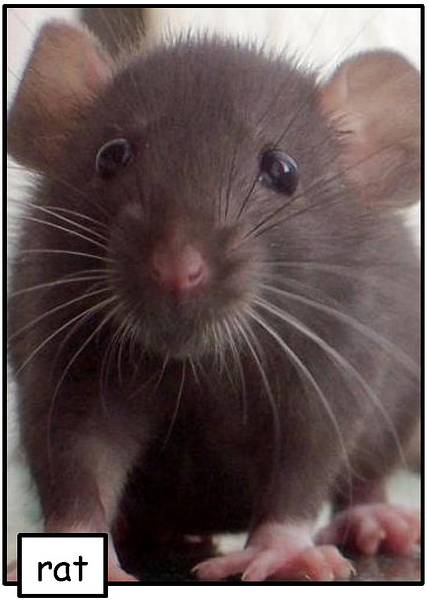
Rat. Photo by Charles J. Danoff


Seats of government seem to have problems with rats.

A case in point: during the first half of Canada’s existence as a nation, so many rats lived on Parliament Hill, they fed a large colony of feral cats.

However, in the 1950s, decision makers on the Hill started using pesticides to control rodents. The cats were out of a job, and for the next six decades, the felines were on the dole, like some resource-industry workers through the same years. Human volunteers took over care and feeding of the Parliamentary strays. This January, the Parliament Hill cat sanctuary closed forever.

Admittedly, cats could only control, not eradicate, Parliamentary rodents. Leaving out grain laced with poison kills rats more efficiently.

Continue reading….


Sources for this article include:

Parliament Hill cat sanctuary closes – CBC News

Rat-free Anacapa Island – LA Times

Green lawns not worth the health risks: Doctors – Times Colonist 

CAPE presentation to BC pesticides committee

More doctor reaction to pesticide decision – The Tyee

Killing rats is killing birds – Nature.com


We live in a plastic world: terror at chemicals in humans' blood stream and breast milk. Photo by Kevin Dooley

We live in a plastic world: dismay at chemicals in human blood stream and breast milk.
Photo by Kevin Dooley

Granny always sent us outside to play. She was right—being outside was good for us—but she was right for reasons she couldn’t have foreseen 40 years ago.

Numerous recent studies indicate our homes and offices have filled in recent decades with chemicals meant to benefit us, which instead might be harming us. These substances are called endocrine-disrupting chemicals, because of the way they interfere with our hormonal processes.

A recent report by the World Health Organization and the U.N. Environment Programme summarizes the latest in the ongoing science on these substances. Researchers in B.C. and Canada continue to contribute to our understanding of the complex issue, including how we are exposed to these compounds.

Continue reading…


Sources include:

World Health Organization’s report on the State of the science of endocrine-disrupting chemicals, 2012.

Flame retardants in human breast milk

Indoor sources of PFCs in 152 Vancouver homes

Tracking daily exposures to toxins in Europe

CHILD study


Homework, photo by Kate Hiscock, www.katehiscock.com

I’d like a robot.

I’d like a robot to do all my gardening. The robot of my dreams would clean out gutters and drains, paint the siding, sweep the patio, and tidy the garage. On a good day, said robot would also do all the housework. It would also be a treat if it could provide deep-tissue massages and yoga instruction, cook tasty and healthful meals, do the dishes and the shopping, and keep me organized.

Yes, I’d like a robot that is a gardener–housekeeper–chef–personal assistant. That way, I could concentrate on more satisfying, more creative activities.

It appears that the way I view technology is pretty typical for an adult. We adults usually think of technology as a tool to help us with tasks—in particular, with chores. We consider it separate from humanness.

Kids, apparently, see technology very differently. A survey of students aged 8 to 12 reveals young people expect future technology to fulfill functions much more essential to the human experience. Kids, it seems, tend to think of it as fundamentally human.

U.S.-based social/technology-research consultants Latitude Research conducted the study in collaboration with the LEGO Learning Institute and Australia’s Project Synthesis. They asked 348 youngsters from six Western countries to write stories about what their lives would be like if robots were a fixture in their learning environments—at school and beyond.

When the researchers applied a coding scheme to the stories, they found the under-13 respondents saw robots as supportive, nonjudgmental friends. The youngsters indicated they wanted their robots to provide comfort and company, encourage them to learn and grow, motivate and empower them, and, in some cases, fulfill emotional needs more reliably than humans do.

Suddenly my robot requirements seem paltry and…limited.

Yes, I can put my name down for a robot that prepares pancake breakfasts, German sausage breakfasts, sushi, shish kebab, or complete turkey dinners, or I can hanker for a truck-sized model that whips up entire Chinese dinners. I can also settle for an engineering marvel that folds tea towels perfectly. I can even finally learn to program the auto-cook setting on my 12-year-old oven.

But what are pancakes, Chinese dinners and perfectly folded tea towels next to, well, friendship?

With Pink Shirt Day coming up next Wednesday and the tragedies of Amanda Todd and targets of bullying this past year, what an indictment about our society that kids see machines of the future providing the most basic aspects of what friends, parents and family represent.

I’m not talking about the homework part, although of course good friends and family provide support with that, too. I’m talking about encouragement, acceptance, tolerance, trust, respect, comfort, approval, reassurance….

This is the kind of support that might have made a big difference—a vital difference—to Todd and other casualties of social isolation and bullying.

The goal of the Robots@School study were to determine how technology facilitates learning, play and creativity, what relationships children hope to develop with and through robots, and how robots and other technologies might ignite and encourage children’s learning and creativity. The researchers state in their report, “Robots are a useful proxy for understanding kids’ social, creative and learning aspirations in ways that might be more illuminating than if we engaged them directly on such issues. Robots allow kids to project their weak­nesses, strengths and ambitions.”

In the report, kids see robots as better versions of teachers and parents, offering limitless time and patience, encouraging confidence and self-direction, and allowing kids to make mistakes without self-consciousness. The kids believed robots’ supportiveness would lessen kids’ fear of failure and empower them to take more creative risks without fear of being ostracized.

In other words, the kind of support that B.C.-raised slam poet Shane Koyczan could have used during his grade-school Pork Chop incident. Koyczan describes the incident that led to years of being bullied in his animated poem, To This Day, published this week.

As he says in the poem, “If a kid breaks in a school and no one chooses to hear, do they make a sound?”

I’ll forgo putting in the order for the robot and go make friends with some kids instead.


Sources include:

Latitude Research’s Robots @ School

Chinese cook robot

Kebab-cooking robot

German sausage-breakfast robot

Dinner-cooking robot

Towel-folding robot


Eastern grey squirrel, photo by TexasDarkHorse, flickr

When Nature Boy took down the backyard thicket of Himalayan blackberries, he gave little thought to what would come after.

Thousands of broom and Daphne laureola seeds that had lain dormant for decades sprouted. Ivy and periwinkle quickly spread into the gap.

These plants have no place in the ready-made Garry oak meadow Nature Boy envisioned. Quick to grow and become established, these species handily outcompete native sea blush, camas and ocean spray.

That’s what invasive species do. They reproduce easily and spread in new environments. They alter ecosystems within the new territories in unpredictable ways, often causing harm.

Continue reading….


Sources for this post include:

Saanich invasive species strategy process

Saanich Pulling Together program

Capital Region Invasive Species Partnership

B.C. Barred Owl cull

B.C. Spotted Owl info


1.73-m Plaskett Telescope mirror, photo by "Scratch" @ Scratchley.org

Two developments occurred recently to advance large telescopes and the study of the universe around us. Scientists in the U.S. completed the first of seven 8.4-metre mirrors for the Giant Magellan Telescope, under construction in Chile. Six of the mirrors will be arranged petal-like around the seventh, central mirror.

When construction is finished, the telescope will have four times the light-gathering capacity of instruments used today.

An event closer to the hearts of Victoria astronomers involves the Thirty-Metre Telescope. In November, state officials in Hawai’i recommended construction of the telescope on the state’s highest peak, Mauna Kea, be approved. The recommendation is a key step in the long, complicated process required to build atop Hawaii’s volcanoes.

The Thirty-Metre Telescope will feature a light-collecting mirror that is—surprise!—30 metres across. When it begins operation in 2020, it will be one of the world’s most powerful optical and infrared telescopes.

With telescopes, size matters.

Continue reading….


More info:

Thirty-Metre Telescope

Giant Magellan Telescope

Plaskett Telescope

John Stanley Plaskett

Hooker Telescope


Walking, by Elliot Margolies, www.emargolies.blogspot.com

Thousands of British Columbians will wake up tomorrow, put on their shoes, and walk.

They’re raising money through the Alzheimer’s Society of BC’s Walk for Memories. Funds raised support the society’s community programs.

The event’s signature activity and timing create an intriguing, synergistic combination.

Scheduled for the last Sunday in January, Walk for Memories comes on the heels of the week containing “the most depressing day of the year.” According to calculations first done in 2005 as a publicity stunt for a British travel agency, we’ve survived 2013’s nadir.

Continue reading….


Sources include:

Alzheimer’s Society of Canada’s report, Alzheimer’s Disease: What’s it all about? Where do we stand in search of a cure?

Alzheimer’s Society of BC

Minds in Motion