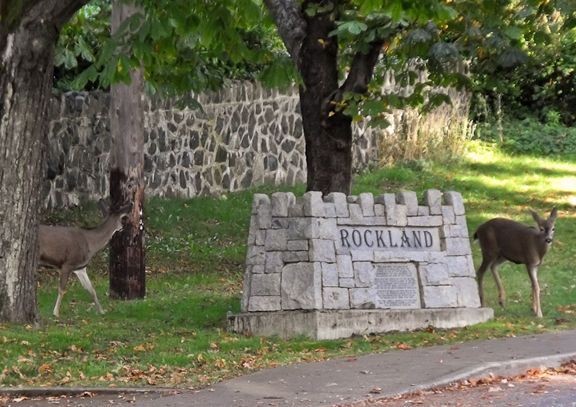
deer in rockland, by Mike Nelson Pedde, http://www.flickr.com/photos/wolfnowl/5445478667/


Victoria Times Colonist, December 1, 2012—Four schools were locked down in November due to cougar sightings, and on Wednesday, CRD’s planning, transportation and protective services committee began considering the new Regional Deer Management Strategy.

Predator. And prey.

No discussion of one can completely ignore the other.

We’ve heard a great deal about the apparent increase in local deer populations, about aggressive deer, increased damage by deer to crops and gardens, and deer-caused car accidents.

Deer have always lived here. They come to our gardens, farms and parks, lured by tasty pickings. They reproduce. They become habituated to humans.

And they are protected by our intolerance of large carnivores, like cougars, wolves and bears, and by our laws restricting hunting, harassment and transport of wildlife.

We create an island paradise for deer. Then we complain.

But, by encouraging abundant deer, we also invite their predators to move in. If we’re uncomfortable with the current numbers of deer, we’re even more nervous about their predators.

In the 12 years I’ve lived here, I’ve seen a cougar once, but I know they’re around. There are too many green spaces, too many new developments squeezing big-cat territory, and too many deer for the region to be cougar-free.

Cougars prefer to eat deer. When deer are unavailable, the cats will prey on rabbits, rodents, raccoons, dogs, house cats, geese… even insects. British Columbians are more likely to be killed by domestic dogs, stinging insects, deer or moose, or other humans than by cougars, but that doesn’t mean we want cougars anywhere near our children or our pets. Or us. Because very occasionally, cougars do attack humans.

Every time a cougar is reported in the area, focus turns on the cats. If conservation officers and their dogs confirm the sighting, the cat is tracked, usually captured and carted away, sometimes killed.

I suspect most cougars that find their way into urban Victoria are young males trying to establish themselves on edges of territories claimed by older, tougher males. They have to be young to be here, because we removed the older cats long ago.

The curious thing is, when we did that, we paved the way not just for the current increase in deer–human encounters, but also for increased cougar–human encounters. According to researchers at Washington State University, when you kill off older, experienced cougars—the cats that have learned to avoid humans—young, dumb cats move in. The youngsters are just looking to survive their first years away from Mom, and aren’t yet wise to the fact that mixing with humans is Trouble.

Every wildlife issue we’ve experienced in the region—the feral rabbits, the abundant and aggressive deer, the less common cougar and bear incursions, the garbage raccoons and the rats—is really a human-management issue. We did away with the predators. We introduced rabbits and rats. We encourage the raccoons and deer. We live in their territory. We don’t learn.

Wildlife biologists agree that coexistence between carnivores and humans depends primarily on managing human attitudes and behaviours. Among the recommendations included in the Regional Deer Management Strategy for decreasing deer–human conflicts are a number that touch on our own unhelpful behaviours.

These recommendations include enforcing municipal bylaws against feeding wildlife, encouraging use of deer-resistant plants in gardens and landscaping, fencing in food gardens and using repellants wherever possible, and generally discouraging deer from habituating to humans.

The strategy also recommends municipalities adjust bylaws to allow higher, deer-proof fences, examine and implement population-reduction measures appropriate to each area, provide support to farmers, in terms of fencing costs, hazing tactics, and crop protection, and adjust signage, speeds, and road-allowance maintenance on roadways to lower the number of vehicle collisions with deer.

It also suggests region-wide public education will be critical.

As capturing and relocating humans from the region aren’t options, addressing our ongoing contributions to wildlife problems is critical.

When we consider the strategy’s recommendations to the CRD over the coming months, we must consider also the broader wildlife implications. Whatever we do about prey species will affect their predators. And vice versa.

And not necessarily the way we intend.

–30–

A version of this article appeared in the Victoria Times Colonist.
Victoria Times Colonist, November 23, 2012—The words “isle” and “isolation” share linguistic roots. Both derive from the Latin word insula, which itself gives us the word “insulate”.

A curious thing can happen to large-ish mammal species that live on isolated, insulated isles. Over long periods of time, some species become smaller.

This phenomenon is called island, or insular, dwarfism. Scientists believe it results from the limited food resources typically available on islands and in other geographically cut-off areas.

In the short term, food deprivation leads to smaller birth weights and decreased growth in mammals. Over the long term, smaller bodies require less energy, or food.

Think of how much a football player or a basketball player or, better yet, a Sumo wrestler eats to maintain muscle mass and energy levels.

When food is persistently scarce, being petite confers a survival advantage.

And, so, over time, mammals on the large side when they live on mainlands may shrink in size when marooned for generations on desert isles.

(Gilligan, the Skipper, too, the millionaire and his wife, and the rest of S.S. Minnow gang weren’t stranded on their island long enough to show the effects….)

Living examples of island dwarfism include the Key Deer, found only on the Florida Keys. The Channel Island fox is the world’s smallest fox. It is native to California’s—you guessed it—Channel Islands.

Here on the B.C. coast, we have the Sitka deer on Haida Gwaii. Columbian black-tailed deer that live on the smaller Gulf Islands tend to be smaller than their mainland cousins. This, despite the abundant shrubberies and other garden delicacies we provide year-round.

Extinct species include dwarf ground sloths in the Caribbean, dwarf elephants in the Mediterranean and small elephant-like creatures in Southeast Asia. The Philippines once were home to small buffalo. Indonesia’s Bali boasted the smallest tiger of all until it went extinct in the last century.

And so, when B.C. Ferries raises rates and cuts service, and adds to the existing physical isolation of B.C.’s islands, the spectre of island dwarfism raises its tiny cranium in my own tiny cranium. As a science nerd, when I hear of the ferry corporation’s proposed cuts to meet budget constraints, I sigh and think of the Hobbit.

Not Bilbo Baggins. Nor the Peter Jackson movie due out mid-December. I’m talking about Homo floriensis, that wee relative of modern humans whose remains were discovered by archaeologists on the Indonesian island of Flores in 2003.

Partial skeletons of nine individuals were uncovered, dating from 95,000 to 13,000 years ago. The tallest would have stood 87 centimetres tall when alive. Hence the nickname, the “Hobbit.”

As ferry service is cut, as it and the options of flying or watertaxi-ing to and from the islands become ever more costly, what with increases in fares, fuel surcharges, airport and dock fees, parking costs, security levies, carbon taxes, cost of living, etc., etc., will our fate as Island residents be to grow ever smaller, as Hobbit Man (and Woman) did on Flores those millennia ago? Will our descendants follow the eventual path to petite-ness taken by the Sitka and local Columbian black-tailed deer? Will we, too, nibble our neighbours’ shrubberies when food imports from the mainland become too expensive? Will decreasing physical contact betwixt mainland and island eventually result in a new hominid species, our very own Homo vancouverislandensis?

Is this the destiny we choose when we choose to continue living here?

Okay, all smart-aleck questions, but the question of choice underlies them.

And it is a choice. Unlike deer, cougar or bear, we choose to live here, despite the cost of living, inconvenience, and limited employment in some fields.

More accessible and affordable alternatives exist… some, where employers are even hiring. Alberta, Saskatchewan, New Brunswick, and Nova Scotia, for instance. Where it snows more.

We choose this place.

We must also accept the consequences of that choice.

********************************************************

Note: Nature Boy, wildlife expert, assures me island dwarfism won’t happen in our lifetimes, regardless of the outcome of BC Ferries’ current public consultations or its coming service cuts and fare increases.

“I keep hearing about island dwarfism,” he says, “but I’ve lived here for more than a decade and, well, I just keep getting bigger.”

—30—

A version of this article appeared in the Victoria Times Colonist.

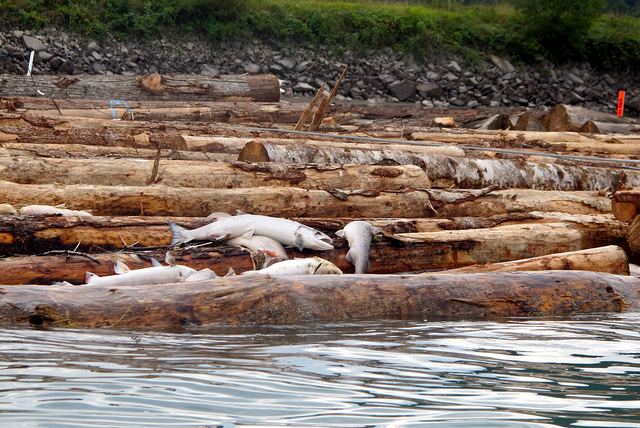
dead salmon, by Christopher Porter

Victoria Times Colonist, November 17, 2012—October’s turn in weather, bringing rain after months of sun and heat, has at last raised water levels  on the Cowichan River and cleared the way for the salmon.

How nice that something can enjoy the end to the glorious summer we had.

Just six weeks ago, the river nearly ran dry along some reaches. Salmon returning to the river found their passage upstream blocked by low water.

. Volunteers started rescuing the salmon. They trapped the fish, trucked them upstream, and released them at Sandy Pools and Skutz Falls.

But a month of rain has replenished river levels. I visited Skutz Falls a few weeks ago. There was still insufficient water to fill the fish ladders around the rapids, but Coho and Chinook were flinging themselves up the river’s natural white-water channels.

They are once again fulfilling their biological destinies by returning to their birthplace to reproduce.

And die.

The salmon’s instinctual call to destiny is a strange and wonderful thing. It places greater value on the interests of future generations than on any individual fish’s survival.

We could learn from that.

The problems on the Cowichan River stem from too much water being released via the Cowichan Lake weir earlier this year, leaving too little to buffer the river from severe drought six months later. But what happened here reflects river-flow problems across North America.

In Prince Edward Island, rivers were so low and warm this fall, fish became scarce. In the U.S., 160-kilometres of Nebraska’s Platte River dried up completely, and the mighty Mississippi fell by more than six metres.

Closer to home, below-average winter snowpack and months of dry, warm weather caused sections of rivers in the Peace Region to turn to mud and gravel. And on the Columbia River, annual flow has declined by more than 14 percent since 1950. One-third of the Columbia’s water originates in here in B.C.

What happens to the Columbia, the Kiskatinaw, the Moberly, the Beatton and the Cowichan can happen to the Fraser, the Skeena and, yes, the Goldstream and the Sooke.

After all, geologists report that Ontario’s Niagara and St. Clair rivers dried up completely 7000 years ago. A 25 to 40 percent decrease in annual precipitation and a 5o C rise in average temperatures caused water to evaporate faster from the Great Lakes than it was replaced. Lake levels dropped 20 metres, cutting off the rivers, shutting off Niagara Falls.

The study’s authors say similar temperatures and precipitation are within the range predicted for the region by 2100.

That is, what happened under climate change once can happen again.

Simon Fraser University researchers say we can expect a 20 percent drop in precipitation in B.C. by mid-century. Under climate change, spring and summer rains will decrease, and annual snow and ice accumulation in the province’s mountains and glaciers will decline. Glaciers store water in winter and release it slowly to rivers in summer. As glaciers disappear, late-summer river levels will fall drastically, right when demand for freshwater for agriculture, fisheries, industry and urban use increases.

Clearly, if these climate scenarios occur, B.C. rivers will experience increasingly difficult years.

British Columbians have always considered freshwater a renewable resource—one that falls from the sky like pennies from heaven. But when it ceases to splash down abundantly where and when it is needed, freshwater may become scarily scarce even here on the Wet Coast.

Kudos to the Capital Regional District for encouraging responsible water use. Despite a 14 percent increase in regional population, the CRD water board reports in its 2012 strategic plan that water use in the region has actually decreased by 11 percent since 2001. Seasonal watering restrictions, metering, rebates on water-efficient fixtures and appliances, and voluntary efficiency audits by businesses have brought about the gains, and will help extend our water supply.

However, more needs to be done by each of us.

It is time, while freshwater remains plentiful here, to learn from this year’s Cowichan River salmon, and reconsider how we each use and manage this resource now, so enough remains for future needs.

And for future generations of salmon.

–30–

A version of this column appeared in the Victoria Times Colonist.
miso soup, by Michael Ocampo: www.facebook.com/coolmikeolntwk

  Nov 10, 2012

There’s a ritual we go through every time we eat at a Japanese restaurant.

It starts when the miso soup is brought to the table. Nature Boy gives his a swirl with his chopsticks. Then he reverently bows his head over the bowl in silent contemplation.

This is no memorial ceremony for Japan’s recent natural and nuclear disasters. The ritual predates those events.

No misguided adaptation of the Japanese tea ceremony.

Nor is this grace.

No, this prayer-like pause is Nature Boy’s version of veneration for the geologic forces that shape our planet.

So it does, in a way, relate to the earthquake in Japan, and the ties between this coast and that coast. Ties that extend far beyond and deep beneath the more than two dozen Japanese restaurants that operate downtown and the hundreds of students who cross the Pacific every year to study English here. Ties that physically bind this island to those islands in the form of massive crustal plates underlying the ocean floor.

It also relates to the recent earthquake in Haida Gwaii.

For, as I have been informed—repeatedly—in every bowl of miso soup, the same thermodynamic forces that churn Earth’s interior and move continents across the surface of the planet convect clouds of soybean paste and shift shredded wakame and chopped scallions.

In every bowl of soup, a demonstration of plate tectonics.

Those same forces caused the Haida Gwaii trembler, and the recent earthquakes in Japan, Mexico, New Zealand, Chile, Alaska, off the coast of Indonesia, around the Pacific Ring of Fire and elsewhere.

The soup itself represents Earth’s mantle, the region of the planet’s liquid interior between solid crust and solid core. The micro-curd miso suspended in the liquid enables The Interested Observer (a.k.a. Nature Boy) to identify convection currents within the soup. Soup at the surface, exposed to restaurant air, cools more rapidly than soup deeper within the bowl. Cool fluid is denser than hot fluid, so it sinks—gravity having its inexorable way. Hot fluid is less dense, so as the cooler liquid sinks, the hot stuff rises to the surface, where it subsequently cools, densifies, and sinks. And so on.

The cycling fluid creates troughs and wells, and pushes the soup’s floaty bits around the surface. Nature Boy gets particularly excited when a piece of seaweed wedges beneath some chopped scallion. He is sure to point out—yet again—the similarities to the Juan de Fuca Plate being driven under the North America Plate in the Cascadia Subduction Zone beneath Vancouver Island.

And I point out the similarities to how my cornea subduct under my eyelids when I roll my eyes.

“That,” he says, “is not at all the same.”

Pause.

“Okay, it is sort of the same.”

But a soup bowl is no crystal ball. No way to foretell a trembler’s timing, location, scale, or scope of impact exists. The October 27 earthquake caught Haida Gwaii residents by surprise. Tsunami alerts followed. Fortunately, despite the earthquake’s 7.7 magnitude, minimal damage occurred and only small ocean waves materialized.

Better to issue a warning when you’re uncertain than to wish you had afterwards.

New technology may provide some predictive potential. The seafloor-sensor network operated by NEPTUNE Canada, the Victoria-based underwater ocean observatory, and the instruments the Woods Hole Oceanographic Institute installed this year above the Cascadia fault monitor seafloor deformations. The sensors will provide minute-by-minute information about what is happening beneath our feet and off our shores.

If the data are analyzed quickly, they just might enable some warning of The Big One when it comes. Measurements of the fault zone where Japan’s earthquake happened revealed slow, small slip occurring two days before that quake. Seafloor monitors also detected movement. Unfortunately, the data weren’t analyzed in time to provide notice. Nor could anyone have known slow, small slip foretold a 9.0-magnitude shakedown in that case, or the size of the subsequent tsunami.

Greater warning might have made tremendous difference. It might mean all the difference for us.

Perhaps—just perhaps—we’ll have enough warning to gulp our soup and dash for stable, high ground.


A version of this article appeared in the  Victoria Times Colonist.
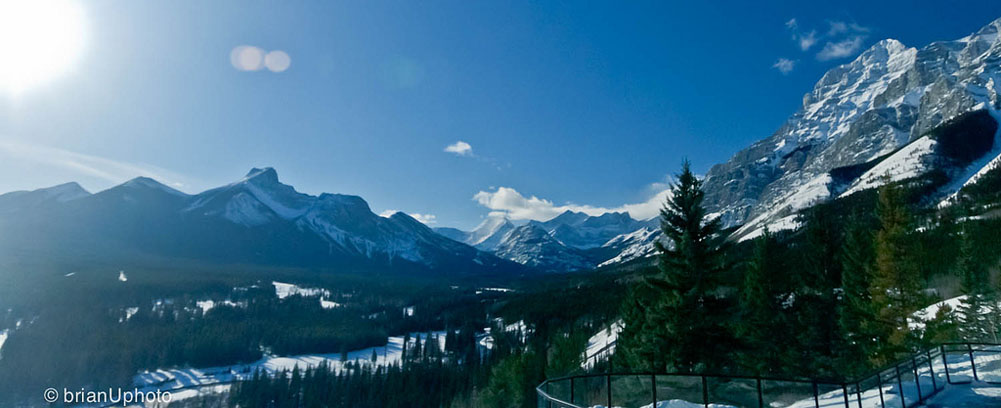
Kananaskis Country in winter. Photo by Brian Uhreen, http://www.flickr.com/photos/snype451/5644810651/

Although weather in Alberta’s mountains can be counted on to be unpredictable, when it’s sunny, it’s glorious. Photo by Brian Uhreen

Explore Kananaskis, Winter/Spring 1997Covering more than 5,000 square kilometres, Alberta’s Kananaskis Country encompasses everything from foothills in the east to the rock, alpine Continental Divide in the west, from the wide, windswept Bow River Valley in the north to narrow passes and valleys in the south.

With such variety in terrain, elevation and exposure, one of the few things you can count on regarding weather in the wilderness region is that is it unpredictable. The adage, “If you don’t like the weather, wait five minutes,” applies.

Winter – generally

Winter in Kananaskis starts in November and lasts until March. Unless it starts in September. Or ends in May. There are years when an early drop in seasonal temperatures lowers the snow line soon after Labour Day. There are as many years when winter blasts on and on until June, at which time summer arrives, bypassing spring altogether.

Duelling weather systems

Kananaskis Country generally has two continental weather systems in play during winter. Frigid, dry Arctic systems from north or east blow without resistance over the prairie until they smack into the Rocky Mountains. These ramparts of stone funnel and deflect the air-flow southward. The arrival of these systems usually means cold temperatures and ice crystals in the air. These systems can also dump snow in the foothills while bypassing points further west.

Contrast that with the Pacific weather that blows in from the west coast. These systems tend to be warmer than Arctic systems, and are laden with moisture that falls as rain in Vancouver and turns to snow as they are forced up the staircase of mountain ranges across British Columbia. By the time the systems arrive at Alberta’s western reaches, the majority of the moisture has already condensed into clouds and precipitated out on the western side of the Continental Divide.

The amount of snow lessens the further east a wintertime Pacific system extends. Thus, West Bragg Creek, on Kananaskis Country’s east side, receives less snow from these systems than does Peter Lougheed Provincial Park, abutting the Continental Divide to the west.

Elevation effects

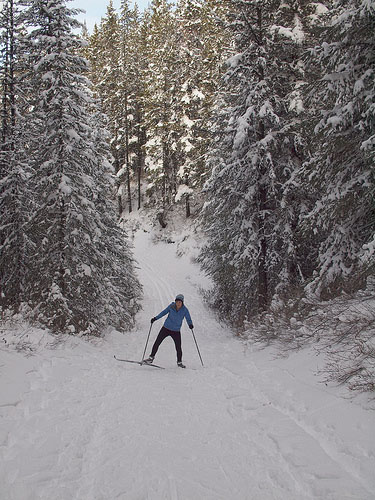
Cross-country skiing, in Kananaskis Country. Adam Kahtava photo - http://www.flickr.com/photos/kahtava/5213943879/

Kananaskis Country is home to some of the best cross-country skiing in Canada. Photo by Adam Kahtava.

Elevation influences the differences in snowfall and accumulation between east and west Kananaskis Country. The higher you go, the colder it gets, the more likely that what precipitation there is will fall as snow, not rain. Snow accumulates; rain does not.

However, to every rule, there is an exception. Although higher elevations usually do mean lower temperatures, diehard winter outdoor enthusiasts have been known to leave Calgary where it is –35° C and spend a sunny day on Peter Lougheed Provincial Park trails in balmy –10° C temperatures. This winter phenomenon is called temperature inversion, and occurs frequently in this part of the world. Arctic high-pressure systems spread a thin layer of cold, murky and sometimes polluted air over the prairies and foothills valleys. One of the warmer western systems—as much as 15° C warmer—sits above it, trapping the cold air below.

To find out when to take advantage of a temperature inversion, compare Environment Canada’s Calgary forecast to its Banff forecast. If it’s warmer in Banff, temperature inversion is occurring.


Chinooks: spring in February

Chinook Arch at Sunset. Photo by Tuchodi, http://www.flickr.com/photos/tuchodi/5381184500/

Chinook Arch at Sunset. Photo by Tuchodi

East–west differences in snow accumulation can also be affected by recurring Chinook winds. Chinooks are a distinctive part of the Pacific weather system: as many as 10 times each winter, they blow in from the west, gradually chilling and dumping snow as they climb the British Columbia mountain staircase. With one final dump on the Continental Divide, a now-near-dry Chinook wind flows down the mountains to the plains, skipping over the Rocky Mountain front ranges and foothills like a rock skipping over water. As the wind descends, its temperatures rise faster than they had cooled on the ascent. Somewhere over the eastern edge of the front ranges, the Chinook encounters a very cold, Arctic high-pressure system locking the prairies in its frigid grip. What moisture remains in the Pacific systems condenses, forming a distinct arch of cloud along the line of the mountains.

The Chinook Arch announces a dramatic reprieve from winter. Temperatures can rocket from –30° C to +10° C in a matter of hours. Snow vanishes. Gutters fill. Spirits rise. Calgarians go home in the shirtsleeves, lugging parkas in their arms. Elk and deer, and antelope on the prairies further east, can feed and move about easily again.

Points west in Kananaskis Country tend to be frequently skipped over by Chinooks. Although these winds do occur in Peter Lougheed Park and the Spray River Valley, they tend to be weaker and more ephemeral there. The Bow River Valley sees the most Chinooks of all of Kananaskis, often serving to funnel them east out of the mountains and onto the plains.


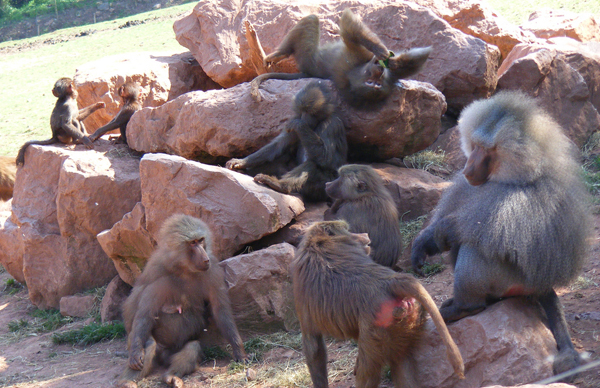
Baboons. Photo by Marie Hale.

Baboons are more like humans than we may like to think. They are as nasty to each other as we are. Photo by Marie Hale.

Victoria Times Colonist, November 2, 2012—Within less than 24 hours on October 9–10, 2012, two 15-year-old girls made newspaper headlines.

Amanda Todd and Malala Yousafzai lived worlds apart, separated by language, history, culture, and geography. Their stories, however, share tragic similarities.

Todd, as we know, committed suicide after being bullied online and at school. Yousafzai was shot in the head and neck by Taliban terrorists, which in my opinion, are nothing more than organized bullies with guns and grenades.

Todd and Yousafzai were targeted for abuse because—according to the narrow strictures of each group of bullies’ codes of conduct—these two young women had crossed moral lines—lines defined and marked and defended by the bullies themselves.

Todd and Yousafzai were targeted because they were women. Todd was fighting to move beyond a painful series of incidents that had started when she was sexually exploited by a cyber-stalker/blackmailer. Yousafzai spoke out for the rights of girls and women to attend school in a country where they had, very recently, been forbidden education.

I’m not saying bullies pick only on girls. Of course not. Bullies single out anyone whom they can get away with picking on. Some choose weaker and more vulnerable targets. Like Amanda, who lacked a supportive peer network that could help her and intervene on her behalf. Like Reena Virk, Dawn-Marie Wesley, Hamed Nastoh, Ashkan Sultani and all other teens—female or male—who have been bullied to death in B.C.

Bullies also prey on those who are strong or successful in some way because of the threat this poses to the bullies’ positions, worldviews or self esteem. Yousefzai, in advocating for women’s education and in blogging about her life under the Taliban for the BBC, fits this category.

We know bullying isn’t unique to humans. Stanford University neuroscientist and stress researcher Robert Sapolsky details his work studying baboons in Kenya’s Serengeti in many of his books. In A Primate’s Memoir, he writes, “Baboons live in big, complex social groups, and the population I went to study lived like kings…. The baboons work maybe four hours a day to feed themselves; hardly anyone is likely to eat them. Basically, baboons have about a half dozen solid hours of sunlight a day to devote to being rotten to each other. Just like our society….”

Typical baboon bullying goes something like this: A troop’s alpha male appropriates a subordinate’s hard-earned lunch of tubers. The subordinate, smarting, slashes the next guy down the pecking order, who bites a female, who smacks a juvenile, who thumps the newest kid on the block….

All within seconds.

Disturbingly like some families, schoolyards and online chatrooms.

And so the hurt in Sapolsky’s baboon troops cascades down and around. Then, one year in the 1980s, animals from one troop feasted on meat they found in the garbage dump behind a nearby tourist lodge. Many of the troop partook of the feast; the most aggressive partook the most.

Alas, the meat was diseased. Many in the troop perished, including all the aggressive males.

Females suddenly outnumbered guys. The males that survived were more interested in grooming and being groomed—in connecting socially with members of the troop—than in terrorizing others. And when aggressive adolescent males wandered in off the savannah to become troop members, they were quickly made to leave bullying behaviors at the door.

A kinder, gentler baboon society was born. According to Sapolsky, that society continues to thrive today, some 25 years later.

Sapolsky’s tale provides hope for us so-called higher primates. Of course, we humans are not permitted to feed tainted meat to or otherwise dispatch bullies, sociopaths, anti-social jerks and others who make our lives miserable. But those in charge and those below and those around and those online can connect and support and stand up for each other. We can each refuse to tolerate language and actions meant to hurt or intimidate, whether directed at us or at others. We can each intervene when hurt happens. We can each say, “No. Not on my watch.”

After all, if baboons can do it, surely we can, too.

Can’t we?

—30—


A version of this article appears in the Victoria Times Colonist


09. October 2012 · Enter your password to view comments. · Categories: France

This content is password protected. To view it please enter your password below:

Les Jacobins, Toulouse

Les Jacobins was built by St-Dominic to ensure the converted heretics didn't revert after the fall of Toulouse during the Albigensian Crusade.

Les Jacobins, Toulouse

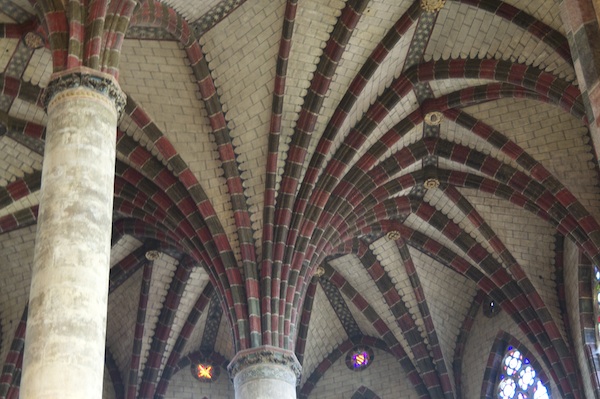
Polychromatic decor in les Jacobins


Les Jacobins, Toulouse

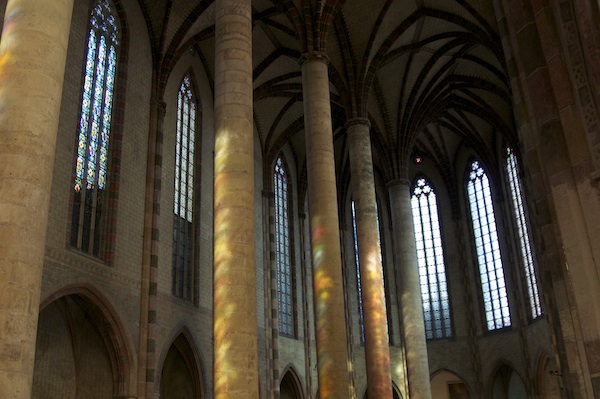
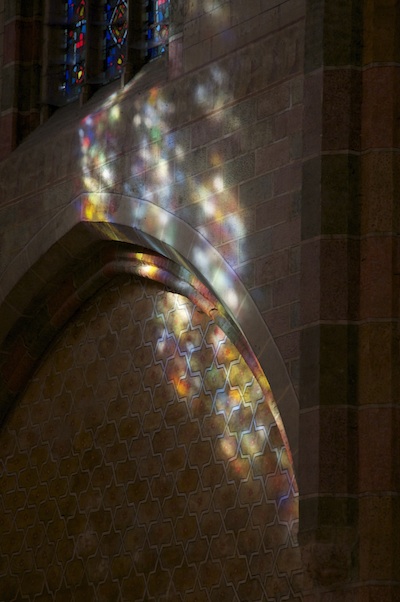
Glass-filtered light on the inner walls of les Jacobins

Saint-Sernin Basilica, Toulouse

Saint-Sernin Basilica is another of Saint-Dominic's post-crusade construction / evangelical efforts in Toulouse

Saint Sernin Basilica organ

St-Sernin Basilica organ

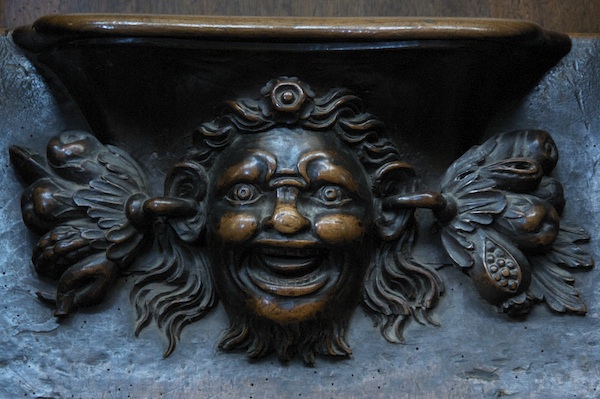
Carving, Toulouse

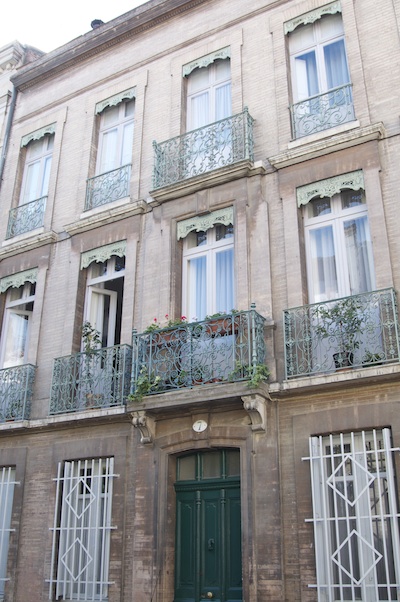
Toulouse façade

Scrolling grillwork is common on old-Toulouse façades