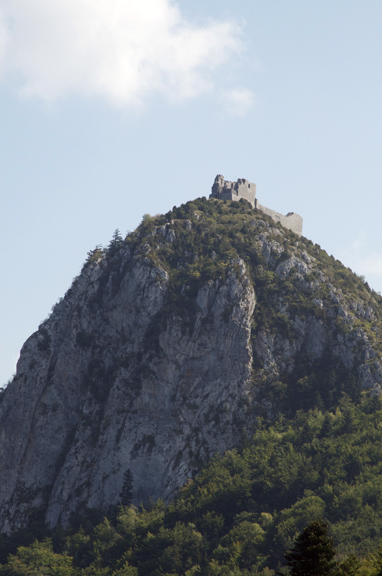
montsegur pog, France, by SMair

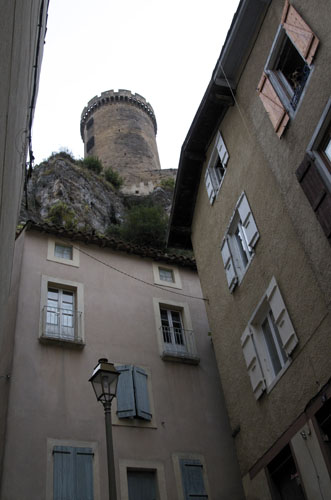
Montségur fortress sits atop the mountain pog. It’s a steep climb up to see the remains.

When you greet people here in the deep south of France, they reply to your “Bonjour” with what sounds like “Bonjeu.” Good game. Not the Sorbonne-approved elocution Mme Abdel-Kadar required of me and my classmates those many years ago, but an appropriate greeting to a person on vacation.

We’ve been seeing a fair amount of bilingual signage lately: The regular French, and also the Occitan equivalent. For instance, in Belloc, a village near our country rental, the blue sign at the turn to the Mairie says rue de l’Occitane; the red sign right below says roux de l’Occitanie. The name Belloc is also Occitan; in French—and apparently 700 years ago after the French overran the region—it was Beaulieu. In fact, any village name you encounter in the south that ends in oc or ac or ec has Occitan origins. Including Lautrec or Salazac…

The word for peak—as in mountain peak—is the delightful sounding pog.

A few days ago, Gaston and I slogged up the pog at Montségur (translation: Mount Secure) to look at what’s left of the fortress. Not much: the lower bit of the original keep, some walls where the medieval village had clung to the slope, and the curtain walls (called pregnant walls in French: murs enceinte—which rerouted my translating neurons to “retaining walls” for a number of days, for the obvious symptom connection. Pregnant pause… okay, never mind.). Hard to believe 600 people lived there—even if there had been multiple floors on which to stack them all.
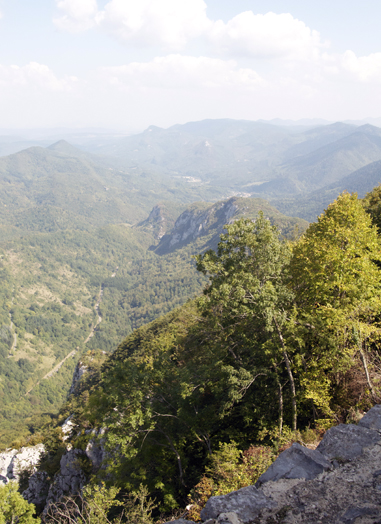
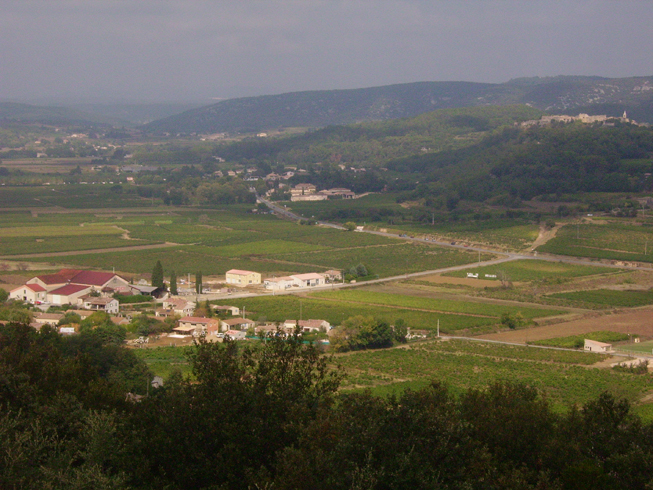
view from Montsegur, France

The Cathars would have seen French troops approach from miles away.

And a long way to go for fresh water.

But the view is spectacular: they would have seen those Catholic hordes coming from miles up the valleys around.

On the way down (“Bonjour,” “Bonjour;” “Bonjeu;” “Bonjeu”), we passed the tortured faces going uphill of all those French people who supposedly never formally exercise, doing their patrimoinic duty.

The site is close to the pilgrim way through the south to Santiago di Compostela, and is something of a pilgrim site in its own right. The last Cathar fortress to stand against the Catholic and French hordes, it withstood a months-long siege by some 10,000 troops. In March 1244, the Cathars surrendered. Approximately 220 were burned en masse in a bonfire at the foot of the peak when they refused to renounce their faith.
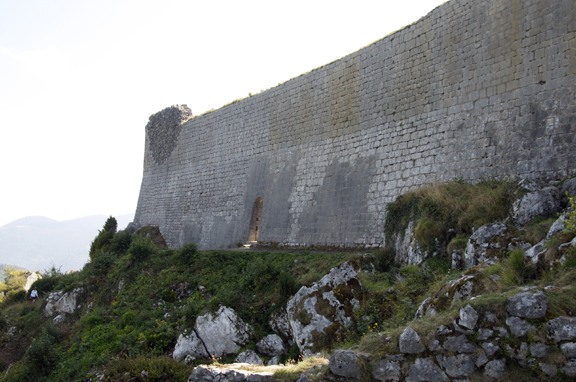
Approaching the fortress of Montsegur, France

The forbidding final approach to the fortress.
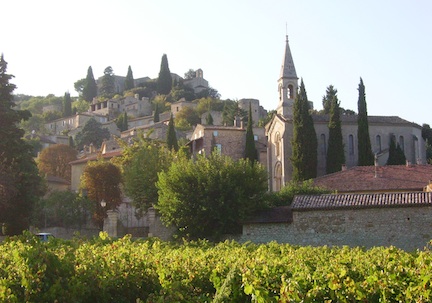
La Roque-sur-CezeWe’ve found the prettiest village in France. Officially, it’s only one of the prettiest this year and only for the past six years.

At the top of the hill is a real medieval chateau in which lives a real (presumably French, as they don’t like to sell significant symbols of their patrimony) family. I don’t know if they are of the same line of seigneurs de la Roque-sur-Cèze as the one who lived there in the 12th century, and set off to rescue the princess of Verfeuille (another picturesque walled town, about 15 minutes away driving) when he heard she was abducted.

He was successful, by the way, but on the return to the-Rock-on-the-Cèze-River (and why he was bringing her there, when he should have been bringing her home to the bosom of her loving family is a question only modern cynics would ask), she fainted at the chapel of Saint Sauveur. He awoke her with a kiss (the panacea for all damsels in distress at the time…. Or maybe it was the “kiss” that was the problem) and asked her to marry him. I’m sure that made her feel much better.

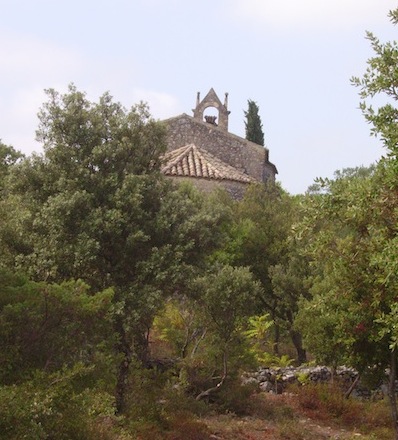
St-Sauveur Chapel

St-Sauveur Chapel, above St-Gély

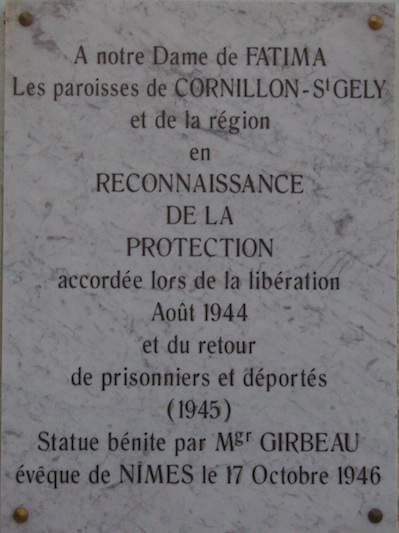
Because of this legend, the chapel has a reputation of bringing happy-ever-after to all lovers. The chapel hill is also where the monument to lost and deported victims of WWII stands, so some of the ecclesiastic ruins display graffiti from those who fought in the war.

WWII memorial, St-GelyHope and grief, on one hilltop.


La Roque-sur-Cèze is one river valley and one hill away from the chapel. Judging from the names on the post boxes, the former-seigneur’s village owns its recent renaissance to an infestation of Brits. Brits with loads of moulah. Even the streets are cobbled. Ce n’est pas typique.

For instance, in another picturesque bastide (medieval walled fortress town) on a hilltop across the Cèze valley in the other direction (west) from St-Gély, Cornillon has asphalted over the cobblestones of its twisty, windy, narrow streets. I can only presume this is why the last time it was officially named “one of the prettiest villages in France” was in 2006.

It’s so darn picturesque here. Medieval buildings, “perched” villages, cafes with awnings and abrupt waiters perfunctorily serving you café ou vin (but who also remember exactly what you ordered the first time in when you wander in again two days later), and field upon field of vines.

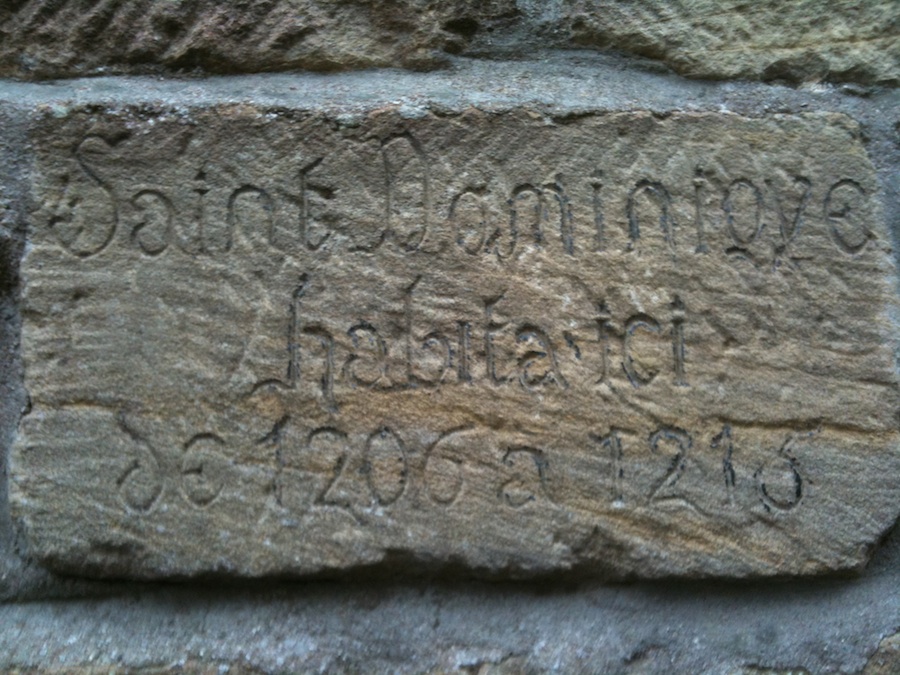
St-Dominique sign Fanjeaux

Saint Dominque habita ici de 1206 a 1215

Carved into the wall beside the front door of Fanjeaux’s abbey is the announcement: St-Dominique habita ici de 1206 à 1215. Dominic (or Domenge, if you prefer the Occitan language) came to tour the region at the behest of the pope, bringing his warm and personal touch to interrogating and torturing Cathar heretics as part of the Inquisition—initiated when the military end of the Albigensian Crusade seemed to French king and RC pope to be taking too long. With the good saint’s assistance, the process quickened significantly, and the Cathars disappeared: through a combination of being forcefully converted to Rome-approved doctrine, slaughtered, burned alive at the stake, or made to take part in other block-party events arranged specially for them.

Ah, yes, the good ol’ days, when personal belief and expression were mandated by politics. (Oh, wait, that’s today, too!)

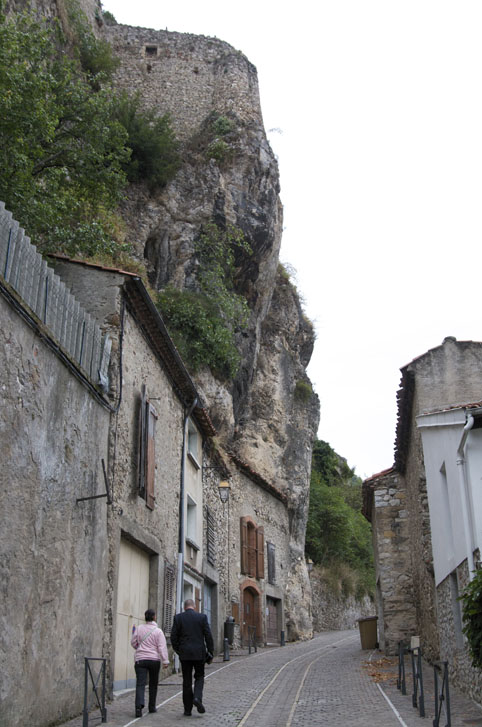
Walking up the rue du Chateau, in Foix, France

Walking up the rue du Château, Foix, France

Historically significant persons are frequently commemorated this way in France. Small signs may appear on the corners of buildings in Paris, alerting those who stop and read that such-and-such a member of the Resistance was shot by German authorities in the vicinity, or that some painterly bon vivant or other starved in the garrett there, or that a particular literary sage wrote his first poems/essays/novel at the corner table in that cafe.

Contrast those announcements with the plaque on a house on Foix’s rue du Château: Ici, Gaston Fébus n’habitait pas. Gaston Fébus did not live here.

Instead, Gaston Phoebus—or more to the point—Gaston the FABULOUS!, comte of Foix and Béarn, lived for a short time up the hill in the chateau—a curious, imposing, three-towered pile of stone looming over the town.

Foix chateau looms

It would have been difficult to escape the feeling of being watched in the town of Foix when the chateau was occupied.

The old boy had quite an opinion of himself, fancied himself a poet and musician, as well as God’s gift in the physical looks department. Think Hank VIII with fewer wives. In keeping with the commemoration theme, one would think good ol’ Gasser would have personally placed a commemorative plaque on the exterior wall of his own chateau, at the very least. But, as with so many people who have to resort to PR personnel and marketing specialists to convince the world of their superior personal qualities (something St-Dominic didn’t bother with, but then he had all of Rome, a couple of armies and – oh, yes – a few burning stakes behind him to convince the populace of his charms), Mr. FABULOUS! was a tad insecure. He may not have had Hank VIII’s marital problems, but he did have his own share of family issues. These, he resolved as Henry would do 150 years later—simply by doing away with them: brothers, sons, etc. (Alas, my love, you do me wrong…)

Mr FABULOUS! and his surviving relatives decamped from Foix, part of the kingdom of France since the Albigensian crusade, to Béarn, then still an independent state, to pretend they too were still independent of the various French kings Louis. His fancy castle on the hill became a prison at about the time of the French Revolution. This is why the buildings and towers survived, with new wall decorations in the form of graffiti, and stylish grillwork over the windows to keep the burglars out—or in, as the case may be.

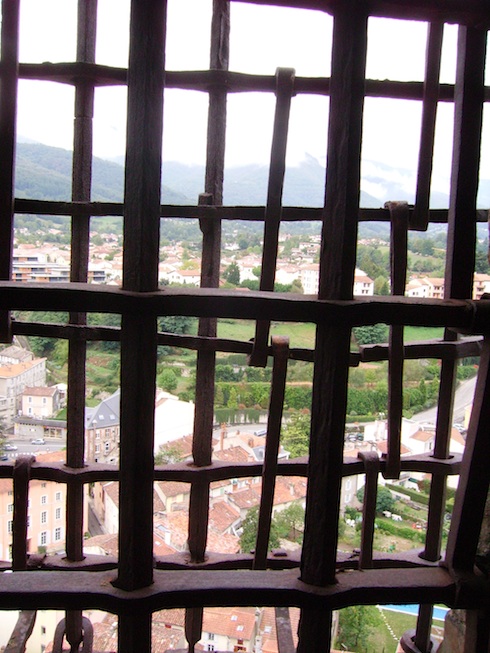
Antique window grills to keep prisoners in, Foix chateau, France

The castle became a prison after the French Revolution. Security was a problem even then.

We’ve had a few busy days exploring the Ariège/Hers region. We’ve climbed many, many spiral staircases up towers—always corkscrewing to the right: apparently built that way to disadvantage attackers, who most likely would be right handed and therefore unable to maneuver swords effectively around the tight bends—slipped up and down rain-slicked cobble streets, gazed out at rolling, wooded foothills, and eaten both good and not-so-good meals.


Upon waking at la Maison des roses on our first day in St-Gély, about 20 minutes west of Bagnols-sur-Cèze in the south of France, we were up with the roosters. Before the roosters. And at about 9:00 A.M., right when the village was stirring, Gaston announced he was in need of a nap: jet lag was taking its toll.

view-of-st-gely

St-Gély on the valley bottom at the left; Corneillon on the hilltop to the right

Two hours later, he was awake and ready to walk the three kilometres through wood and vale into Gourdagues for groceries. But—ah!— it was Sunday: We managed to catch the bakery just before it closed, but were too late for the supermarket. Half the week had passed before we amassed ingredients for a green salad.

As Mrs. Plaskett said to Helen Sawyer Hogg on the subject of incessant afternoon-tea engagements in Victoria in the 1920s and 1930s: “It has quite simply ruined my digestion.”

France pretty much shuts down at noon on Sundays. This is, of course, the case any day of the week. At midi, which lasts from noon until 2:00 P.M. at least, the only creatures that stir in the country’s towns and villages are cats, lizards, and visitors such as ourselves who haven’t figured out the French daily rhythm. And, on Sundays in deep France, you often don’t even have the post-siesta opening hours to look forward to.

However, after about a week of getting it wrong, in Fanjeaux, a village perched on the north edge of the Sault plateau about 20 minutes from Mirepoix, we found a wee salon du thé serving through the prolonged lunch hour. It opened its doors across from the back door to the Dominican abbey.

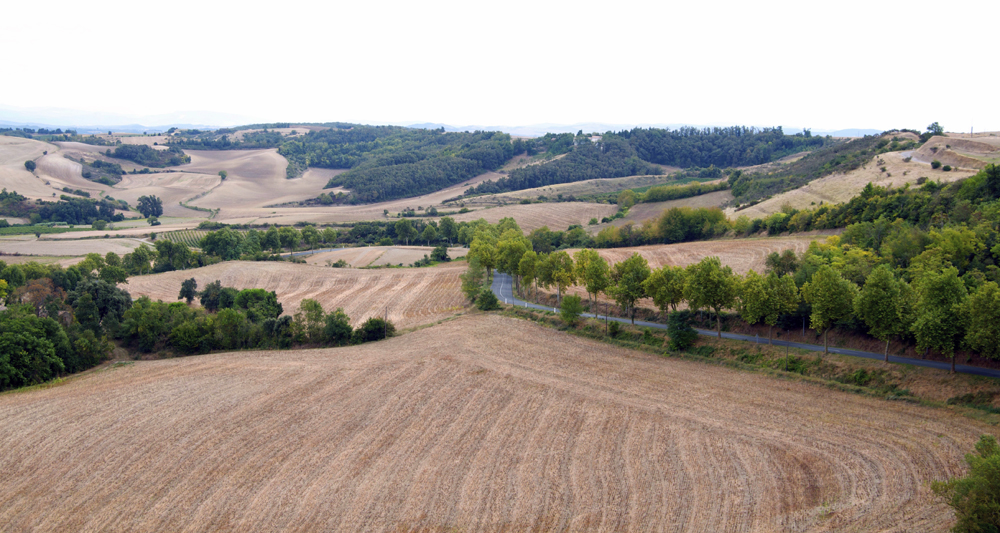
view-from-fanjeaux
Defenders of the faith at Fanjeaux’s Dominican abbey would have literally overseen miles of countryside.
The church and abbey themselves were firmly closed until 3:00 P.M.; Fanjeaux is a pilgrim town, being not only one of the way stops along the route through France to the via Compostela but home also briefly to Saint-Dominic. Church and abbey offer the faithful hope for refreshment on Sunday afternoons.

When we met up with Jason, whom Gaston had hired at Kananaskis Country 15 to 20 years ago, for supper on our one evening in Paris, he warned us about French mealtimes and their implications on the rest of one’s life if one does not abide with traditional working hours. He’s been in Paris for a few years now, working with producers and musicians there, as well as producing his own tunes in his studio, and he said it took him many, many many months to parse out the few cafes—mostly ethnic—in his faubourg, Montmartre, that remain open during the afternoon’s dark hours.

“I had to. Sometimes I don’t get out of the studio until 3:00 or 3:30, and after working for seven or eight hours straight, I can’t wait until 7:00 P.M.” Like many Parisians, Jason doesn’t cook much at home.

Not that any self-respecting restaurant in France would be ready to serve a guest at 7:00 P.M. Sure you can go in (with a reservation, bien sûr) and have a leisurely aperitif or two, but the staff are going to be bustling around you preparing for the evening for at least another half hour. It unlikely they’ll ask you for your order much before eight. But then, in France, they don’t rush you at the end of the meal by presenting the bill until you ask for it.

Since the early days in our vacation, we have adapted to local rhythms. Gaston now gets up in time to walk down to the bakery in our current village for croissants au beurre still warm from the oven. The neighbour’s dog, which greets him noisily and annoyingly on his return gets me up. We’re up and out the door for the morning’s adventures by 10:00 A.M., which is the earliest you can expect anything to be open around here. We’ve had a number of al fresco picnics on the side of the road while traveling from point A to point B. We consider that clever and efficient use of the extended noon-hour, which shows how un-French we are.

However, by the time the French lunch time is over and everything is once again open (by 3:00-ish, if you’re thinking commercial establishments), my lunch-time blood sugar levels start to dive. That, combined with the heat at the hottest part of the day and the searing sunshine and the day’s increased traffic on the roads, makes for clenched, knotted jaws and headaches for one, perhaps both, of us. Not completely adjusted, in other words. And the latest we’ve managed to eat supper at home is 7:00 P.M.

There was the very Parisian sight on leaving the hotel in the rue de Malte on our first morning in France. A man exited the building across the street and relieved himself au français by the front door.

This was perhaps considered acceptable behaviour a couple of centuries ago. It’s illegal now. Pissing perps can be fined hundred of Euros… if they’re caught. This explains the furtive look both ways for police as the guys sidle to the sides of buildings. That they continue to do it explains the smell of Paris in August or after any warm spell without rain for several days.

That this particular law-breaker was dressed in traditional Hassidic get-up, with high-crowned hat, black coat and side-curls, and the door next to which he was faire pisser was the entrance to a store-front synagogue added local colour.

orca off southern Vancouver Island, by Thomas Forster

Canadian Geographic, July 2009

A black Labrador retriever named Tucker is helping researchers determine why orcas summering off southern Vancouver Island are dying.

Tucker lends his nose to science by standing in a moving open-decked motorboat and sniffing the wind to detect orca scat floating on the surface of the Strait of Georgia and Haro Strait. His human colleagues, including Sam Wasser, director of the University of Washington’s Centre for Conservation Biology, scoop of the greenish brown goo and later analyze its hormone levels.

“Killer whale scat doesn’t stay afloat long, and it’s about the same colour as the water,” says Wasser, who uses dogs to study elephants, caribou, spotted owls and other at-risk species. “Without a dog, we’d have a hard time getting enough samples.”

Because Tucker can smell the poop from a long way off, the researchers needn’t crowd the whales. Preliminary analysis of hormones in the scat suggests that boat traffic stresses orcas.

The results from samples collected since 2006 also indicate the whales’ preference for Chinook salmon may be causing them to starve. Stress hormones in the scat peak and thyroid hormones plummet from September through December, when the salmon are at their scarcest. Thyroid hormones help regulate metabolism. When an animal starves, levels drop and metabolism slows. Wasser says the hormone levels mirror observed orca death rates.

“In 2007, thyroid levels in the samples were highest, and no whales died. They were intermediate in 2006, when there was five percent mortality, and lowest in 2008, when mortality decreased to eight percent.”

More samples are needed to confirm the results. Wasser and Tucker will return to the straits to patrol for poop this summer.