Explore Kananaskis, Summer/Fall 1997—Tiny pink elephants. Flesh-eating plants. Thieving flowers. They sound like characters in a fantastical Arabian Nights story, but in Kananaskis Country, these characters act out these roles under our noses every summer. The wildflowers of Kananaskis have no 1,001 nights in which to bloom and fade: if they’re lucky, they’ll get a mere 60 to 90 frost-free days in which to tell their stories.
Only the hardy and the strong survive this rugged environment. The plants and flowers found in Kananaskis Country have spent many generations adapting to harsh temperatures and poor soil conditions. No shrinking violets, here, if you please.
Cool nights mean flowers last longer and shine brighter. A chemical reaction within the colour molecules of a flower occurs during warm nights, when the plant isn’t photosynthesizing. The reaction breaks down the pigments, causing the flowers to fade.
An abbreviated growing season also means a riot of wildflowers blooming in a very short period. For flowering plants, a short summer is a frantic flurry. A plant must accomplish a year’s worth of activity in just two or three months. Not only must it flower, produce nectar and pollen to attract pollinators, be pollinated, and produce seeds, it must grow enough green stuff to make sufficient food to supply the energy for all of that flowering, pollination, and seed production—and store enough food to survive the winter and early days of the following spring.
As hard as life may be for a plant in Kananaskis Country, they aren’t passive victims. Each species possesses its own mechanisms for survival, honed and passed down through generations. Click on the gallery images for a glimpse at the lives of some of Kananaskis Country’s summer beauties.

Herds of elephanthead thrive in boggy alpine meadows.
Elephanthead is another Kananaskis wetland plant, but one that has better table manners than its butterwort neighbours. Its burgundy, fern-like leave are distinctive from a distance, but to see the elephants, you have to get close. Each flower on the long spiky stem resembles a tiny elephant head, with high forehead, big ears, upraised trunk, and tusks.
Photo by Jim Kravitz – http://www.flickr.com/photos/jimmypk/6036996432/

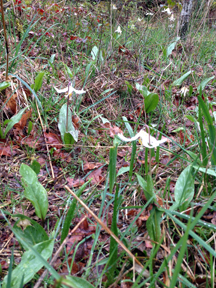
The western wood lily spreads its matching petals and sepals to catch the summer sun.
If you’re wandering open woodland in mid-August, the elegant western wood lily may catch your eye. The flower ranges from orange to orange-red, and consists of three petals and three sepals. Like most lilies, the wood lily grows from a bulbous root. It has little green material to convert sunlight into food: only a few whorls of narrow leaves surround the stately upright stalk.
Almost all the food energy stored in the bulb goes into making this big, bold flower. The flower will attract insects for pollination and produce seeds. Little energy remains.
The wood lily often falls prey to flower-snatchers. Such a large amount of the plants’ food-producing matter occurs in the stem. When flower-pickers take most of that, the plant usually dies.
To see wood lilies in Kananaskis Country, walk the Fullerton Loop Trail in the Elbow Valley, or go to Bow Valley Provincial Park.
Photo by Kate Ter Haar – http://www.flickr.com/photos/katerha/4721292001/

The yellow lady’s slipper orchid teases pollinators, but provides no nectar or edible pollen in return.
The tricksters of the flower world include the orchids—especially, the Lady’s Slipper orchids. They look beautiful. They smell lovely. They seem to keep a stash of nectar and pollen to make a closer look worth a pollinating insect’s while. They also provide a handy landing pad just below the nectar-and-pollen lunch counter.
But when Mr. Mosquito stops by Lady’s Slipper to dine and wanders up to place his order—whoops, down into her pouch he goes, pollinating the flower on his way down. As he struggles out of the pouch, his hairy antennae pick up her waxy pollen.
Mr. Mosquito isn’t too bright, because he keeps falling for this trick, over and over and…. But then, if he were smarter, he wouldn’t be pollinating orchids and making the world more beautiful.
Three varieties of lady’s slipper orchid grow in Kananaskis Country. Yellow Lady’s Slippers can be found along Many Springs Trail in Bow Valley Park. Venus Lady’s Slippers and Sparrow’s-Egg Lady’s Slippers can be found there and in Bragg Creek Provincial Park.
Orchids are under siege in Kananaskis. Everyone want to take them home. Please don’t. They won’t survive if you transplant them, and a whole generation of orchids ends if you pick them.
Photo by Dendroica cerulean – http://www.flickr.com/photos/dendroica/5698506662/

Happy to socialize, but self sufficient if need be, early blue violets have their own reproductive safeguards.
Early blue violets bloom first first in spring. You can find them in clusters in dry, sandy soil at lower elevations.
Like many violets, the early blue produces two types of flowers. Spring blossoms bloom large and showy to attract pollinating insects. However, if pollination doesn’t occur, the plant flowers a second time, during summer. Summer flowers never open, have no petals, and grow close to the ground. These flowers self pollinate. They form the plant’s insurance plan for reproduction. Taking no chances on bug romances, Violet’s no fool.
Photo by Miguel Vieira – http://www.flickr.com/photos/miguelvieira/4836616228/

Wad up yarrow leaves and shove them up your nose to stop nosebleeds.
Common yarrow’s Latin name, Achillea millefolium, was given in honour of Achilles, the Greek hero. Achilles made an ointment from yarrow to heal the wounds of his soldiers during the siege of Troy 3,000 years ago.
The plant’s healing properties are mythic. It may be diaphoretic, diuretic, stimulant, astringent, and tonic. It (apparently) reduces hair loss, helps with toothaches, cures spider bits, increases milk supply, reduces fever, and, if you roll the leaves up and stick the wad up your nose, stops nosebleeds.
The second part of its Latin name, millefolium, describes the plant’s leaves. These are long, lacy and much-divided. The plant looks like it has “1000 leaves.”
The flowers cluster on top of long stems. They dry well and their golden heads can be seen standing through the snow throughout the winter.
To see yarrow in profusion, stroll Campers Link ski trail next to Sandy McNabb campground in August.
Photo by orchid galore – http://www.flickr.com/photos/25609635@N03/2670694691/

Bug-blood-thirsty butterwort looks demure and innocent in its boggy habitat.
The single, funnel-shaped purple flower at the top of a long stalk seems harmless, but the Common Butterwort has a taste for blood—for bug blood.
The flower lures tiny insects to horrible deaths. The weapon sits near the ground: the leathery, yellow-green leaves around the base of the stem attract, trap, and digest insects. All that remains are black specks. These hard bits of exoskeleton provide evidence of bug murder.
Butterworts evolved this food-gathering strategy because they live in homes that lack the usual plant food. The bogs and wet, rocky banks where butterworts grow tend to be nutrient poor. What’s a plant to do?
Look for butterworts along Beaver Flats or Many Springs interpretive trails.
Photo by Sara Bjork – http://www.flickr.com/photos/aegishjalmur/778667568/