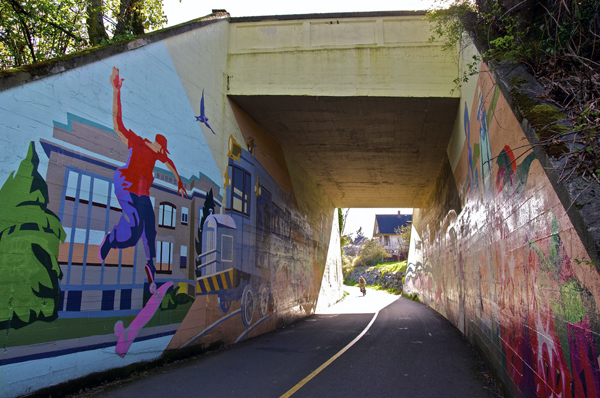
Mural art along the Galloping Goose trail. Photo by Alejandro Erickson

A couple of years back, archeologists undertook to examine decades-old graffiti on the walls of a London flat once rented by the punk-rock band the Sex Pistols.

The vandalism comprises eight scrawling cartoons. Most were created by John Lydon, a.k.a. Johnny Rotten, and feature himself, his fellow band members and other Pistols associates.

The archeologists later intoned in the journal Antiquities that the drawings, like the cave paintings at Lascaux, France, are pieces of art and deserve archeological investigation.


Continue reading…


Sources for this article include:

Johnny Rotten’s graffiti: the new heritage?

Capital Regional District bylaw

Church dome painted by graffiti artists


1.73-m Plaskett Telescope mirror, photo by "Scratch" @ Scratchley.org

Two developments occurred recently to advance large telescopes and the study of the universe around us. Scientists in the U.S. completed the first of seven 8.4-metre mirrors for the Giant Magellan Telescope, under construction in Chile. Six of the mirrors will be arranged petal-like around the seventh, central mirror.

When construction is finished, the telescope will have four times the light-gathering capacity of instruments used today.

An event closer to the hearts of Victoria astronomers involves the Thirty-Metre Telescope. In November, state officials in Hawai’i recommended construction of the telescope on the state’s highest peak, Mauna Kea, be approved. The recommendation is a key step in the long, complicated process required to build atop Hawaii’s volcanoes.

The Thirty-Metre Telescope will feature a light-collecting mirror that is—surprise!—30 metres across. When it begins operation in 2020, it will be one of the world’s most powerful optical and infrared telescopes.

With telescopes, size matters.

Continue reading….


More info:

Thirty-Metre Telescope

Giant Magellan Telescope

Plaskett Telescope

John Stanley Plaskett

Hooker Telescope


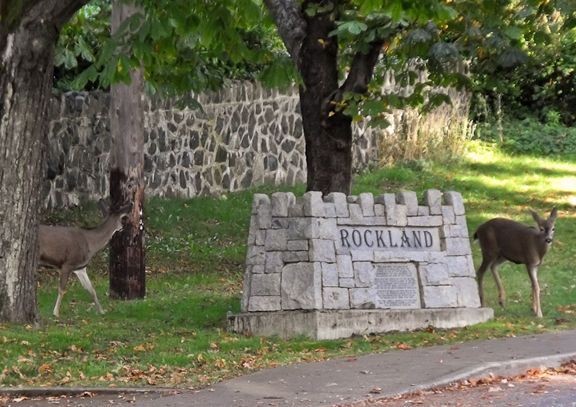
deer in rockland, by Mike Nelson Pedde, http://www.flickr.com/photos/wolfnowl/5445478667/


Victoria Times Colonist, December 1, 2012—Four schools were locked down in November due to cougar sightings, and on Wednesday, CRD’s planning, transportation and protective services committee began considering the new Regional Deer Management Strategy.

Predator. And prey.

No discussion of one can completely ignore the other.

We’ve heard a great deal about the apparent increase in local deer populations, about aggressive deer, increased damage by deer to crops and gardens, and deer-caused car accidents.

Deer have always lived here. They come to our gardens, farms and parks, lured by tasty pickings. They reproduce. They become habituated to humans.

And they are protected by our intolerance of large carnivores, like cougars, wolves and bears, and by our laws restricting hunting, harassment and transport of wildlife.

We create an island paradise for deer. Then we complain.

But, by encouraging abundant deer, we also invite their predators to move in. If we’re uncomfortable with the current numbers of deer, we’re even more nervous about their predators.

In the 12 years I’ve lived here, I’ve seen a cougar once, but I know they’re around. There are too many green spaces, too many new developments squeezing big-cat territory, and too many deer for the region to be cougar-free.

Cougars prefer to eat deer. When deer are unavailable, the cats will prey on rabbits, rodents, raccoons, dogs, house cats, geese… even insects. British Columbians are more likely to be killed by domestic dogs, stinging insects, deer or moose, or other humans than by cougars, but that doesn’t mean we want cougars anywhere near our children or our pets. Or us. Because very occasionally, cougars do attack humans.

Every time a cougar is reported in the area, focus turns on the cats. If conservation officers and their dogs confirm the sighting, the cat is tracked, usually captured and carted away, sometimes killed.

I suspect most cougars that find their way into urban Victoria are young males trying to establish themselves on edges of territories claimed by older, tougher males. They have to be young to be here, because we removed the older cats long ago.

The curious thing is, when we did that, we paved the way not just for the current increase in deer–human encounters, but also for increased cougar–human encounters. According to researchers at Washington State University, when you kill off older, experienced cougars—the cats that have learned to avoid humans—young, dumb cats move in. The youngsters are just looking to survive their first years away from Mom, and aren’t yet wise to the fact that mixing with humans is Trouble.

Every wildlife issue we’ve experienced in the region—the feral rabbits, the abundant and aggressive deer, the less common cougar and bear incursions, the garbage raccoons and the rats—is really a human-management issue. We did away with the predators. We introduced rabbits and rats. We encourage the raccoons and deer. We live in their territory. We don’t learn.

Wildlife biologists agree that coexistence between carnivores and humans depends primarily on managing human attitudes and behaviours. Among the recommendations included in the Regional Deer Management Strategy for decreasing deer–human conflicts are a number that touch on our own unhelpful behaviours.

These recommendations include enforcing municipal bylaws against feeding wildlife, encouraging use of deer-resistant plants in gardens and landscaping, fencing in food gardens and using repellants wherever possible, and generally discouraging deer from habituating to humans.

The strategy also recommends municipalities adjust bylaws to allow higher, deer-proof fences, examine and implement population-reduction measures appropriate to each area, provide support to farmers, in terms of fencing costs, hazing tactics, and crop protection, and adjust signage, speeds, and road-allowance maintenance on roadways to lower the number of vehicle collisions with deer.

It also suggests region-wide public education will be critical.

As capturing and relocating humans from the region aren’t options, addressing our ongoing contributions to wildlife problems is critical.

When we consider the strategy’s recommendations to the CRD over the coming months, we must consider also the broader wildlife implications. Whatever we do about prey species will affect their predators. And vice versa.

And not necessarily the way we intend.

–30–

A version of this article appeared in the Victoria Times Colonist.

Victoria Times Colonist, November 23, 2012—The words “isle” and “isolation” share linguistic roots. Both derive from the Latin word insula, which itself gives us the word “insulate”.

A curious thing can happen to large-ish mammal species that live on isolated, insulated isles. Over long periods of time, some species become smaller.

This phenomenon is called island, or insular, dwarfism. Scientists believe it results from the limited food resources typically available on islands and in other geographically cut-off areas.

In the short term, food deprivation leads to smaller birth weights and decreased growth in mammals. Over the long term, smaller bodies require less energy, or food.

Think of how much a football player or a basketball player or, better yet, a Sumo wrestler eats to maintain muscle mass and energy levels.

When food is persistently scarce, being petite confers a survival advantage.

And, so, over time, mammals on the large side when they live on mainlands may shrink in size when marooned for generations on desert isles.

(Gilligan, the Skipper, too, the millionaire and his wife, and the rest of S.S. Minnow gang weren’t stranded on their island long enough to show the effects….)

Living examples of island dwarfism include the Key Deer, found only on the Florida Keys. The Channel Island fox is the world’s smallest fox. It is native to California’s—you guessed it—Channel Islands.

Here on the B.C. coast, we have the Sitka deer on Haida Gwaii. Columbian black-tailed deer that live on the smaller Gulf Islands tend to be smaller than their mainland cousins. This, despite the abundant shrubberies and other garden delicacies we provide year-round.

Extinct species include dwarf ground sloths in the Caribbean, dwarf elephants in the Mediterranean and small elephant-like creatures in Southeast Asia. The Philippines once were home to small buffalo. Indonesia’s Bali boasted the smallest tiger of all until it went extinct in the last century.

And so, when B.C. Ferries raises rates and cuts service, and adds to the existing physical isolation of B.C.’s islands, the spectre of island dwarfism raises its tiny cranium in my own tiny cranium. As a science nerd, when I hear of the ferry corporation’s proposed cuts to meet budget constraints, I sigh and think of the Hobbit.

Not Bilbo Baggins. Nor the Peter Jackson movie due out mid-December. I’m talking about Homo floriensis, that wee relative of modern humans whose remains were discovered by archaeologists on the Indonesian island of Flores in 2003.

Partial skeletons of nine individuals were uncovered, dating from 95,000 to 13,000 years ago. The tallest would have stood 87 centimetres tall when alive. Hence the nickname, the “Hobbit.”

As ferry service is cut, as it and the options of flying or watertaxi-ing to and from the islands become ever more costly, what with increases in fares, fuel surcharges, airport and dock fees, parking costs, security levies, carbon taxes, cost of living, etc., etc., will our fate as Island residents be to grow ever smaller, as Hobbit Man (and Woman) did on Flores those millennia ago? Will our descendants follow the eventual path to petite-ness taken by the Sitka and local Columbian black-tailed deer? Will we, too, nibble our neighbours’ shrubberies when food imports from the mainland become too expensive? Will decreasing physical contact betwixt mainland and island eventually result in a new hominid species, our very own Homo vancouverislandensis?

Is this the destiny we choose when we choose to continue living here?

Okay, all smart-aleck questions, but the question of choice underlies them.

And it is a choice. Unlike deer, cougar or bear, we choose to live here, despite the cost of living, inconvenience, and limited employment in some fields.

More accessible and affordable alternatives exist… some, where employers are even hiring. Alberta, Saskatchewan, New Brunswick, and Nova Scotia, for instance. Where it snows more.

We choose this place.

We must also accept the consequences of that choice.

********************************************************

Note: Nature Boy, wildlife expert, assures me island dwarfism won’t happen in our lifetimes, regardless of the outcome of BC Ferries’ current public consultations or its coming service cuts and fare increases.

“I keep hearing about island dwarfism,” he says, “but I’ve lived here for more than a decade and, well, I just keep getting bigger.”

—30—

A version of this article appeared in the Victoria Times Colonist.

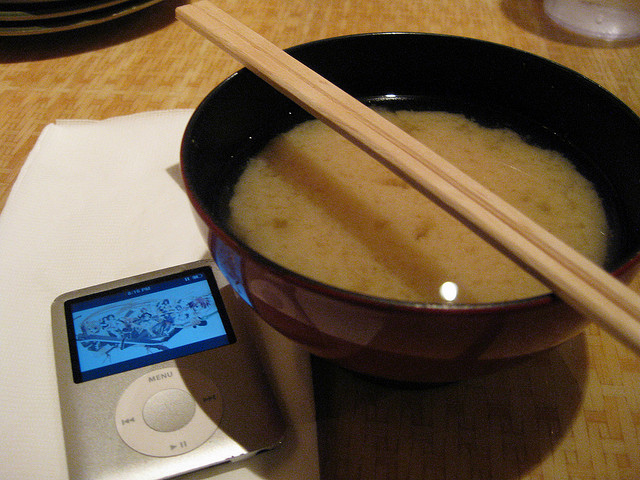
miso soup, by Michael Ocampo: www.facebook.com/coolmikeolntwk

  Nov 10, 2012

There’s a ritual we go through every time we eat at a Japanese restaurant.

It starts when the miso soup is brought to the table. Nature Boy gives his a swirl with his chopsticks. Then he reverently bows his head over the bowl in silent contemplation.

This is no memorial ceremony for Japan’s recent natural and nuclear disasters. The ritual predates those events.

No misguided adaptation of the Japanese tea ceremony.

Nor is this grace.

No, this prayer-like pause is Nature Boy’s version of veneration for the geologic forces that shape our planet.

So it does, in a way, relate to the earthquake in Japan, and the ties between this coast and that coast. Ties that extend far beyond and deep beneath the more than two dozen Japanese restaurants that operate downtown and the hundreds of students who cross the Pacific every year to study English here. Ties that physically bind this island to those islands in the form of massive crustal plates underlying the ocean floor.

It also relates to the recent earthquake in Haida Gwaii.

For, as I have been informed—repeatedly—in every bowl of miso soup, the same thermodynamic forces that churn Earth’s interior and move continents across the surface of the planet convect clouds of soybean paste and shift shredded wakame and chopped scallions.

In every bowl of soup, a demonstration of plate tectonics.

Those same forces caused the Haida Gwaii trembler, and the recent earthquakes in Japan, Mexico, New Zealand, Chile, Alaska, off the coast of Indonesia, around the Pacific Ring of Fire and elsewhere.

The soup itself represents Earth’s mantle, the region of the planet’s liquid interior between solid crust and solid core. The micro-curd miso suspended in the liquid enables The Interested Observer (a.k.a. Nature Boy) to identify convection currents within the soup. Soup at the surface, exposed to restaurant air, cools more rapidly than soup deeper within the bowl. Cool fluid is denser than hot fluid, so it sinks—gravity having its inexorable way. Hot fluid is less dense, so as the cooler liquid sinks, the hot stuff rises to the surface, where it subsequently cools, densifies, and sinks. And so on.

The cycling fluid creates troughs and wells, and pushes the soup’s floaty bits around the surface. Nature Boy gets particularly excited when a piece of seaweed wedges beneath some chopped scallion. He is sure to point out—yet again—the similarities to the Juan de Fuca Plate being driven under the North America Plate in the Cascadia Subduction Zone beneath Vancouver Island.

And I point out the similarities to how my cornea subduct under my eyelids when I roll my eyes.

“That,” he says, “is not at all the same.”

Pause.

“Okay, it is sort of the same.”

But a soup bowl is no crystal ball. No way to foretell a trembler’s timing, location, scale, or scope of impact exists. The October 27 earthquake caught Haida Gwaii residents by surprise. Tsunami alerts followed. Fortunately, despite the earthquake’s 7.7 magnitude, minimal damage occurred and only small ocean waves materialized.

Better to issue a warning when you’re uncertain than to wish you had afterwards.

New technology may provide some predictive potential. The seafloor-sensor network operated by NEPTUNE Canada, the Victoria-based underwater ocean observatory, and the instruments the Woods Hole Oceanographic Institute installed this year above the Cascadia fault monitor seafloor deformations. The sensors will provide minute-by-minute information about what is happening beneath our feet and off our shores.

If the data are analyzed quickly, they just might enable some warning of The Big One when it comes. Measurements of the fault zone where Japan’s earthquake happened revealed slow, small slip occurring two days before that quake. Seafloor monitors also detected movement. Unfortunately, the data weren’t analyzed in time to provide notice. Nor could anyone have known slow, small slip foretold a 9.0-magnitude shakedown in that case, or the size of the subsequent tsunami.

Greater warning might have made tremendous difference. It might mean all the difference for us.

Perhaps—just perhaps—we’ll have enough warning to gulp our soup and dash for stable, high ground.


A version of this article appeared in the  Victoria Times Colonist.

09. October 2012 · Enter your password to view comments. · Categories: France

This content is password protected. To view it please enter your password below:

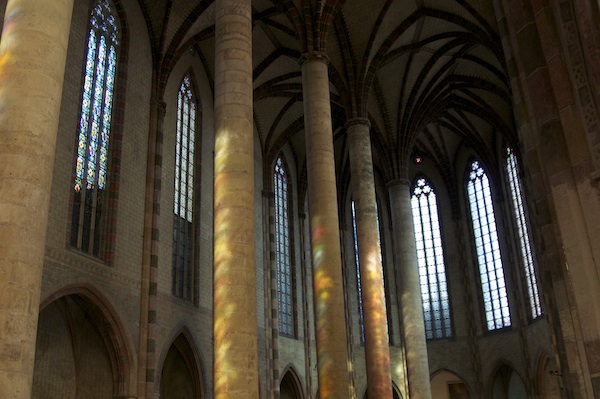
Les Jacobins, Toulouse

Les Jacobins was built by St-Dominic to ensure the converted heretics didn't revert after the fall of Toulouse during the Albigensian Crusade.

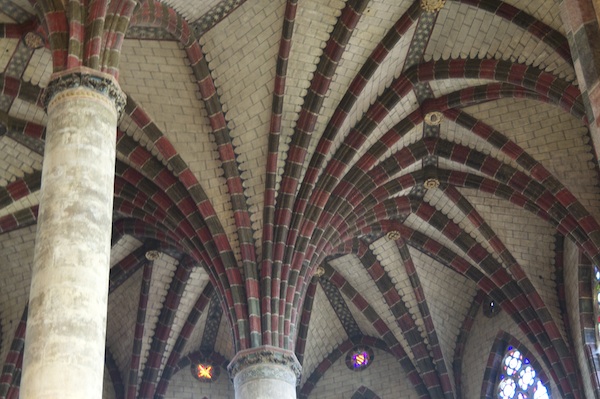
Les Jacobins, Toulouse

Polychromatic decor in les Jacobins


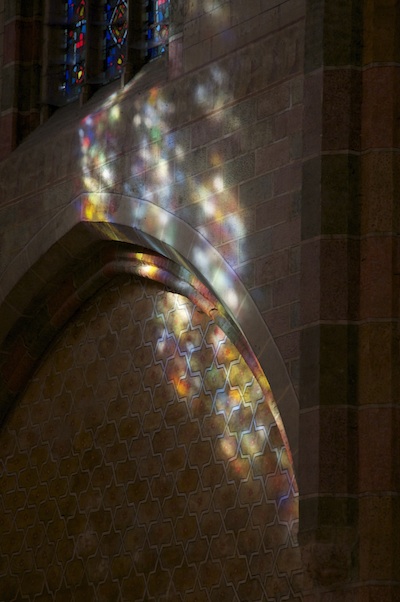
Les Jacobins, Toulouse

Glass-filtered light on the inner walls of les Jacobins

Saint-Sernin Basilica, Toulouse

Saint-Sernin Basilica is another of Saint-Dominic's post-crusade construction / evangelical efforts in Toulouse

Saint Sernin Basilica organ

St-Sernin Basilica organ

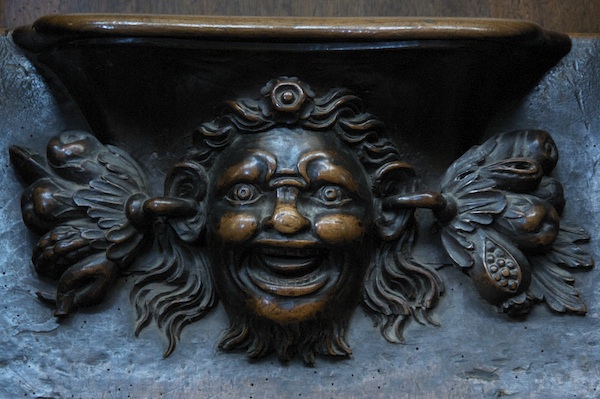
Carving, Toulouse

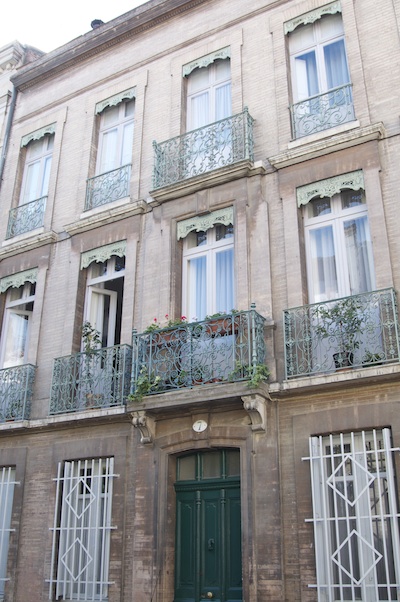
Toulouse façade

Scrolling grillwork is common on old-Toulouse façades

Buses stop running on many routes in Toulouse at 8:30 P.M. Which is right about the time we made it to the bus stop after an afternoon seeing the sights and dining early (for France). A bus that earlier would have taken us directly to our hotel did eventually come along, but the driver informed us that service was finished. Instead he wrote out directions for an alternate way back—one that required three transfers.

I thanked him profusely, we returned to the sidewalk, and I turned to Gaston: “We’re taking a cab.”

Fortunately, the taxi was only €15. Clearly, this isn’t Victoria.

Back at the hotel, our next task was to find a gas station and fill up our rental car’s tank. We had filled up in Mirepoix earlier, so had almost a full tank, but the rental agency isn’t interested in “almost” full.

“Do you want me to come along?” I asked.

Gaston: “If you want to, I would be delighted.”

Mimi: “I’m thinking that, as it’s dark out and we don’t know the area, it will be easier if there’s a set of eyes watching for gas stations and directions, and one set of eyes watching the road.”

So off we merrily went, remembering vaguely from two years earlier, that we’d filled the then-rental tank en route to the airport, and that the route to the airport is well indicated.

However, we failed to remember in time—vaguely or otherwise—that the gas station the two-years-previous hotel staff had directed us to back then was off to the right at the first traffic circle. We instead followed the signs to the airport.

I’m happy to report that route to the Toulouse–Blagnac airport is indeed very well signed.

I’m not so happy to report that there are no gas stations along the route to the airport.

We arrived at the Departures level, swung around the roundabout, and headed back the way we came.

And you know what, the route back to our hotel from the airport is not signed at all.

In desperation—because, after all, we had cleaned the car out earlier in the day and so had no maps on hand—we took one of the exits to Centre ville (city centre), and headed towards the bright lights in the distance. After just having been driven through centre ville by a taxi driver who knows the town intimately, we quickly realized that navigating downtown Toulouse is not an experience for the inexperienced or for strangers-to-town up the creek without a map, so to speak, and we’d better find another way that avoided the maze that we were heading into.

A sign for the Péripherique (the ring road freeway) flashed by. The road curved and we drove along the bank of a canal. After some consideration, while Gaston was getting tenser and tenser at the wheel and beginning to breathe more and more shallowly, I laid out my Navigator’s plan: “The hotel is near Exit 29 off the Péripherique. Turn around. We’ll get back on the Péripherique and we’ll follow it around until we get to Exit 29, even if we have to drive all the way around the city.”

Gaston kept driving. A left-hand turn over the canal loomed.

“Turn here.”

“But …(blah, blah).”

“Just turn.”

He slowed at the lights, and turned over the dark water, and headed up the road on the other bank. At the next set of lights, he made to turn left again.

“Stop! Where are you going? The Péripherique is up ahead.”

“But what if that is the road by the hotel?”

“It’s not. The hotel is nowhere near the canal du Midi.”

“How do you know this is the canal du Midi?!”

“The hotel is nowhere near any canal. Keep straight on.”

Onward we went. Signs for the Péripherique and another major throughway appeared. We followed the arrows.

And merged onto a freeway, with signs indicating exits and routes to Boulogne, to Gaillhac, to Montpellier, back to the airport, and to the Péripherique, and cars and trucks whizzing past us.

“Go there,” I said, pointing to the exit that was upon us.

Gaston signalled, swung the car into the middle lane, made it into the exit lane, but couldn’t get through the traffic into the next lane to make the next exit off the exit.

Crap.

Wailing and gnashing of teeth. “This is going to be a very, very long night,” Gaston said.

Montpellier, here we come.

Not at all what we had in mind.

Stunned, we kept going. Signs to the airport flashed by.

Then, suddenly, a sign for Purpan l’Hôpital.

It looked familiar. It looked very familiar.

“This is it! We’re on the Péripherique!”

Another sign: to l’Hôpital. And Exit 29!

****

We made it back to the hotel, but had even more room in the gas tank to fill up. This time, as we drove towards the first traffic circle by the hotel, I instructed Gaston to take the exit to the right, and yes, sure enough, there was a 24-hour supermarket with gas station about half a kilometre on.

As we drove up to it, we both exclaimed: “Ah, yes, I remember this!”