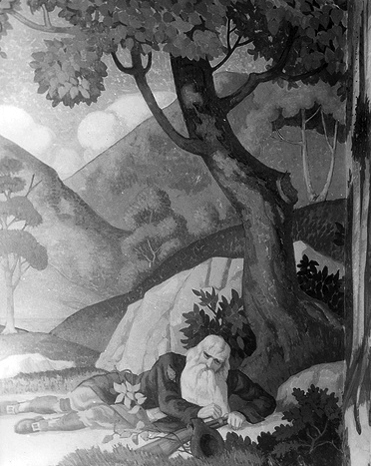
Accumulating evidence suggests that Disney and Washington Irving may have it right. Prolonged youth, or at least extended quality of life past normal life expectancy, hinges on adequate amounts of sleep.
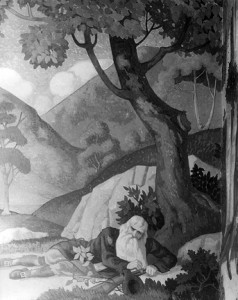
The old man awakens
Of course, it’s more complicated than that. (Isn’t it always?) To find my own Rip van W(r)inkle-in-Time, I would have to track down Henry Hudson’s 17th-century crew and quaff strange brew with them. Or find a wicked witch prepared to poison a spindle for me. Or contract some medical personnel of questionable ethics and adequate willingness to lower my body temperature, slow my heart, and bring my metabolism down to a threshold low enough to just keep my heart beating and organs functioning for hours, weeks or months at a time.
For, lo, the holy grail for keeping aging at bay is not mere sleep, but hibernation.

Grizzly bear, Denali Park, Alaska. Photo by Barbara Miers
Bears are masters at this. For as much as four to six months in our northern climes, bears do not eat, drink, or pee. Their metabolism slows drastically. Slow metabolism means slow heart rate. Heart rate can drop from 80 to 90 beats per minute to 20 to 25 beats per minute—and sometimes as low as 9 beats per minute. Low enough to cause heart failure in humans. And yet Bruin suffers no harm. The low heart rate enables bears to survive conditions non-hibernating animals would succumb to. And they emerge in the spring svelte from months of dieting.
However, if that doesn’t fit your lifestyle, you could take a lesson from certain northern rodents instead.
Chipmunks and some hamster species, for example, have evolved torpor—hibernation lite, as it were. Torpor neither lasts as long as hibernation nor does it reduce metabolism, heart rate and other bodily functions to the same degree. The rodents enter torpor for a few hours or days at a time, wake up, eat a bit, attend to rodent business, then re-enter torpor, wake up, eat a bit… and so on. As winter progresses, the cycle speeds up.
Researchers recently found that torpor in Siberian hamsters actually stops and even reverses the daily wear-and-tear breakdown of DNA linked to aging.
Now we’re talking.
Apparently, torpor helps protect and repair damage to telomeres, the tiny end-caps that safeguard chromosomes. Every time a cell divides, telomeres within the cell deteriorate slightly. Eventually, the telomeres are worn beyond repair, the chromosomes begin to unravel like old shoelaces, and the cell dies. And the ol’ body ages a little bit more.
Genetic testing by the researchers revealed that the hamsters which entered torpor more often not only kept their DNA in better shape, they grew longer telomeres, providing more protection to their chromosomes. And the hamsters which attained the lowest body temperatures during torpor showed the greatest amount of telomere lengthening.
I am curious as to whether the lowered body temperatures, slowed metabolism, and lowered body mass that characterize hibernation and torpor—no matter the species—has anything to do with the anti-aging mechanisms that scientists have been seeing in restricted-calorie studies undertaken with species as diverse as yeast, spiders and monkeys. In those studies, animals fed nutritionally adequate, yet calorie-limited diets were found to live up to 40 percent longer than their free-feeding counterparts. The dieting animals’ susceptibility to cancer, neurodegeneration, diabetes and other age-related disorders was also delayed.
In humans, caloric restriction (not to be confused with eating disorders, which is going hungry on a different scale altogether) has been shown to lower cholesterol, fasting glucose, and blood pressure, some of the signs of aging. The effect on human longevity is as yet unknown, as human subjects have a tendency to live too long to be conveniently studied by fellow-human researchers. Besides, for most people, stringent dieting on that order simply isn’t feasible.
So, what does all this tell me? If I want to live forever, I can stay hungry for the rest of my life, or spending most of my time in a coma on ice.
Somehow, it seems easier to prevail upon the local wicked fairy godmother to proffer a poisoned spindle on which to prick my finger. That method served—ahem, preserved— Sleeping Beauty and her castle-bound cohort well for a century or so.
Disney says so, so it must be true.

Sleeping Beauty, by Krystn Palmer Photography