Calypso orchids, by Jason Hollinger
During a recent walk through John Dean Provincial Park, Nature Boy encountered his first Calypso orchid of the year.

He was so excited, he called the rest of us back to crowd around and join the admiration parade. He dusted off his annual Calypso orchid lecture: blah, blah, blah, and so on and so forth.

I’d long thought this little orchid with its spiky purple flower was named for the Greek nymph Calypso, whose youth, beauty and — ahem — other charms waylaid wayward Greek hero Odysseus for umpteen years on his way homeward after the siege of Troy.

The orchid’s other names similarly hint at ability to beguile and enchant. Venus lady’s slipper, fairy slipper… the names for this wee flower imply a big reputation.

Continue reading this article at the Victoria Times Colonist….

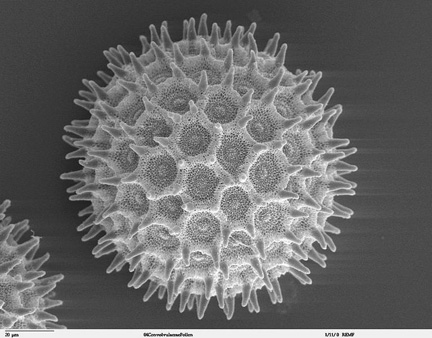
Plant-pollen particle. Pphoto by yellowikis, Creative Commons

I’m allergic to plant sex. Specifically, plant sex of the windblown variety. Even more specifically, grass sex.

Lucky me, the Aerobiology Research Laboratories report high levels of grass pollen in Victoria this week, so I’m keeping eye drops and hankies on hand. The Ottawa-based labs use measurements of plant pollen in cities across Canada to track and predict local week-by-week allergy severity.

With so much of Victoria’s landscape bursting into bloom at this time of year, we could celebrate a Spring Sneeze-Up following April’s Blossom Count.

Flowers are plants’ naughty bits, after all. Because plants suffer from mobility issues, they take advantage of wind, rain and animal pollinators to help them do the deed and make plant  embryos, or seeds.

We who suffer from airborne-pollen misery are merely immunologically protesting the presence of abundant, floating sperm released by plants without regard to Victorian propriety or the neighbours.

Continue reading this post at the Victoria Times Colonist….


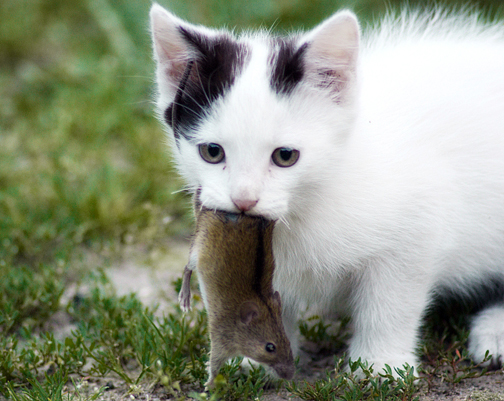
Killer kitty catches mouse. Photo by Chris (Eisenbahner)

A neighbour’s cat adopted me last year. When she’s bored and I’m home, she visits. She gets a lap to nap on. I get a cat without kitty litter, cat food, or hair on everything.

It also keeps her safe, during each brief visit, from becoming roadkill, eating or drinking noxious substances, and from stalking birds, squirrels, garter snakes and other garden wildlife.

I’ve never seen her hunt, but why would she differ from other cats?

Because Felix (or Felicia) the cat is deadly. When scientists from the Smithsonian Institute and the U.S. Fish and Wildlife Service scaled data from local surveys and studies to the national level last year, they estimated that domestic cats in the U.S. kill 2.4 billion birds and 12.3 billion mammals. Every year….

Read the rest of this editorial in the Victoria Times Colonist


Additional sources:

Stephen Raverty: Veterinary pathologist

Toxoplasma gondii-Infected Marine Sentinel Species

Impact of free-ranging wildlife: Nature Communications

Milky Way Galaxy. Photo courtesy of NASA.

The Milky Way Galaxy. Photo courtesy of NASA.

Today is International Astronomy Day. While amateur astronomers around the world will spend the day and evening extolling and exploring the wonders of the night sky, Victoria’s chapter of the Royal Astronomical Society of Canada has additional reason to celebrate. After a year of planning, the society and the municipality of Oak Bay have designated our own Cattle Point as the first urban star park in western Canada.

Cattle Point, Oak Bay. Photo by Evan Leeson, www.ecstaticist.com

At night, Cattle Point (see here in the evening) remains a dark refuge within the Greater Victoria urban area. Photo by Evan Leeson, www.ecstaticist.com

Star parks conserve and promote dark skies and the ability to see the stars. They form part of an international initiative to draw awareness to light pollution and its effects on health and quality of life. Star parks in urban areas are rare, due to nearby city lights.

Canada’s only other urban star park is located in Saint John, N.B. Canada’s 14 other dark-sky preserves are found in rural or wilderness areas.

“We’re lucky here,” says Mark Bohlman, who leads the Victoria initiative. “We can see the stars when the weather’s good. There are very few other places in North American cities where you can see the Milky Way.”

….

Read the rest of this column in the Victoria Times Colonist


 Other sources, this editorial:

Victoria sky-light quality map

Spring greens grow. Photo by James Mann, www.backyardgardeningtips.com

As a child of Depression-era children, I experienced the annual toil of backyard gardening early on. Mostly reluctantly, and only because the alternative to spending summer Saturday mornings outside among the lettuces, carrots and beans was spending that time scrubbing toilets and cleaning the weekly hairball out of the shower drains.

Despite the eloquent persuasiveness of that choice, no under-18s in the household at that time considered weeding a privilege.

Now, however, older, wiser and much busier, we each find ourselves spending time mucking around in the dirt to grow our own fodder. Our kitchen gardens range from year-round herbs for seasoning, to seasonal salad fixin’s, to more ambitious items like vegetables and fruit.

Just having the time to muck around is a treat.

It also helps that produce you produce tastes better. Even a little garden parsley and rosemary in soup creates freshness for the taste buds. Potatoes, peas, corn and carrots cooked and eaten within minutes of being picked exist in taste categories on their own.

There’s also the feeling of moral superiority and self satisfaction of getting the ultimate scoop on the 100-mile diet. Footprints from garden plot to soup pot: 20. Carbon footprint: Zero.

You can’t get much more local than that.

….

Read the rest of this editorial in the Victoria Times Colonist


Capital Region Food and Agriculture Initiatives Roundtable

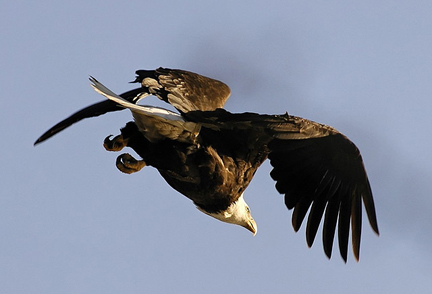
Bald eagle. Photo by Brendan Lally, www.brendanlallyphotography.com

Bald eagle. Photo by Brendan Lally, www.brendanlallyphotography.com

Bald eagles could be the bird world’s version of heavyweight-boxer Mike Tyson. The eagle is a big bruiser of a bird. It bullies other birds, steals meals, and scavenges whenever it can. Yet, during mating season, incongruously thin, soprano sweet nuthin’s emerge from predator’s curving yellow beak.

In addition to eagles’ springtime singing along the Gorge waterway, I’ve noticed local ravens pairing up and chortling amongst themselves. Robins now out-chirp each other thoughout the day, varied thrushes rend dawn with their off-key whistles, and towhees mimic hinges in need of oil. The chestnut-backed chickadee has changed its tune from “chickadee-dee” to “Hey, baby!” And the winter wren’s love-lorn performances make me wonder how these tiny avian opera singers can sustain so many trills and arpeggios with just one breath.

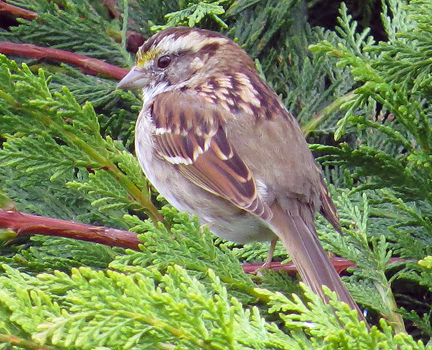
White-throated sparrow. Photo by leppyone

White-throated sparrow

It’s easy enough to guess what they’re singing about right now. Something along the lines of “Let’s make beautiful music together” to the ladies, and “Get off my beat or I’ll beat you up” to other guys. These themes play out in human songs as well, as Pacific Opera’s performance of Tosca demonstrates this month. They also cause many of the same emotional responses in both animals.

Apparently, breeding female white-throated sparrows—a songbird of Canadian forests—respond to the songs of male sparrows in the same way that humans respond to pleasant music. The reward centres in the sparrow brains light up just like ours do, say the researchers who scanned the birdbrains.

Read the rest of this editorial in the Victoria Times Colonist

Sources include:

How human language could have evolved from birdsong

Birdsong syntax

Some birds seem to have grammatical rules in their songs

Birds teach secret passwords to unhatched chicks

Birdsong: music to their ears (and hearts)

Thwarted child abduction, Toronto, March 2013

1.73-m Plaskett Telescope mirror, photo by "Scratch" @ Scratchley.org

Two developments occurred recently to advance large telescopes and the study of the universe around us. Scientists in the U.S. completed the first of seven 8.4-metre mirrors for the Giant Magellan Telescope, under construction in Chile. Six of the mirrors will be arranged petal-like around the seventh, central mirror.

When construction is finished, the telescope will have four times the light-gathering capacity of instruments used today.

An event closer to the hearts of Victoria astronomers involves the Thirty-Metre Telescope. In November, state officials in Hawai’i recommended construction of the telescope on the state’s highest peak, Mauna Kea, be approved. The recommendation is a key step in the long, complicated process required to build atop Hawaii’s volcanoes.

The Thirty-Metre Telescope will feature a light-collecting mirror that is—surprise!—30 metres across. When it begins operation in 2020, it will be one of the world’s most powerful optical and infrared telescopes.

With telescopes, size matters.

Continue reading….


More info:

Thirty-Metre Telescope

Giant Magellan Telescope

Plaskett Telescope

John Stanley Plaskett

Hooker Telescope


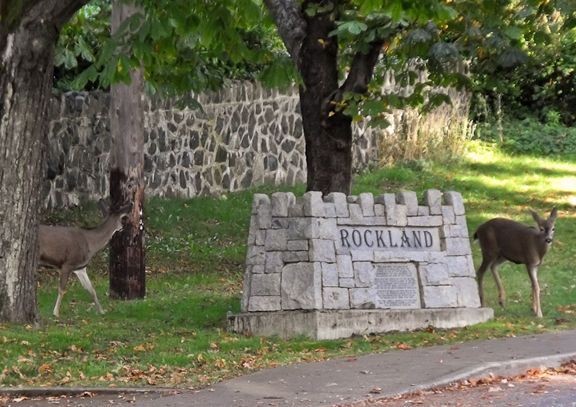
deer in rockland, by Mike Nelson Pedde, http://www.flickr.com/photos/wolfnowl/5445478667/


Victoria Times Colonist, December 1, 2012—Four schools were locked down in November due to cougar sightings, and on Wednesday, CRD’s planning, transportation and protective services committee began considering the new Regional Deer Management Strategy.

Predator. And prey.

No discussion of one can completely ignore the other.

We’ve heard a great deal about the apparent increase in local deer populations, about aggressive deer, increased damage by deer to crops and gardens, and deer-caused car accidents.

Deer have always lived here. They come to our gardens, farms and parks, lured by tasty pickings. They reproduce. They become habituated to humans.

And they are protected by our intolerance of large carnivores, like cougars, wolves and bears, and by our laws restricting hunting, harassment and transport of wildlife.

We create an island paradise for deer. Then we complain.

But, by encouraging abundant deer, we also invite their predators to move in. If we’re uncomfortable with the current numbers of deer, we’re even more nervous about their predators.

In the 12 years I’ve lived here, I’ve seen a cougar once, but I know they’re around. There are too many green spaces, too many new developments squeezing big-cat territory, and too many deer for the region to be cougar-free.

Cougars prefer to eat deer. When deer are unavailable, the cats will prey on rabbits, rodents, raccoons, dogs, house cats, geese… even insects. British Columbians are more likely to be killed by domestic dogs, stinging insects, deer or moose, or other humans than by cougars, but that doesn’t mean we want cougars anywhere near our children or our pets. Or us. Because very occasionally, cougars do attack humans.

Every time a cougar is reported in the area, focus turns on the cats. If conservation officers and their dogs confirm the sighting, the cat is tracked, usually captured and carted away, sometimes killed.

I suspect most cougars that find their way into urban Victoria are young males trying to establish themselves on edges of territories claimed by older, tougher males. They have to be young to be here, because we removed the older cats long ago.

The curious thing is, when we did that, we paved the way not just for the current increase in deer–human encounters, but also for increased cougar–human encounters. According to researchers at Washington State University, when you kill off older, experienced cougars—the cats that have learned to avoid humans—young, dumb cats move in. The youngsters are just looking to survive their first years away from Mom, and aren’t yet wise to the fact that mixing with humans is Trouble.

Every wildlife issue we’ve experienced in the region—the feral rabbits, the abundant and aggressive deer, the less common cougar and bear incursions, the garbage raccoons and the rats—is really a human-management issue. We did away with the predators. We introduced rabbits and rats. We encourage the raccoons and deer. We live in their territory. We don’t learn.

Wildlife biologists agree that coexistence between carnivores and humans depends primarily on managing human attitudes and behaviours. Among the recommendations included in the Regional Deer Management Strategy for decreasing deer–human conflicts are a number that touch on our own unhelpful behaviours.

These recommendations include enforcing municipal bylaws against feeding wildlife, encouraging use of deer-resistant plants in gardens and landscaping, fencing in food gardens and using repellants wherever possible, and generally discouraging deer from habituating to humans.

The strategy also recommends municipalities adjust bylaws to allow higher, deer-proof fences, examine and implement population-reduction measures appropriate to each area, provide support to farmers, in terms of fencing costs, hazing tactics, and crop protection, and adjust signage, speeds, and road-allowance maintenance on roadways to lower the number of vehicle collisions with deer.

It also suggests region-wide public education will be critical.

As capturing and relocating humans from the region aren’t options, addressing our ongoing contributions to wildlife problems is critical.

When we consider the strategy’s recommendations to the CRD over the coming months, we must consider also the broader wildlife implications. Whatever we do about prey species will affect their predators. And vice versa.

And not necessarily the way we intend.

–30–

A version of this article appeared in the Victoria Times Colonist.