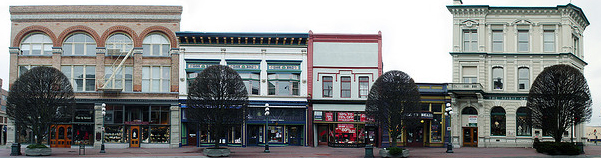
One block along Victoria's Government Street. Photo © Jason Vanderhill, via flickr & Creative Commons

One block along Victoria’s Government Street. Photo © Jason Vanderhill, via flickr & Creative Commons

I have little need for t-shirts, caps or jackets emblazoned with our capital’s name. I don’t bother with coasters, tea cozies or trinkets to remind me of my day-to-day existence here.

When I can step out my door to live the dream, I rarely think of shops that sell souvenirs to people who visit and want reminders of their brief time here.

I’m not the intended market.

However, a market clearly exists to keep the souvenir-type shops along Government Street in business, year after year.

They comprise about a dozen of the 50 or so shops along the eight blocks between Humboldt to Fisgard streets. This stretch of Government Street has been in the news lately, after Victoria Mayor Lisa Helps suggested lowering commercial property taxes along the street to encourage revitalization. The number of empty storefronts and For Rent signs—13 blackened storefronts at recent count—prompted her proposal.

Yet, while shops catering mostly to tourists are a minority along that stretch, their presence greatly influences the street’s informal, local brand. When many local residents think of Government street, it is often these shops that come to mind – and long lines of idling tour buses, sidewalk-clogging crowds, and phalanxes of kamikaze scooters.

Read the rest of this editorial at the Victoria Times Colonist….
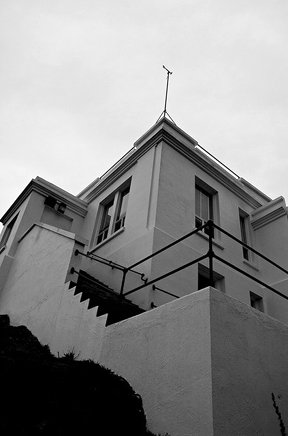
 

Gonzales Observatory served as Victoria's weather and time station. Photo © Cindy Andrie via flickr and Creative Commons


We lost an hour last night.

Don’t send out a search party. The hour is not hiding under the bed, or communing with dust bunnies at the back of the closet. It hasn’t eloped with a dish or a spoon, or ridden a cow bareback over the moon.

Our concept of time, with its discrete hours, minutes and seconds, is a result of our need for predictability and stability, and the progress of our technology.

Before moment-to-moment measurement became possible, we relied on the Earth’s tilted, spinning loops around the sun to measure time. Every sunrise, sunset, high noon, or full or new moon brought a new unit of time. The sun’s creep along the horizon signaled seasons. Animals and our own patterns provided points of approximate precision to our days. Wrinkles creeping across faces, children becoming adults, saplings maturing into trees, and other signs indicated decades.

Technology overturned that. Fire and electricity made night into day. Clocks introduced minutes and seconds, and made promptness, regular schedules and shift work possible.

Even after clocks became portable, sailors relied on the sun to determine how far east or west they had travelled. Ships’ captains determined high noon where they were, set one time piece on board to that time, and compared the difference against another time piece. On any ship flying under the Union Jack, that second time piece was set to Greenwich time, in England. In those pre-GPS days, time accuracy was essential for ships in port to set their time pieces and measure position.

As a major shipping port for the British Empire, Victoria benefited. For example, in February 1859, the Victoria Gazette reported that Captain Trevett of the Hudson’s Bay Company steamer Labouchere, which was in harbour, consented to fire a gun at noon every Thursday, so that the citizens of Victoria could “regulate their time pieces and obtain the true time.” Two decades later, the Work Point garrison established a time-keeping routine by firing its time gun at eight or nine o’clock on Monday nights….

Read the rest of this editorial at the Victoria Times Colonist….
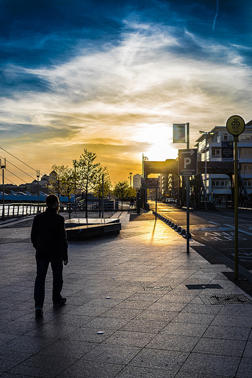
Man walking at sunset. Photo © Giuseppe Milo, www.pixael.com, via flickr & Creative Commons

Photo © Giuseppe Milo, www.pixael.com

Last year, Paul Glassen, of Nanaimo, wrote to me:

“We all walk in the first couple years of life, many start cycling and riding buses in grade school. We don’t drive the auto until we are in our later teens. Why do we call walking, cycling and transit ‘alternative transport’? Clearly, they are primary transportation, and the auto is the alternative.”

Glassen’s reasoning plays on the order in which people adopt ways of moving about during their lives. As such, walking—by itself—would indeed be the primary form of transportation. Cycling or public transit would be the secondary and tertiary modes of transport, and driving, the quaternary (car-tenary) form. Crawling, abandoned once we’re upright, loses its initial place in our early years….

Read the rest of this editorial at the Victoria Times Colonist….
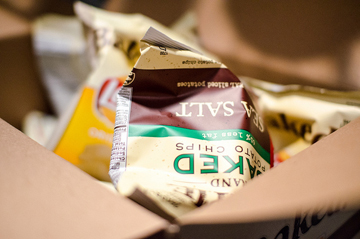
Single-serving bags of chips. Photo © m01229, via flickr and Creative Commons

Nature Boy waved a bag of potato chips at me.

“No, thanks. I’m not hungry,” I said.

“But when you see this bag, how do you feel? Do you feel a twinge of guilt? Do you feel nostalgic?”

“Actually, right now, I feel puzzled and exasperated….”

Nature Boy’s household psychological experiment came after he’d read about neuromarketing, a field of study that examines how the sight of certain products triggers specific and not always expected emotional responses deep within people’s brains.

That’s the neuro-part of the field. The marketing part comes when companies use that information to design, package and position products to increase sales….

Read the rest of this editorial at the Victoria Times Colonist….

Flu vaccination. Photo © U.S. Army Corps of Engineers, Europe District, via flickr & Creative Commons

With the annual flu season underway, the annual influenza-related controversies are also making the rounds.

They started last summer, with problems at Canada’s main flu-vaccine production facility in Quebec. A shortfall of vaccine doses resulted, forcing the Canada’s Public Health Agency to place orders with other suppliers.

By the start of flu season in November, it became known that this year’s flu-vaccine missed the virus bull’s eye. The World Health Organization decides each spring which strains of influenza to target in the year’s vaccine. It selected one strain of Influenza B and two strains of Influenza A in 2014. However, the A virus that has since come to dominate the season mutated, leaving the vaccine less effective….

Read the rest of this editorial at the Victoria Times Colonist…. 
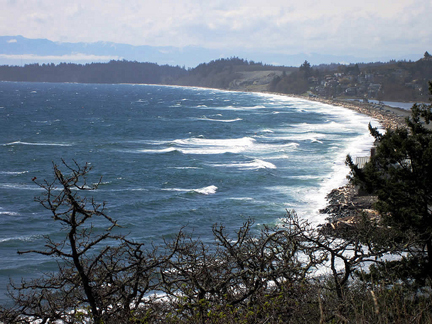
Royal Roads shoreline outside Esquimalt Lagoon. Photo © David Stanley via flickr and Creative Commons. www.southpacific.org

The year has begun amidst a series of earth-shaking events.

Three earthquakes were reported for the Vancouver Island region on January 2. The biggest, at magnitude 5.4, occurred 211 kilometres west of Port Hardy, while two smaller tremblers occurred west of Port Alberni. Five days later, a 4.8-magnitude quake west of Port Alice shook the coast.

They form part of a regional swarm of earthquakes that began late last year, as the tectonic plates beneath Vancouver Island released rock-bending pressure. To add perspective, about 4,000 earthquakes occur in B.C. every year. Of these, only a few—like the larger January quakes—are felt by people.

As solid as the ground beneath our feet seems, when the forces that shape the our planet’s surface start squeezing it, the granites, basalts and sedimentary rock on which our region’s municipalities are built take on the consistency and strength of something like fine, aged Cheddar….


Read the rest of this editorial at the Victoria Times Colonist….
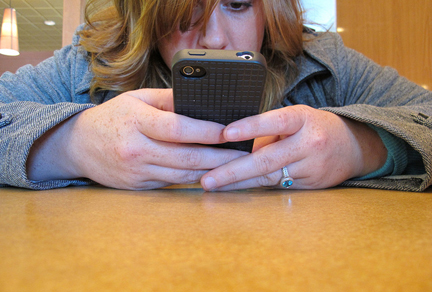
Checking email. Photo © www.buzzfarmers.com, via flickr and Creative Commons

Photo © www.buzzfarmers.com

When he was younger and had more hair, Nature Boy often marked this time of year by resolving to break annoying habits. These included snacking between meals, spending too much time onscreen, sleeping until the last possible minute before getting up and getting ready for work, and so on.

Year after year, he resolved to get smarter, fitter, faster or just get up.

You could say he was beginning to develop a habit of making resolutions to break bad habits.

Alas, as with so many resolutions made by so many people, a resolution-making habit does little to squelch the habits prompting the resolutions….


Read the rest of this editorial at the Victoria Times Colonist….
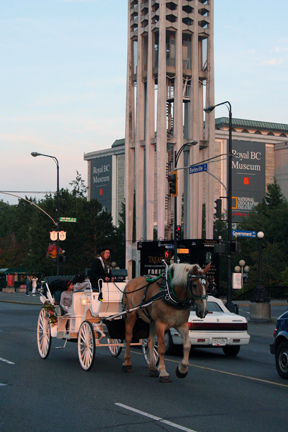
 

Royal BC Museum from Belleville Street, Victoria. Photo © Robin Zebrowski, via flickr and Creative Commons

This week, the Royal BC Museum opens its doors to the local community. For the price of a cash donation, residents and visitors can tour the museum’s galleries, travel back to the province’s early years, and view one of the world’s best collections of West Coast First Nations art and artifacts.

Some weeks ago, online travel-booking company TripAdvisor.ca announced that the museum ranked first in the company’s Top 10 Canadian museums for 2014. The museum was also confirmed as a Travellers’ Choice winner, a position the museum has enjoyed for several years. The awards are based on reviews and opinions posted on the online site by travellers.

TripAdvisor announced its news on November 18. That is also Canadian Museums Day. Marking the date with the announcement created synergies for TripAdvisor, the museums being celebrated, Canada’s museum industry, the travel and tourism industry, the online-booking industry, the power of people who share their opinions online….

But, in another sense, the timing was unfortunate….

Read the rest of this editorial at the Victoria Times Colonist….