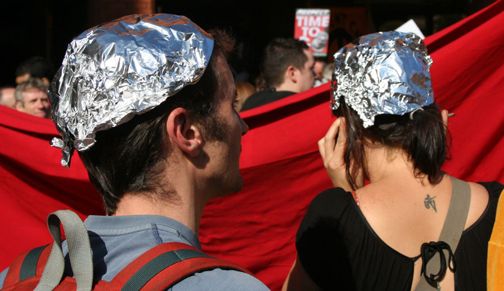
Tinfoil hats. Photo © teaeff, via flickr“They don’t need to read my mind,” I informed Nature Boy when he offered me his tinfoil helmet. “They can read everything else.”

What They would read are my emails, my Internet use, my cellphone data, and every other item or card on or near my person with a radio-frequency identification tag, GPS or other signal.

Every time I use a bank or credit card, turn my cellphone on, drive my GPS-enabled vehicle—even use a telephone landline—I leave a digital trail.

That trail can be tracked.

What I find truly amazing is that anyone could possibly find li’l ol’ me interesting enough to want to access the virtual banality of my existence.

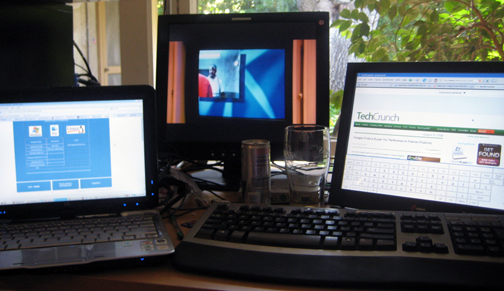
Connected and ready to share (and be tracked). Photo © Nik Cubrilovic.
When former National Security Agency contractor-turned-renegade Edward Snowden revealed the NSA’s Internet spying program earlier this year, the revelations threw light on who might be interested in the digital trails I and hundreds of millions of others create every day.

Compared to that, this month’s ruling by the Office of the Information and Privacy Commissioner to uphold B.C. employers’ rights to track their workers’ whereabouts seems, well, small potatoes….

Continue reading this editorial at the Victoria Times Colonist….

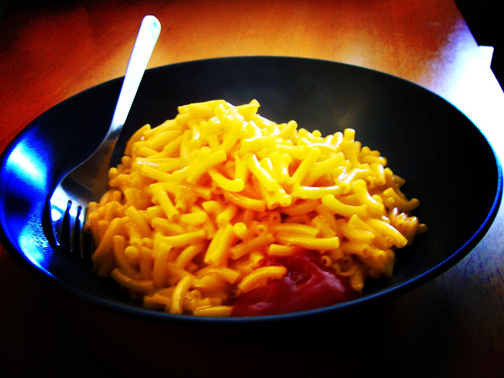
KD. Photo © Stephen Boisvert, on flickr

All sorts of two-legged critters are migrating to school-supply bargain-hunting grounds south of the border this weekend. The last young of the summer are fledging and moving out of the nest into college residences.

And turkeys, pigs, and first-year university students are facing being fattened up in time for forthcoming feast days.

Variations on the Freshman 15—the extra body weight from eating the high-starch, high-sugar, high-fat diet so readily available in university cafeterias—manifest widely. So to speak.

But avoiding university carb-palaces doesn’t mean a student fresh from the farm chooses food wisely in his first months away. Kraft Dinner, after all, sells 75 million boxes of its bright-orange, cheesy-flavoured macaroni to Canadians each year—the greatest per capita sales of any country, and enough to have it proclaimed Canada’s national dish by the likes of Douglas Coupland.

Read the rest of this editorial in the Victoria Times Colonist….

The Walrus – Manufacturing Taste: The (un)natural history of Kraft Dinner—a dish that has shaped not only what we eat, but also who we are

Instant noodle sales top 100 billion units a year amid insatiable global demand

A Maternal Junk Food Diet Alters Development of Opioid Pathway in the Offspring

Can You Be Addicted To Carbs? Scientists Are Checking That Out

Refined Carbs May Trigger Food Addiction

Effects of dietary glycemic index on brain regions related to reward and craving in men

Revealing the scientific secrets of why people can’t stop after eating one potato chip


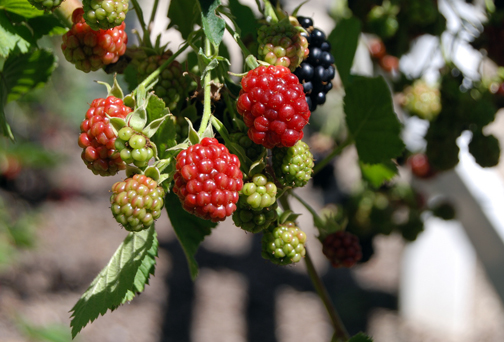
Blackberries in season. Photo © Julie (hello-julie flickr)

Blackberry picking, like developing Blackberry devices, is a prickly business.

When Nature Boy was growing up on the Mainland—long before e-mail or smartphones came along—his family would venture out to harvest THEIR blackberry patch near Pitt Meadows.

Nature Boy always assumed danger duty. He’d armor himself with rubber boots and his grandfather’s welding helmet and jacket. Then off he’d go with an ice-cream pail, pushing deep into the brambles. Once inside, he’d fill bucket upon bucket with berries no other human dared to reach.

These days, we can find berry lovers harvesting this year’s bounty along many of the region’s trails, roadsides or parks.

Likewise, we’ve recently been hearing of the tumbling fortunes of Blackberry. The Canadian tech giant has been losing market share to Samsung, Nokia even, and that other fruit company.

In August, the company announced it was seeking buyers or alternative investment options. Going private or being bought would allow the company to re-organise its business in peace without outside shareholder scrutiny.

Given the current open season on both kinds of blackberry/Blackberry, I’ve assembled a few pointers on how to approach picking either fruit….

Read the rest of this editorial in the Victoria Times Colonist.

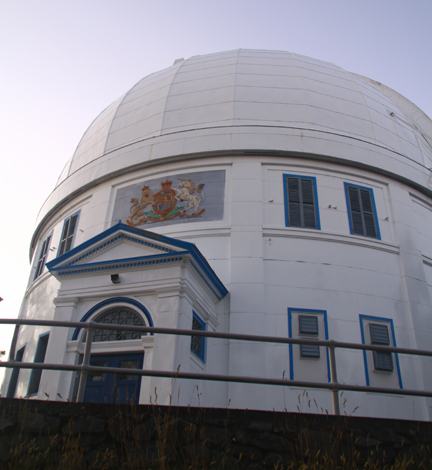
Dominion Astrophysical Observatory, on Little Saanich Mountain, Victoria, BC. Photo © Caylin (plums_deify, flickr)

No lights shine at the Centre of the Universe today.

The staff who ran the interpretive centre at Little Saanich Mountain’s Dominion Astrophysical Observatory cleaned out their desks yesterday, turned the light out, and vacated the building. So ends 12 years of educational programming about astronomy and Canada’s place in scientific research.

The National Research Council, which operates the centre, had the unenviable choice this year of cutting outreach or cutting even deeper into research.

It was one of many challenges the federal agency faces. The government recently adjusted the NRC’s research priorities to match private sector goals that focus on applied, or practical, research

Applied research is important. It can lead to patents, jobs, manufacturing, and all that good economic stuff.

However, the shift at the observatory is ironic.

In 1910, when astronomers suggested Canada’s government build a new, bigger, better national observatory, they specified it be purpose-built for studying astrophysics.

Not astronomy. Astrophysics….

Read the rest of this editorial at the Victoria Times Colonist….

Parks like East Sooke Park help make nearby residents happier and healthier. Photo by Logan C (flickr's LoganTech)Back when Nature Boy worked at a big California museum, I flew down to visit on a semi-regular basis.

I remember looking out over the city as the aircraft made its final approach to L.A.’s airport. Below me stretched mile upon mile of concrete: buildings, roads freeways, parking lots. Few trees and no green spaces relieved the sunbaked ugliness that extended from the mountains in the city’s east to the Pacific Ocean.

No wonder, I thought at the time, crime rates were so high. No wonder crazy people were using drivers on Los Angeles freeways for daily target practice—events which, by that time, were so commonplace, even the most reputable of the city’s news organizations no longer reported them.

With so many people living in Los Angeles, the absolute number of already-crazy people living among them was going to be high.

But packing so many people in so close together would surely compound the problem. Those conditions could easily push anybody unstable and close to the breaking point, mentally and emotionally speaking, over the edge into outright nuts-dom….

Continue reading at the Victoria Times Colonist

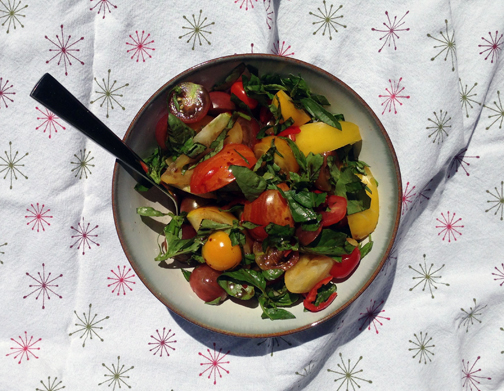
Tomato salad

Tonight’s supper

Five varieties of tomatoes, two kinds of peppers, and fresh herbs picked from the garden 10 minutes ago. Drizzled with a bit of olive oil and balsamic vinegar.

Mmmm.

Dallas Road dog park. Photo by Martin…T (flickr)I find the recent cooler days and periods of rain a relief. My garden does, as well, but more to the point, the cooler weather means things smell better. The effect is particularly noticeable along the dog-park section of Dallas Road and at Thetis Lake’s unsanctioned dog beach.

I realize dogs (and their owners) need a place to be dogs (and owners) and to socialize with their kind, but after 30-plus days of blue skies and warm temperatures, the resulting accumulations of ammonia, methane and, well, toilet can make the driest eyes water and the strongest stomach clench.

Rain and cooler temperatures help dampen the fumes of the dog days of summer.

But let’s get something straight. The phrase “dog days” does not refer to Fido or his doo-doo. Nor does it describe Rover’s snooze-all-day-in-the-shade summer behaviour.

The ancient Greeks and Romans believed Sirius — the Dog Star, not the radio satellite — influenced summer weather.

When I mentioned this to Nature Boy, he looked at me blankly, then burst out: “That’s impossible. Sirius (the star) is a winter star. At this time of year, it’s barely over the horizon.”

Yup. Sirius is the largest and brightest star in Canis Major, and this, the Big Dog constellation, chases the constellation Orion the-hunter-with-the-studded-belt across the winter sky.

At this time of year, the sun’s light hides Sirius, except just before dawn. At that time of day, at this time of year, if you peer toward the east, near where the sun will first peep over the Earth’s curve, a bright, party-coloured star glimmers just above the horizon.

That’s Sirius, the Dog Star, the bright, glowing heart of the Big Dog constellation.

The observant ancients noticed the hottest days of the year coincided with the star’s appearance in the same part of the sky as the sun, just before dawn.

They concluded that the celestial canine must exert some constructive force on our star. The word “Sirius” comes from the Greek for “scorching” or “glowing.”

Because it lies so close to the horizon at this time of year, you see it through a shallower angle of atmosphere than the stars above. The water and dust and everything else in the atmosphere act like a gelatin filter on a stage light, altering Sirius’s colour and causing it to twinkle. It shimmers and glints, and can glow green, red, yellow or white.

This changeability led the ancients to believe Sirius not only made the sun go into heat, but caused people down here on Earth to go off their rockers.

Anybody working in an office without air conditioning or cooling breezes this July knows that heat can make concentration difficult and patience in shorter supply.

Many hot-climate cultures accommodate this effect of heat on productivity by institutionalizing longer lunch breaks that push the end of the work day into cooler, more productive hours of the evening.

Noel Coward captured the sentiment with “mad dogs and Englishmen go out in the midday sun,” and acknowledged that the English, and most northern cultures, “detest-a the siesta.”

Although Sirius appears to be a single point of light to us, it’s actually two stars dancing in tight orbit around each other. We see Sirius A, the bigger, brighter star. Its companion is a much dimmer white dwarf star, nicknamed the Pup.

Preceding Canis Major in pursuit of Orion-the-hunter across the sky is another marker named for our loyal, four-legged friends: Canis Minor, or the Small Dog constellation.

The dog days of summer might refer to celestial phenomena, not our pets, but long-ago European sky-watchers commemorated the likes of Fido and Rover in the heavens.

Long before orbiting cremation satellites and space burials became possible or even affordable, as was announced this week by new high-tech memorial startup Elysium Space, the ancients affected a general glorification for all canine companions in our lives — whatever the season.

Or the temperature.

Read this editorial in the Victoria Times Colonist….
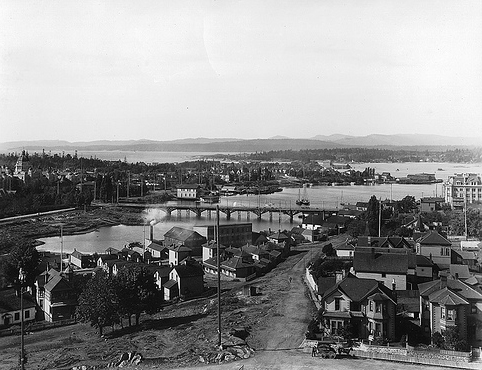
Victoria from cathedral tower, 1897, from http://www.vintag.es/2012/09/old-photographs-of-canada-from-1858-1935.html

Victoria from cathedral tower, 1897, before the mudflats where the Empress now stands were filled in and the causeway built. Victoria was home to a thriving opium-processing industry at this time, yielding substantial revenues for the federal government in Ottawa.

Four former mayors of Vancouver, three former attorneys-general, and municipal councils. All have gone on record supporting the decriminalization, regulation and taxation of marijuana in British Columbia. And now Federal Liberal Party leader Justin Trudeau has pushed debate on the issue one step further, stating the drug should be legalized.

And thanks to all these letters and statements, residents of Greater Victoria get to watch history repeating itself. We have front-row seats in this latest development in our region’s long historical association with officially sanctioned production and trade in drugs.

For almost 50 years, beginning in the 1860s, Victoria reigned as the opium capital of the New World. Fifteen Chinese-owned refineries operated between Herald and Johnson streets in the late-1880s, and employed dozens of workers. In one year alone, they refined about 41,000 kg of opium. Okay, nowhere near the magnitude of output of B.C. Bud today, but significant for the time. …

Read the rest of this article in the Victoria Times Colonist….