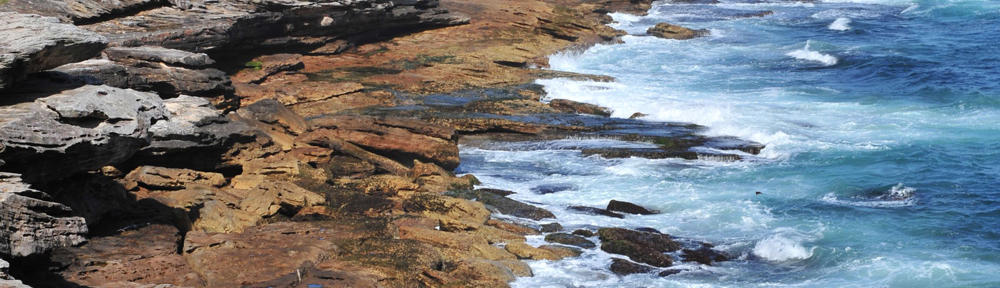
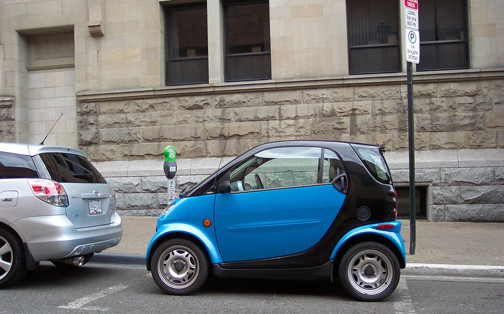
Curbside parking, Victoria. Photo © Christina T, creative commons on flickr

Parking brings out a surprising amount of passion in people. Whenever changes to parking rates and availability are proposed, claws unsheath, and accusations and fur fly.

Looking at the reactions since the City of Victoria proposed changes in February to city-controlled downtown parking, you’d think planners had suggested they intended to make young children and puppies play on Blanshard Street during rush hour, or use parkades for hospital-ward overflow.

Although I’m as delighted as the next person when I find free or cheap parking near a destination, I suggest we park passion and politics for a moment….

Read the rest of this editorial at the Victoria Times Colonist….

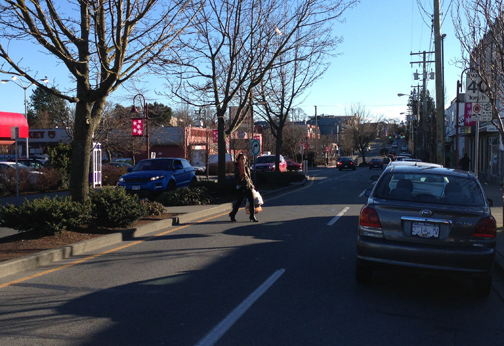
Quadra village street way—designed to slow traffic and encourage community. ©2014.

One of the buzzwords in urban planning these days seems to be “people-friendly streetscapes.”

The intent is to transform the car-centric corridors that crisscross our region into people-oriented spaces.

For example, Victoria’s new official community plan, unveiled last week, calls for transportation systems that prioritize pedestrians, cyclists and people using public transit.

You could consider Quadra Village as an example. As soon as you cross Hillside Road going south, the driving lane narrows, more vehicles are parked at the kerb, more street plantings, arty, low-hanging street lamps and banners change the feel of the street. They immediately shift roadway priorities away from traffic towards the people who live, work, walk, cycle, shop, and make the village viable.

Saanich’s draft plans for Shelbourne Street also call for improved focus on people. In the past, transportation planning along the corridor focused on vehicles, as many as 25,000 of which travel the corridor daily, en route from somewhere else to points beyond. Walking and biking routes are piecemeal. The plans recognize that communities along Shelbourne Street now need to be retrofitted to serve people and these multiple uses.

Brentwood Bay’s slower speed limits, and the Gorge–Tillicum area’s roundabouts also help refocus community throughways on people.

They manifest a paradox known as psychological traffic calming, or playing with drivers’ minds to slow them down….

Read the rest of this editorial at the Victoria Times Colonist….


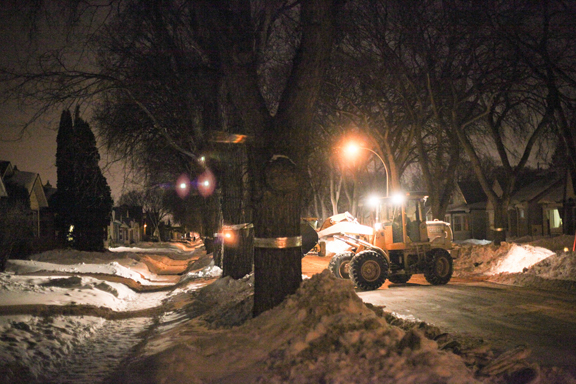
Ploughing snow in Winnipeg. Photo © AJ Batac

I spent some time in Winnipeg before the holidays. While there, I had the dubious pleasure of experiencing, among other things, a goodly period of the city’s second coldest December on record.

Yay, me.

I grew up on the prairies, and I thought I knew what cold was. But apparently my time in Alberta was misspent. My time here in Victoria has made me even softer and weather-wimpier.

As many prairie-folk-come-to-Victoria can attest, –46-degree windchill is Something Else. Minus 46-degree windchill atop –35 degrees out of the wind, for day after day after day, is also exhausting and, in my case anyway, cranky-making….

Read the rest of this editorial in the Victoria Times Colonist….

Victoria residents recently demonstrated again how keen many of them are about birding. Preliminary results from this year’s Christmas Bird Count show more than 200 volunteers turned out in mid-December to watch for birds throughout the Capital Region. The birders recorded 144 species this year. Data collected by birders during the count are used to assess and monitor bird population numbers and health in communities across North America. Community organizers select one day from December 14 until January 5, and send their volunteers out to scour a 24-kilometre-diameter area that stays the same from year to year. Ninety-five communities in B.C. have taken part in the annual event this year. The final numbers of species sighted won’t be tallied until the event officially finishes tomorrow. Started by the Audubon Society in 1900, the Christmas Bird Count now provides 114 years of regularly collected data about bird population numbers across the continent. It helps bird scientists and ecologists assess and monitor species health in regions and individual communities. For example, scientists have used information gathered by community birders during the count to get the Western Screech-Owl, Rusty Blackbird, and Newfoundland Red Crossbill added to Canada’s Species at Risk lists. It also provides opportunity for regular people to engage in and contribute to science. In fact, the Christmas Bird Count is one of the longest-running and better-known citizen-science programs going. The concept of citizen science has grown in scope, popularity and opportunity during the last decade. Thanks in large part to advances in web technology, folk like you and me, who don’t have Ph.D.s and lack access to science labs, can make our own small marks in the scientific process—and learn more about things that interest us.

Victoria residents recently demonstrated again how keen many of them are about birding. Preliminary results from this year’s Christmas Bird Count show more than 200 volunteers turned out in mid-December to watch for birds throughout the Capital Region. The birders recorded 144 species this year.

Data collected by birders during the count are used to assess and monitor bird population numbers and health in communities across North America. Community organizers select one day from December 14 until January 5, and send their volunteers out to scour a 24-kilometre-diameter area that stays the same from year to year. Ninety-five communities in B.C. have taken part in the annual event this year. The final numbers of species sighted won’t be tallied until the event officially finishes tomorrow.

Started by the Audubon Society in 1900, the Christmas Bird Count now provides 114 years of regularly collected data about bird population numbers across the continent. It helps bird scientists and ecologists assess and monitor species health in regions and individual communities. For example, scientists have used information gathered by community birders during the count to get the Western Screech-Owl, Rusty Blackbird, and Newfoundland Red Crossbill added to Canada’s Species at Risk lists.

It also provides opportunity for regular people to engage in and contribute to science. In fact, the Christmas Bird Count is one of the longest-running and better-known citizen-science programs going.

The concept of citizen science has grown in scope, popularity and opportunity during the last decade. Thanks in large part to advances in web technology, folk like you and me, who don’t have Ph.D.s and lack access to science labs, can make our own small marks in the scientific process—and learn more about things that interest us….

View the rest of this article in the Victoria Times Colonist….

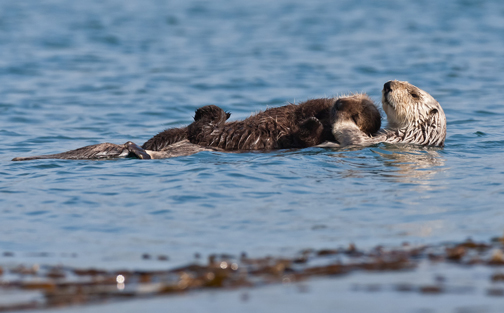
Sea Otter Moms with Pup, Morro Bay CA 13 Dec 2010. Photo © Mike Baird, www.bairdphotos.com

“Sea otters, bah!” Nature Boy says, tongue in cheek. “They’re too easy to love. How can you respect a plush toy?”

Nature Boy is responding to recent reports of sea otters off Langara Island, in Haida Gwaii, and elsewhere on our coast. Although still not common in mid-B.C. waters after its 1970s’ re-introduction, the small marine mammals are slowly repopulating their historic range.

The sea otter’s return is one of Canada’s conservation successes. Confirmed as extirpated by the 1920s, listed as “threatened” in 2002, the sea otter is now considered a “species of concern.”

Nature Boy continues, “Now, the sea urchin—that is a remarkable animal. It has these amazing, intricate jaws….”

“—No match for sea otter jaws,” I interrupt. “Nor is the sea urchin a species at risk. Unlike the sea otter. Or the abalone.”

“Abalone are pretty cool, too,” he admits. “They have those weird breathing holes in the shell, and of course lovely mother of pearl. And they taste real good, too.”

Always a disadvantage for an animal….


Read the rest of this editorial at the Victoria Times Colonist.

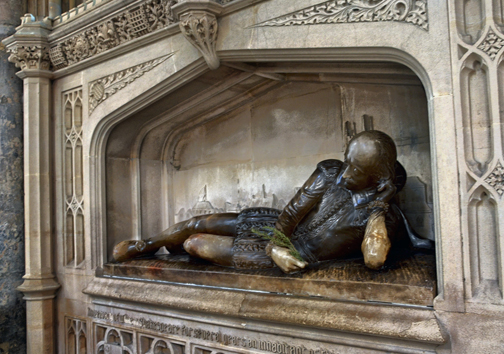
Shakespeare memorial at Southwark Cathedral, U.K. Photo © Duncan Harris.

William Shakespeare had a lot to say about the importance of sleep. His memorial at Southwark Cathedral, U.K.

We can sleep a little longer this weekend. Most of North America resets its clocks one hour back tonight, marking the end of daylight saving time.

If we choose to slumber through the hour gained, we’ll wake up slightly more rested and slightly better able to deal with the coming week’s events and obligations.

For some of us, that week includes attending Tuesday’s opening performance of the new show at Victoria’s Belfry Theatre. A Tender Thing, by British playwright Ben Power, re-imagines Shakespeare’s Romeo and Juliet as lovers grown old together. It is the second of three Shakespeare-inspired shows the Belfry audiences will see this season.

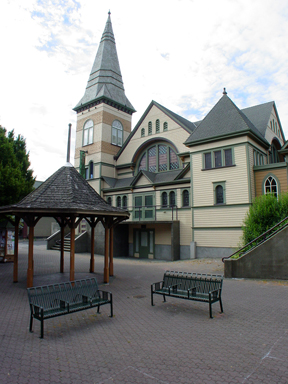
Victoria's Belfry Theatre. Photo © Jason M Vanderhill, illustratedvancouver.com

Victoria’s Belfry Theatre presents Shakespeare three ways this season. A Tender Thing starts the week after clocks change back to Pacific Standard Time.

As with so many aspects of life, William Shakespeare had something to say about the importance of sleep. Four centuries ago, he described sleep as “sore labour’s bath / Balm of hurt minds, great nature’s second course / Chief nourisher in life’s feast” (MacBeth).

Sleep research, most of which has occurred only within the last few decades, confirms the accuracy of Shakespeare’s 400-year-old descriptions. …

Continue reading this editorial at the Victoria Times Colonist….
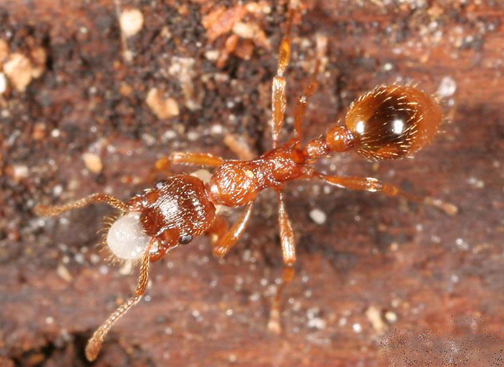
European imported fire ant. Photo by Gary Alpert, Harvard University, via bugwood.com

The European imported fire ant is one of many introduced insect species that are getting comfortable in the Victoria area.

In Germany earlier this year, a woman called the police after her doorbell rang repeatedly in the night, terrifying her. The cops apprehended the culprit—an ant nest built tight into the doorbell was tripping the switch.

My friend experienced a similar problem. Her home-security system spontaneously and repeatedly went off over a period of several months. It usually rang during the day, when she was at work. The alarm would signal the alarm company. The alarm company would notify the police. The police would come by and find nothing amiss. Telephone calls and letters from the company to my friend would follow. My friend would—again and again—call in technicians to find the problem.

It turns out the problem had eight legs and a dime-sized body, and liked to hide in crannies….

Read the rest of this editorial in the Victoria Times Colonist….

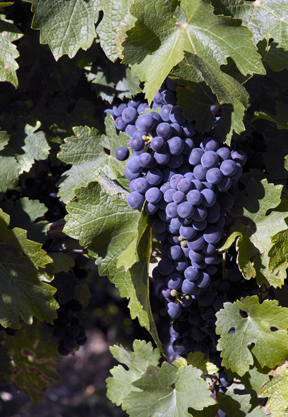
Grape clusters. Photo © Scott Mair

We rarely see grapes being crushed by foot these days, but visitors to the Cowichan Wine and Culinary Festival earlier this month witnessed an old-fashioned grape stomp. Seven teams, dressed in costume, with grape juice soaking the hems of their trousers, shorts, gowns and dresses, competed against each other to stomp the grapes the fastest.

Their bare feet and enthusiasm served to remind spectators of wine making’s fundamentals.

Here and everywhere, wine making starts with sun, water, soil, and vines that take all of the above and turn it into grapes. Those who tend the vines and those that turn the grapes into wine strive to create product that represents and reveals the most desirable qualities of the fruit, place, climate, and so on. Each resulting bottle contains a bit of the heart and soul of the land and of the people who work it.

Yet, behind the growers of grapes and makers of wine, another community of players calls the shots. I’m not talking about grape stompers, who have been mostly replaced by mechanical presses these days. I’m talking about more enduring, pervasive contributors.

In the most basic sense, microbes make the wine….

Continue reading this editorial at the Victoria Times Colonist….
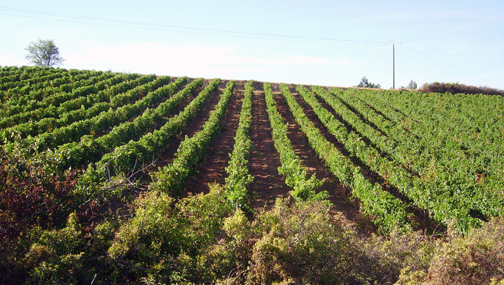
Grape vineyard. Photo © Monique Keiran 2009.