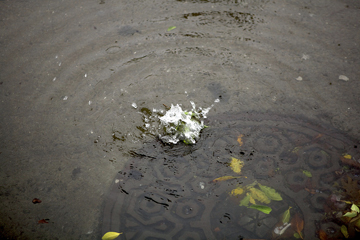
Manhole cover in the rain. Photo © Scott Schiller, via Creative Commons

When government officials and industry specialists gather downtown on Tuesday, they’ll be discussing an issue rarely off the public radar for long in this region: water management.

The Partnership for Water Sustainability in British Columbia and the Irrigation Industry Association of British Columbia are hosting the one-day workshop, Convening for Action on Vancouver Island: How Managing Water Now Will Shape the Future.

The forecast calls for rain.

Sure, we enjoyed one of the region’s drier summers. Rivers dropped to worrisome levels. Water restrictions up Island were extended past their usual end dates.

We’ve also experienced the soggy lash of Hurricane Ana’s remnants. And, in September, a storm so sudden and intense hit the region that water gushed out from beneath manhole covers onto Victoria’s streets. In October, the beach at Cadboro Bay was closed to the public yet again, because high-rainfall mixing of stormwater and sewage in Oak Bay’s aging drains system flushed human waste into the bay.

And the City of Victoria officially announced its new stormwater utility.

As mentioned, water and water management are perennial topics for discussion here….

Read the rest of this editorial at the Victoria Times Colonist….

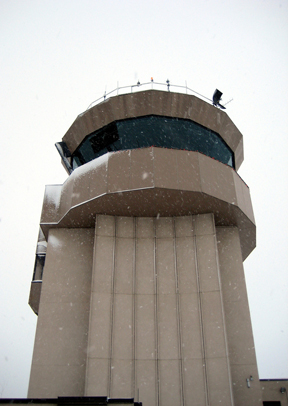
YYJ control tower. Photo © Brian Burger WireLizard via flickr and Creative Commons

YYJ control tower. Photo © Brian Burger WireLizard via flickr and Creative Commons

A Supreme Court of B.C. decision confirmed earlier this month that the air-traffic control tower at Victoria International Airport should be valued at $20. The property had been assessed at $1.43 million.

The ruling came after a long battle between North Saanich, where the airport is located, and Nav Canada, which owns and operates Canada’s civil air-navigation system.

The court-confirmed value of the property means about $26,000 less annual tax revenue for North Saanich. The municipality has already reimbursed Nav Canada $43,000 for taxes paid for 2011 and 2012. It is now expected to refund $55,000 for 2013 and 2014.

The ruling also applies to three other Nav Canada properties in B.C. The air traffic control towers at the Castlegar, Penticton and Pitt Meadows airports had originally been assessed at between $270,000 and $423,000.

And it sets a precedent for Nav Canada’s appeals of assessments of 120 other properties in B.C., including properties at the Vancouver International Airport valued at $9.9 million.

It sets a precedent also for other properties with single uses and low market exchange.

It has been pointed out that Nav Canada’s legal weaseling out from its property-tax responsibilities is yet another way in which other governments—with significantly larger revenue bases—are downloading responsibility for services and their funding onto municipalities….

Read the rest of this editorial at the Victoria Times Colonist….

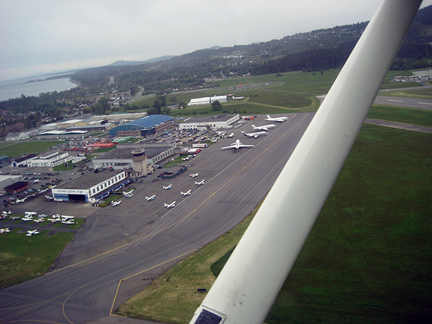
YYJ from the air. Photo © Brian Burger, WireLizard, via flickr & Creative Commons

YYJ from the air. Photo © Brian Burger, WireLizard, via flickr & Creative Commons

Coffee cups—reusable is more environmentally friendly if you use them often and for a long time. Photo © Marit & Toomas Hinnosaar, via creative commons and flickr

Coffee cups—reusable is more environmentally friendly if you use them often and for a long time. Photo © Marit & Toomas Hinnosaar, via creative commons and flickr

Back when I was young, a University of Victoria researcher published a paper that shifted the ground under my idealistic, environmentally conscious, fairtrade sock-clad feet.

The year was 1994. Scientists had published the first big studies documenting rapid, modern climate change. Alberta’s tar-sands companies had publicly accepted government bail-outs. Earth Day was big, and environmental education was the new cool, despite—perhaps in spite of—Canada’s conservative Fraser Institute’s statements that it constituted social brainwashing.

Chemist Martin Hocking’s paper presented an analysis of which type of beverage container was most energy efficient to use—paper cups, ceramic mugs, glass mugs, styrofoam cups, or hard plastic cups.

The answer surprised me and many others.

Conventional wisdom was that ceramic or glass—reusable—cups beat plastic or paper cups in eco-friendliness….

Read the rest of this editorial at the Victoria Times Colonist….

Elevator buttons: dirtier than a toilet seat. Photo © Dan Taylor, via creative commons and flickr

Nature Boy recently scaled back using his hands.

He stopped coughing and sneezing into them during the SARS outbreak in 2002. He now spews his sputum and microbes into the insides of his elbows. This prevents him from spreading his viruses to everything and everyone he touches.

It’s all part of his civic/civilized duty, he says.

Then he cut back on direct contact with certain fixtures in public and semi-public spaces—toilet-flush levers, washroom and drink-fountain taps, and telephones that he hasn’t personally sanitized.

Too much television prompted the escalation of Nature Boy’s no-hands policy. According to MythBusters, the popular Hollywood-effects show where the hosts shoot and blow up things—all in the name of proving or debunking common wisdom, each square centimetre on an office telephone can harbour more than 10,000 microbes, while a square centimetre on a public water fountains can hold as many as one million bacteria.

By limiting direct contact with those fixtures, Nature Boy limits the microbes he picks up from those surfaces. He instead enlists go-between materials, such as tissue for the washroom fixtures, or pencil or pens to call out from telephones. As for holding telephones—“I prefer the speaker function,” he says, waving the eraser end of a pencil at me.

This squeamishness is entirely out of character for Nature Boy. He does, after all, spend his time handling dog-poo-eating banana slugs, being peed on by turtles, and swamping around for bullfrogs. He also knows there’s more to him than himself—his body contains many more bacteria than human cells.

Nonetheless.

He recently added elevator buttons to the no-touch list….

Read the rest of this editorial at the Victoria Times Colonist….

Sign of the foo. Photo © TimParkinson, via Creative Commons and flickr.com/timparkinson/

Sign of the foo. Photo © TimParkinson, via Creative Commons and flickr.com/timparkinson/

In the recent Incident of the Abandoned Ford Thunderbird, the Sooke resident who found the abandoned car, complete with registration papers, in the woods near Bear Creek posted a scathing rant online and notified police.

Instead of immediately fining the car’s owner under the conservation and motor vehicle acts, the RCMP turned the incident into a learning opportunity. They gave the owner a choice: remove and properly dispose of the vehicle within a given timeframe, or face fines of up to $3000.

The related media and online coverage served to remind us all of the laws against dumping garbage and unwanted goods on private and public lands.

The Capital Regional District defines illegal dumping as any activity by which waste materials are intentionally disposed of in an unauthorized location. This includes abandoning used goods on sidewalks, in alleyways and other public spaces. It includes the dumping of waste on logging roads and other rural spaces, and other ways of ridding oneself of garbage at another’s expense.

A 2011 survey of the region’s municipalities, recycling depots and non-profit recycling organizations indicates the most common materials illegally discarded here are furniture and mattresses, and the most frequent locations are along municipal boulevards.

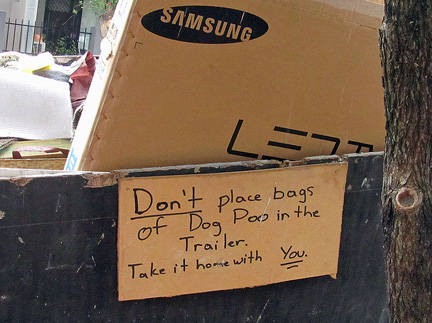
I beg to differ. Far fewer sofas, mattresses and so on are left to rot along the region’s roadways in any given month than bags full of dog doo are left to decorate the bushes, trees and trails of our parks and green spaces….

Read the rest of this editorial at the Victoria Times Colonist….

Dog doo wars. Photo © Newtown Grafitti, via Creative Commons and flickr

Dog doo wars. Photo © Newtown Grafitti, via Creative Commons and flickr

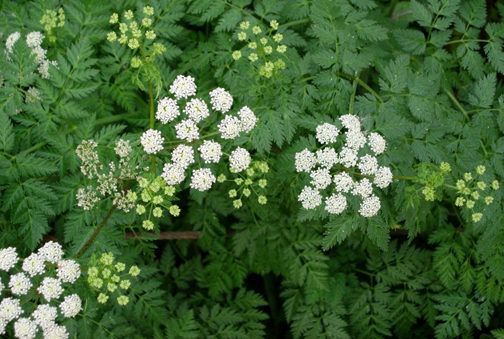
Poison Hemlock flowers. Photo © Paige Filler, via creative commons & flickr

Our benign climate welcomes yet another uninvited transplant to the region. Poison hemlock joins hundreds of other invasive plant species that make themselves at home here.

Like some of those other plants, it contains toxins. Unlike most of them, it resembles a common cooking herb, and can be easily mistaken and ingested as such.

Native to Europe, poison hemlock gained lasting notoriety 2,413 years ago as the poison used to kill Greek philosopher Socrates. In 2002, two people went into respiratory arrest and were hospitalised after eating parts of the plant.

Poison hemlock is to be handled with care and gloves. Consider the precautions part of the evolutionary arms race between plants and animals….

Read the rest of this editorial at the Victoria Times Colonist….

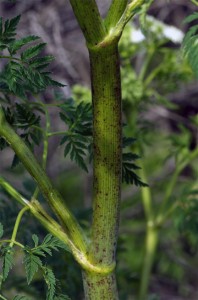
Poison Hemlock has purple-splotched stems. Photo © Jerry Kirkhart, via creative commons & flickr

These image files are intentionally large, so that you can read the text. While you wait for them to load, feel free to read about the project.

The mission: Create an exhibit for less than $5,000 and in less than two months. Use existing trade-show exhibit armatures, and scrounge props and artifacts from researchers’ labs.

An extra challenge: Design and produce the exhibit in such a way that it showcases the capabilities of the large-scale printer that was available for use by researchers at Pacific Forestry Centre and maintains all the design guidelines prescribed for Natural Resources Canada displays and publications. As well, the exhibit had to satisfy requirements of the Official Languages Act, and all interpretive panels had to include text in both English and French. I developed the project plan for Alien Invasives, an exhibit to be installed on the mezzanine level of the Pacific Forestry Centre in time for National Forest Week. I worked with researchers, technicians and managers from Pacific Forestry Centre to develop the interpretive concept and text for the exhibit panels, large and small. Avril Goodall, the Natural Resources Canada graphic designer, determined and executed the design concept.

The Big Idea: Scientists and policy makers at the Canadian Forest Service, Natural Resources Canada, were working to protect Canada’s forests, economy and trade from alien invasive insects.

Audience: school teachers and students who visited Pacific Forestry Centre for National Forest Week’s Forest Fair celebration, staff and visitors.

Key Messages: 

  • Invasive alien forest species are non-native organisms that thrive in Canada’s forests.
  • They can be introduced to Canada’s forests both intentionally and inadvertently, through many different pathways.
  • They can seriously alter Canada’s forest ecosystems, causing environmental, economic and social damage that can be irrevocable.
  • The Government of Canada (Natural Resources Canada and the Canadian Food Inspection Agency) is working to prevent the introduction and spread of invasive alien forest species, and to protect Canada’s forests, economies, communities and trade.

Design and Installation: Each of the attached panels was attached to a 3.66 x 2.44-metre trade-show exhibit armature. Two of the backdrop panels were placed side by side in an arc (exhibit area 1), with the third backdrop facing it across the mezzanine (exhibit area 2). The backdrop panels were designed according to departmental common-look-and-feel design specifications, thereby allowing all other panels greater flexibility in design and presentation. Banners (~8 x 2 metres) with giant, high-resolution images of invasive species draped from steel cables framed each display area. In addition to the backdrop panels shown here, displays with interpretive signage in exhibit area 1 included:

  • A vine maple sapling, with holes drilled into the trunk. Life-size models of Asian longhorned beetles were glued into the holes.
  • A wooden spool for transporting cable, with an interpretive panel discussing how wooden packaging materials such as industrial spools and pallets transported many invasive species from other countries to Canada.
  • A display box of various invasive beetle specimens, on loan from the Pacific Forestry Centre entomology collection.

In exhibit area 2, displays with interpretive signage included:

  • A 1/2-metre-long, super-sized model of a mountain pine beetle.
  • A tree cookie and debarked log section showing beetle galleries.
  •  A funnel trap and bag, similar to those used in a recent lab study on how beetles breed and colonize new trees.

In addition, Avril Goodall designed, fabricated and installed a mobile of Asian gypsy moths in the middle of the Pacific Forestry Centre Atrium to complement the exhibit.
Thanksgiving dinner. Photo © Sarah Ackerman, via creative commons and flickr

On a visit south of the border some time ago, I found myself staring at the nutriional-information panel printed on a box of Triscuits.

At first, I stared without really looking—after all, the “Low-Sodium Triscuit” product sold in the U.S. is the same as the “Low-Sodium Triscuit” product sold in Canada.But something about the information penetrated the fog of my inattention and focussed my penetrating powers of pointy-headed perspicacity on one line:

Serving size: 8 crackers

Now, I’m hardly a Triscuit expert, let along a Triscuit-packaging expert, but in that moment I was pretty certain that number wasn’t what this particular pointy-headed Canadian gal remembered the recommended Triscuit serving size to be. It seemed … generous. I vaguely recalled a smaller serving size listed on boxes of Triscuits north of the border.

Was I mistaken?…

Find out by reading the rest of this editorial at the Victoria Times Colonist….