Although many of my Victoria Times Colonist editorials are posted on this blog, visit the newspaper’s online site to access the complete and up-to-date collection.

Somehow, during the years when I mucked about with rocks and critters, and poked at bones of extinct species, being a geek became, well, cool.
I use the word “geek” with the great respect it deserves. My world is peopled by persons passionate about things odd or overlooked, by collectors of specimens, information and ideas, by those who make it their lives’ work to turn over rocks just to see what lies beneath, to grasp what is remarkable in it, and to remark on it. These people never outgrew the childhood need to ask “What?” ‘Why?” and “How?” that is stifled in so 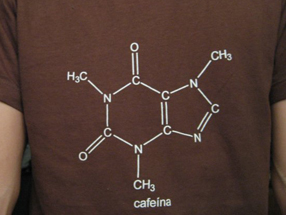 many others.
Sometime during the last 20 years, smart became the new black. Brainy people with focused, intense interests showed that thinking off-centre and poking about in odd corners can mean opportunity, vision and, sometimes—and of particular importance to how our society measures worth—wealth…
Read the rest of this editorial at the Victoria Times Colonist…
Nature Boy spent a few minutes dabbling his toes in the water at Willows Beach last week.
“I don’t feel it,” he reported. “They say a great blob of warm ocean water has moved up to the northern coast. It appears to not have arrived at Willows.”
“Maybe it’s something only marine critters can easily feel,” I say. “If you spent all day in the water, you might notice.”
“If I did that,” he said, “someone might mistake me for a great, warm blob.”
The system Nature Boy refers to first appeared in the North Pacific Ocean in late-2013. Named the Blob by one of the University of Washington researchers who discovered it, it spread across almost two million square kilometres of the Gulf of Alaska, and now plugs up the Bering Sea, with daughter Blobs (Blobbies?) warming offshore waters all the way south to Mexico.
Acting much like the high-pressure Polar Vortex systems that lobed southwards over the prairies and pushed away systems of warmer air throughout the winter and spring of 2013–2014, The Blob redirects cold ocean currents from their eons-old routes. The two phenomena may not be connected.
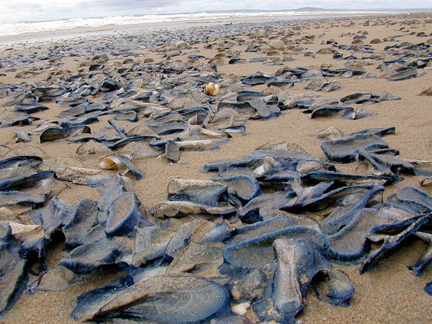
Some unlikely warm-water species are now checking out northern latitudes as a result. Fishermen caught a skipjack tuna caught off Alaska last September, warm-water Velellas, relatives of sea jellies, washed ashore at Tofino and Haida Gwai’i, and rare pygmy orca have been spotted off Washington State.
However, The Blob is primarily a dead zone. With temperatures as much as three degrees above the region’s average, it not only redirects ocean currents, it dampens the natural mixing of water layers. This affects salinity, dissolved oxygen and acidity within the water, which in turn reduces nutrients and biological productivity….
Read the rest of this editorial at the Victoria Times Colonist….
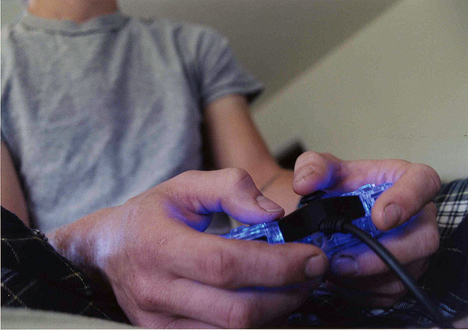
Seven of Victoria’s video-game studios recently launched new games. The games, which include TinyMob’s Tiny Realms and GameHouse’s new version of Slingo, highlight the industry’s growth in the region.
The 20 or so Victoria-based studios employ 240 people and spend about $25 million annually. Eight years ago, about 40 people worked in local game studios.
On a global scale, gaming revenues are predicted to grow to $78 billion in the next two years.
The industry’s growth mirrors that in other digital technology industries. As the Internet advanced in sophistication and conquered both the wider, geographic world and our personal time, so have video games.
We’ve come a long way, baby, from Pokémon, Doom and The Legend of Zelda.
Game designers have also become more sophisticated in attracting and retaining players.
In many games, designers intentionally manipulate players to keep them online and to keep them returning to play more, again and at higher levels. They design consequences into games to prevent players from stopping play, and build in rewards for players who stay in the game, move up to higher levels and to subscribe to advance the game….
Read the rest of this editorial at the Victoria Times Colonist….

Among groups of people, ignoring somebody is often considered a sign of disrespect. The word disrespect itself means disregard, overlook, to not acknowledge or look at something.
Over the last dozen years, we have seen disrespect for federal legislation. The Species at Risk Act became law in December 2002, but for most of its existence it has been disregarded by the very government responsible for enacting the law.
No wonder citizen groups are striking out independently. For example, the Raincoast Conservation Foundation, the Dogwood Initiative, Northwest Wildlife Preservation Society and South Vancouver Island Anglers Association recently announced they would start taking their own action to save the region’s orcas.
The feds declared southern resident orcas endangered 12 years ago. The Species at Risk Act requires the government to develop recovery strategies and action plans for the species within a set period. However, the required federal action plan to protect orcas remains incomplete….
Read the rest of this editorial at the Victoria Times Colonist….
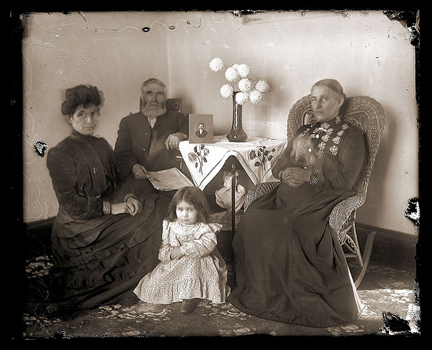
Many mothers I know, no matter how old their kids are, tell me they feel their children continue to be part of them long after birth. Despite decades having passed since the umbilical cords were cut, the ties connecting mothers to their kids can feel strong and eternal.
It appears that a strange, genetic truth backs up those instinctual feelings. Mothers may think continually of their children, but recent genetic studies show mothers also physically retain bits of their kids in their bodies.
During pregnancy, the placenta interfaces between mother and fetus. This organ consists of cells from both mother and child, and permits the mother to supply the developing fetus with oxygen, hormones, and nutrients. It also provides an avenue for the fetus to expel its own carbon dioxide and waste through the mother’s body.
Entire cells cross the placenta in both directions throughout a pregnancy. Now, multiple research studies show that a child’s genetic material can reside within the mother for decades after the child is born. The cells, with their unique genetic coding, may collect in the mother’s skin, liver, spleen, kidneys, heart, muscles, thyroid, and lungs. Research published last year indicates it even infiltrates the mother’s brain….
Read the rest of this editorial at the Victoria Times Colonist….
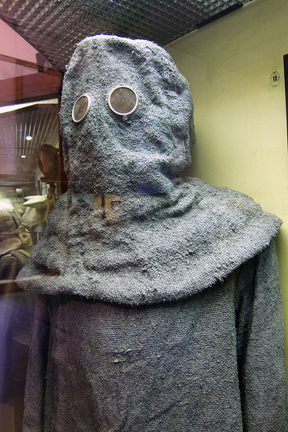
First World War gas mask. Photo © Thom Quine, via Creative Commons and flickr
The recent tragedy experienced by a Fort McMurray family has roots in century-old events.
This February, an eight-month-old baby and her two-year-old brother died after breathing in a pesticide fumigant. Four other family members required treatment, with one requiring intensive care in Edmonton.
The building where the family lives is infested with bedbugs. During a recent visit to Pakistan, the children’s mother had purchased pesticide tablets to kill the bugs.
The pesticide is phosphine. This insecticide is usually sold as tablets that combine phosphide powder with calcium or aluminum. When the powder encounters moisture or humidity, it releases phosphine gas. It’s one of the most toxic pesticides registered in Canada, where it can be purchased and used only by licensed operators.
When inhaled, the gas irritates the lungs and airway, harms the heart and circulation, and produces severe stomach pains. It also interferes with the central nervous system, much like sarin gas, an outlawed chemical weapon.
Its effects can be immediate and severe, depending on level of exposure.
Phosphine gas wasn’t known 100 years ago. Had it been, it may have been used in the war in Europe.
Known as the chemists’ war, the First World War industrialised production of many new chemicals….
Read the rest of this editorial at the Victoria Times Colonist: Fatal pesticide linked to chemical weapons…
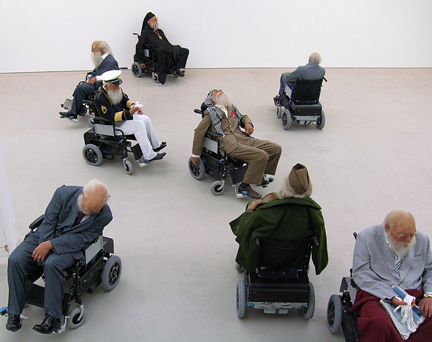
Old Person’s Home, an art exhibit at Saatchi Gallery, London. Photo © Jim Limwood, Creative Commons via flickr
Take 12 minutes.
Twelve minutes represent less than one per cent of a day.
If you work full-time, commute, ferry kids around, do chores, 12 minutes of free time allows you to catch your breath, prepare for the next crisis, or give your kids some undivided attention. Or 12 minutes means you’re late and you’ll be scrambling for the rest of the day.
If, however, your days lack the luxury of busy-ness—if, for example, you depend on others to help you dress, bathe, move about, arrange your social and recreational activities, and provide your meals—12 minutes may seem a mere eye blink in a day that stretches on and on like a geological epoch. Even if you subtract the eight hours of your day spent sleeping, the one hour spent bathing, dressing and personal care, three generous hours for eating and preparing to eat, you still face 12 hours of unalloted time. That’s 60 12-minute periods.
According to the Island Health spokesperson quoted in Katherine Dedyna’s April 9 article in this newspaper, 12 minutes is the minimum amount of physiotherapy or occupational therapy, nursing, or other “allied services” that each senior in residential care in the region receives each day from Island Health. Using $40 as an hourly average payment, Island Health funds 26 facilities almost $3,000 a year per resident, with services determined by the assessed needs of the individual residents. That means one facility may provide more hours of physiotherapy and another may arrange for more social-work hours per resident.
WIth the funds covering the spectrum of allied health services, most residents at most public long-term care facilities in the region receive much less than 12 minutes of physically active therapy daily, if any at all.
Seniors Advocate Isobel Mackenzie highlights that lack in her report, Placement, Drugs and Therapy: We Can Do Better. She reveals that fewer than 12 per cent of B.C. seniors in public residential care homes receive weekly physiotherapy, and only 22 per cent receive recreational therapy such as chair exercises or bingo.
What she doesn’t detail is that, in some residential care facilities, if you need help to stand up, you likely spend your days sitting. Care home staff encourage you to use a wheelchair….
Read the rest of this editorial at the Victoria Times Colonist.


