Table Setting 74. Photo © Didriks, via Creative Commons and flickr. www.didriks.com

“I’m setting out the small dinner plates,” Nature Boy announced the other evening as we prepared to welcome guests. “It will help pace us through the meal.”

Nature Boy recently assumed responsibility for setting the table for evening meals. With meals round these parts typically being the quick and informal sort, the choice of dinnerware rarely receives much thought.

But the task becomes more complicated when, as with the evening in question, guests are expected, menus encompass multiple courses, and appetites must be managed throughout the evening. Such occasions call upon Nature Boy to tune up his geometry and social-engineering skills. It’s not just a matter of how to seat so many people around a limited dining surface, but (he asserts) incorporating the latest social and neurological science into the effects of the setting—and the setting of the table—on the perception and enjoyment of the food served.

Nature Boy’s efforts at table landscaping have climbed to new intellectual and socially manipulative heights.

The studies Nature Boy called on when he selected smaller plates determined that plate size affects how much food people serve themselves and how much they think they’re eating….

Read the rest of this editorial at the Victoria Times Colonist….
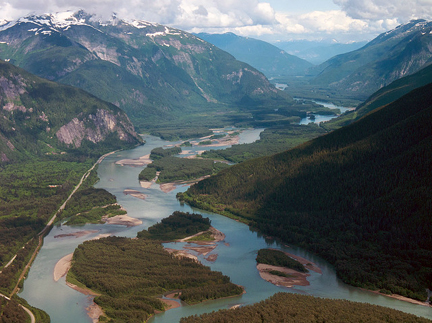
Spectacular Skeena River Valley. Photo © Sam Beebe, Ecotrust

Spectacular Skeena River Valley. Photo © Sam Beebe, Ecotrust

Enbridge first proposed Kitimat as the West Coast terminus of its Northern Gateway pipeline a decade ago. The company has been defending the choice ever since.

For much of the ensuing time, attention has focused tightly on that project.

Oh, sure, the deliberations and demonstrations about the Keystone XL pipeline project in the U.S. were noted, but, until recently, B.C. has concentrated on the Northern Gateway proposal….

Read the rest of this editorial at the Victoria Times Colonist….
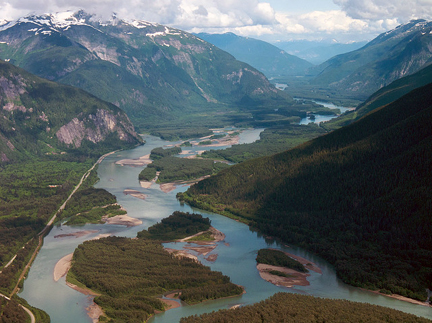
Manhole cover in the rain. Photo © Scott Schiller, via Creative Commons

When government officials and industry specialists gather downtown on Tuesday, they’ll be discussing an issue rarely off the public radar for long in this region: water management.

The Partnership for Water Sustainability in British Columbia and the Irrigation Industry Association of British Columbia are hosting the one-day workshop, Convening for Action on Vancouver Island: How Managing Water Now Will Shape the Future.

The forecast calls for rain.

Sure, we enjoyed one of the region’s drier summers. Rivers dropped to worrisome levels. Water restrictions up Island were extended past their usual end dates.

We’ve also experienced the soggy lash of Hurricane Ana’s remnants. And, in September, a storm so sudden and intense hit the region that water gushed out from beneath manhole covers onto Victoria’s streets. In October, the beach at Cadboro Bay was closed to the public yet again, because high-rainfall mixing of stormwater and sewage in Oak Bay’s aging drains system flushed human waste into the bay.

And the City of Victoria officially announced its new stormwater utility.

As mentioned, water and water management are perennial topics for discussion here….

Read the rest of this editorial at the Victoria Times Colonist….
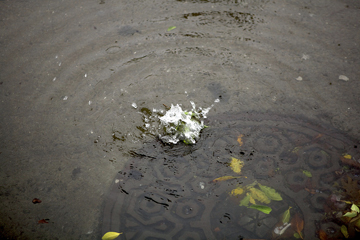
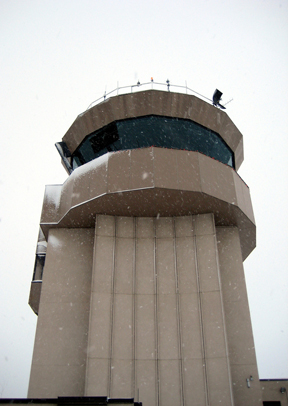
YYJ control tower. Photo © Brian Burger WireLizard via flickr and Creative Commons

YYJ control tower. Photo © Brian Burger WireLizard via flickr and Creative Commons

A Supreme Court of B.C. decision confirmed earlier this month that the air-traffic control tower at Victoria International Airport should be valued at $20. The property had been assessed at $1.43 million.

The ruling came after a long battle between North Saanich, where the airport is located, and Nav Canada, which owns and operates Canada’s civil air-navigation system.

The court-confirmed value of the property means about $26,000 less annual tax revenue for North Saanich. The municipality has already reimbursed Nav Canada $43,000 for taxes paid for 2011 and 2012. It is now expected to refund $55,000 for 2013 and 2014.

The ruling also applies to three other Nav Canada properties in B.C. The air traffic control towers at the Castlegar, Penticton and Pitt Meadows airports had originally been assessed at between $270,000 and $423,000.

And it sets a precedent for Nav Canada’s appeals of assessments of 120 other properties in B.C., including properties at the Vancouver International Airport valued at $9.9 million.

It sets a precedent also for other properties with single uses and low market exchange.

It has been pointed out that Nav Canada’s legal weaseling out from its property-tax responsibilities is yet another way in which other governments—with significantly larger revenue bases—are downloading responsibility for services and their funding onto municipalities….

Read the rest of this editorial at the Victoria Times Colonist….
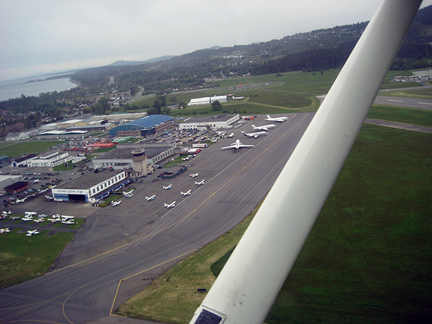
YYJ from the air. Photo © Brian Burger, WireLizard, via flickr & Creative Commons

YYJ from the air. Photo © Brian Burger, WireLizard, via flickr & Creative Commons

Coffee cups—reusable is more environmentally friendly if you use them often and for a long time. Photo © Marit & Toomas Hinnosaar, via creative commons and flickr

Coffee cups—reusable is more environmentally friendly if you use them often and for a long time. Photo © Marit & Toomas Hinnosaar, via creative commons and flickr

Back when I was young, a University of Victoria researcher published a paper that shifted the ground under my idealistic, environmentally conscious, fairtrade sock-clad feet.

The year was 1994. Scientists had published the first big studies documenting rapid, modern climate change. Alberta’s tar-sands companies had publicly accepted government bail-outs. Earth Day was big, and environmental education was the new cool, despite—perhaps in spite of—Canada’s conservative Fraser Institute’s statements that it constituted social brainwashing.

Chemist Martin Hocking’s paper presented an analysis of which type of beverage container was most energy efficient to use—paper cups, ceramic mugs, glass mugs, styrofoam cups, or hard plastic cups.

The answer surprised me and many others.

Conventional wisdom was that ceramic or glass—reusable—cups beat plastic or paper cups in eco-friendliness….

Read the rest of this editorial at the Victoria Times Colonist….
Elevator buttons: dirtier than a toilet seat. Photo © Dan Taylor, via creative commons and flickr

Nature Boy recently scaled back using his hands.

He stopped coughing and sneezing into them during the SARS outbreak in 2002. He now spews his sputum and microbes into the insides of his elbows. This prevents him from spreading his viruses to everything and everyone he touches.

It’s all part of his civic/civilized duty, he says.

Then he cut back on direct contact with certain fixtures in public and semi-public spaces—toilet-flush levers, washroom and drink-fountain taps, and telephones that he hasn’t personally sanitized.

Too much television prompted the escalation of Nature Boy’s no-hands policy. According to MythBusters, the popular Hollywood-effects show where the hosts shoot and blow up things—all in the name of proving or debunking common wisdom, each square centimetre on an office telephone can harbour more than 10,000 microbes, while a square centimetre on a public water fountains can hold as many as one million bacteria.

By limiting direct contact with those fixtures, Nature Boy limits the microbes he picks up from those surfaces. He instead enlists go-between materials, such as tissue for the washroom fixtures, or pencil or pens to call out from telephones. As for holding telephones—“I prefer the speaker function,” he says, waving the eraser end of a pencil at me.

This squeamishness is entirely out of character for Nature Boy. He does, after all, spend his time handling dog-poo-eating banana slugs, being peed on by turtles, and swamping around for bullfrogs. He also knows there’s more to him than himself—his body contains many more bacteria than human cells.

Nonetheless.

He recently added elevator buttons to the no-touch list….

Read the rest of this editorial at the Victoria Times Colonist….

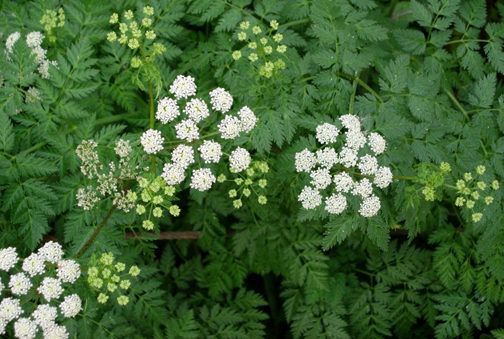
Poison Hemlock flowers. Photo © Paige Filler, via creative commons & flickr

Our benign climate welcomes yet another uninvited transplant to the region. Poison hemlock joins hundreds of other invasive plant species that make themselves at home here.

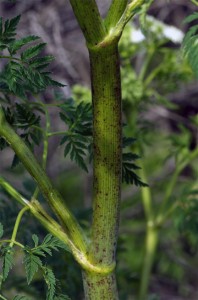
Like some of those other plants, it contains toxins. Unlike most of them, it resembles a common cooking herb, and can be easily mistaken and ingested as such.

Native to Europe, poison hemlock gained lasting notoriety 2,413 years ago as the poison used to kill Greek philosopher Socrates. In 2002, two people went into respiratory arrest and were hospitalised after eating parts of the plant.

Poison hemlock is to be handled with care and gloves. Consider the precautions part of the evolutionary arms race between plants and animals….

Read the rest of this editorial at the Victoria Times Colonist….

Poison Hemlock has purple-splotched stems. Photo © Jerry Kirkhart, via creative commons & flickr

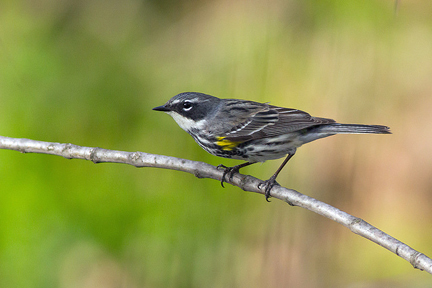
Myrtle warbler. Photo © zenbenscience, via creative commons & flickr

While we await the region’s autumn rains, the rest of the country prepares for winter. After last year’s ordeal, flocks of Snowbirds east of the Rockies are preparing their escape routes.

Some will visit our region. Others will head south.

Our behaviour mirrors a time-honoured tradition begun by our feathered friends eons ago. Scientists recently established that the region’s migrating birds are at heart northern residents that, like their human counterparts, head south to avoid harsh winters.

For years, scientists believed migrating birds first started leaving southern territories to travel northwards across and between continents because of intense competition for space and food in the crowded tropics. After all, most songbirds in the Americas, including those that don’t migrate, live in the South American tropics, and most migratory species have close tropical relatives.

But that theory is now turned upside-down, geographically speaking. After analyzing the family trees and territorial origins ofsparrows, warblers and blackbirds—which together make up the largest group of North American songbirds—scientists found that long-distance migration was twice as likely to arise among bird ancestors from temperate regions than among ancestors from the tropics.

The majority of the species started migrating by moving their winter ranges southwards.

Read the rest of this editorial at the Victoria Times Colonist….