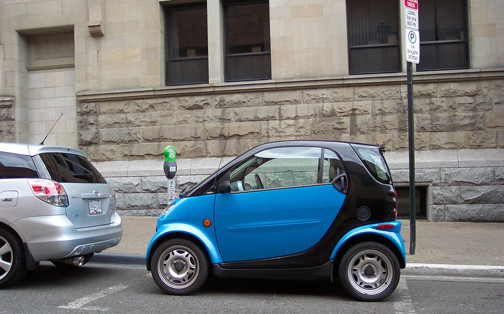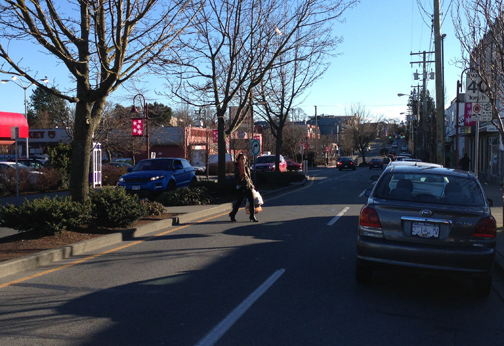
Curbside parking, Victoria. Photo © Christina T, creative commons on flickr

Parking brings out a surprising amount of passion in people. Whenever changes to parking rates and availability are proposed, claws unsheath, and accusations and fur fly.

Looking at the reactions since the City of Victoria proposed changes in February to city-controlled downtown parking, you’d think planners had suggested they intended to make young children and puppies play on Blanshard Street during rush hour, or use parkades for hospital-ward overflow.

Although I’m as delighted as the next person when I find free or cheap parking near a destination, I suggest we park passion and politics for a moment….

Read the rest of this editorial at the Victoria Times Colonist….

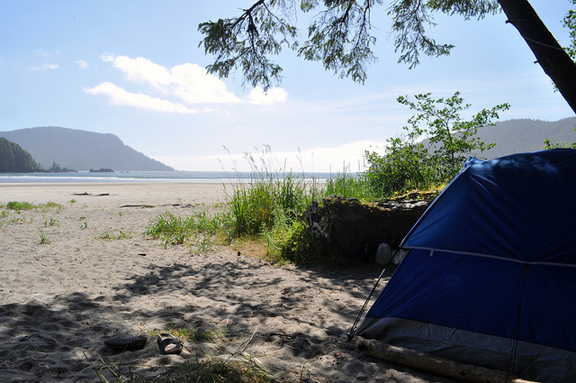
Camping at San Josef's Bay, Vancouver Island. Photo © Madeleine Holland, creative commons flickr

We lose an hour of sleep this weekend, and over the next couple of weeks will be adjusting to that shift to Daylight Saving Time. This coming week, we’ll be waking up before sunrise again and eating later in the evening, because we’re just not hungry for supper at six o’clock. Everything will be just a little bit off, as our internal body clocks try to catch up with the regimented requirements of modern life.

But no matter. We’ll have more daylight in the evening, when we’re awake to appreciate it. This will help us prepare to fine-tune our inner body clocks—every one of them—to longer, brighter days.

It was once thought that the brain controlled our body clocks. That any human-caused shift backwards or forwards on the sundial meant we had to reset that part of the brain that woke us automatically at 6:30 every morning, or at 2:30 a.m. if we’d jetted over to Hawai’i for the February break.

Research over the last decade suggests that the brain is indeed involved, but more as master networking device than a solitary systems timekeeper. It would seem many organs within our bodies measure the passage of time according to their own internal cellular timepieces, quite independent of what HQ in the noggin or the clock on the wall dictates. Cells within each of these organs track time throughout the day, and accordingly produce and release different amounts of enzymes and molecules at different times of day….

Read the rest of the editorial at the Victoria Times Colonist.


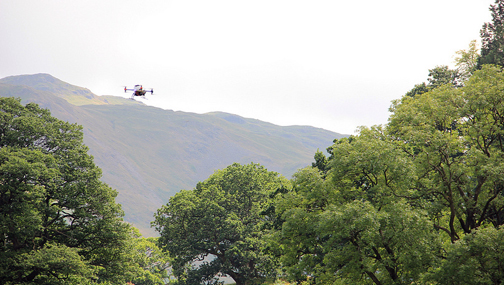
Drone over Patterdale, U.K. Photo © John Mills - millstastic, flickr

Just imagine. You’ve won Lotto 6/49 and are keeping your grandmother’s bit of property in the family. But what’s really amazing in this new, fantastical life of yours is the drone that delivers drinks to you on your terrace in Tuscany, picks up your mail, and delivers your meals from that quaint little place run by Guido’s nonna just off the town square. Oh, and it keeps an eye on your dog and wayward teenaged kids, too.

Okay, so that’s all fantasy.

But a group of fisherfolk in the middle of a frozen lake in the middle of frozen Minnesota got to experience a brief, tantalizing taste of the fantasy this winter. Lakemaid Beer, a craft brewer based in Stevens Point, Wisconsin, used a drone to fly a 12-pack of lager to GPS coordinates provided by anglers huddled in a shack on Minnesota’s Lake Mille Lacs.

And last August, people attending a music festival in South Africa got to skip the line in the beer tent and the ice in central Minnesota to have their drinks drone-delivered onto their heads. The unmanned aircraft hovered 15 metres above the coordinates it had been programmed to deliver to, and parachuted beverages down onto customers.

Look up, Rusty. Look way up….

Read the rest of this editorial at the Victoria Times Colonist….

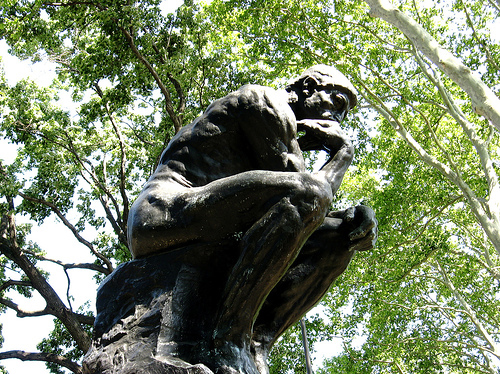
The Thinker. Photo © edillalo, flickr - creative commons

Not so long ago, the Occupational Safety and Health people performed their annual inspection of the safety imperfections of my workspace. Armed with clipboards, they flicked the lights on and off, checked that the bookcases were still attached to the walls, and tsk’d at the four electrical cords plugged into one surge protector. They spent about five minutes in my office, then moved on.

The irony of it.

Oh, they ensured I won’t be buried under a pile of dictionaries and style guides in the event of an earthquake. They made a note to get someone in to fix the ceiling light. They even put an order in for a second surge protector, thereby keeping my computer, data and the rest of the building’s electrical supply safe.

But aside from asking if I needed a pedestal for my computer monitor, they ignored the biggest occupational safety and health risks associated with the work I do. They made no mention nor lifted a single eyebrow about how, for much of each day, I court early death.

Death by sitting….

Read the rest of this editorial at the Victoria Times Colonist.

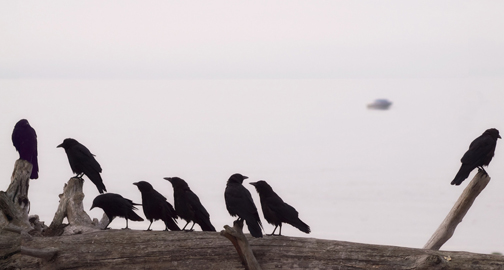
One crow for sorrow; Eight crows for heaven. Photo © Ingrid Taylar @ thewildbeat.com

If this were 2000 years ago, the population may have rioted in the streets.

At the very least, Romans leaders would have put off major undertakings until portents improved. Seers would have watched weather and bird life, listening for the whisperings of Olympian gods in the croak of the crow, the whistle of the eagle or the chirp of the sparrow. They would have looked for signs that the gods had recovered from their most recent bouts of indigestion—side effects of indulging in all that nectar and ambrosia—and were once again smiling favourably on Roman endeavours.

But we live in unsuperstitious times. So, when a major religious figure and a couple of kids in Rome released white doves in a gesture of peace last month, and those very birds were roughed up by their mean-streets feathered brethren, people merely pronounced it a bad omen for events in the Ukraine, for the Olympics, for Syria….

The event and its interpretation presented the pointy-headed crowd with opportunity to roll its eyes and say (I paraphrase), “Hey, those doves are white—the result of generations upon generations of inbreeding. Of course wild birds would attack them. “

White, in Nature, is a statement of nonconformity. And Nature, for the most part, encourages conformity. Being a white animal is Nature’s equivalent of wearing a giant ‘Kick Me’ sign….

Read the rest of this editorial at the Victoria Times Colonist….


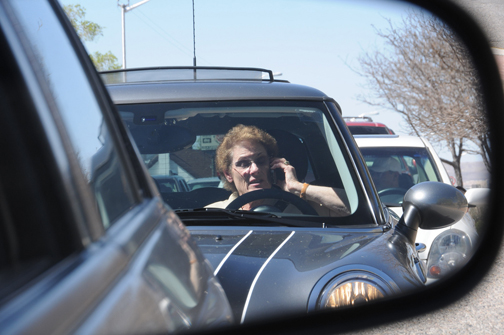
Cellphone driver. Photo © James Legans, Jr., creative commons

A century ago, people who drove automobiles unsafely on city streets were called jay-drivers. Like Toad of Toad Hall from the children’s book, Wind in the Willows, they wandered all over the road, drove too fast or drove too slow, stopped and started unpredictably, and caused mayhem—and consternation—among other road users.

Jay-driver was an insult. “Jay” meant rube, or an uneducated, unsophisticated person, someone so caught up in looking at the sights, they obliviously endangered others.

Today, jay drivers often are DUI or DUD (driving while using devices). And we call them something else altogether other than jay-drivers. Occasionally, we call the cops, too….

Read the rest of this editorial at the Victoria Times Colonist…. 

Quadra village street way—designed to slow traffic and encourage community. ©2014.

One of the buzzwords in urban planning these days seems to be “people-friendly streetscapes.”

The intent is to transform the car-centric corridors that crisscross our region into people-oriented spaces.

For example, Victoria’s new official community plan, unveiled last week, calls for transportation systems that prioritize pedestrians, cyclists and people using public transit.

You could consider Quadra Village as an example. As soon as you cross Hillside Road going south, the driving lane narrows, more vehicles are parked at the kerb, more street plantings, arty, low-hanging street lamps and banners change the feel of the street. They immediately shift roadway priorities away from traffic towards the people who live, work, walk, cycle, shop, and make the village viable.

Saanich’s draft plans for Shelbourne Street also call for improved focus on people. In the past, transportation planning along the corridor focused on vehicles, as many as 25,000 of which travel the corridor daily, en route from somewhere else to points beyond. Walking and biking routes are piecemeal. The plans recognize that communities along Shelbourne Street now need to be retrofitted to serve people and these multiple uses.

Brentwood Bay’s slower speed limits, and the Gorge–Tillicum area’s roundabouts also help refocus community throughways on people.

They manifest a paradox known as psychological traffic calming, or playing with drivers’ minds to slow them down….

Read the rest of this editorial at the Victoria Times Colonist….


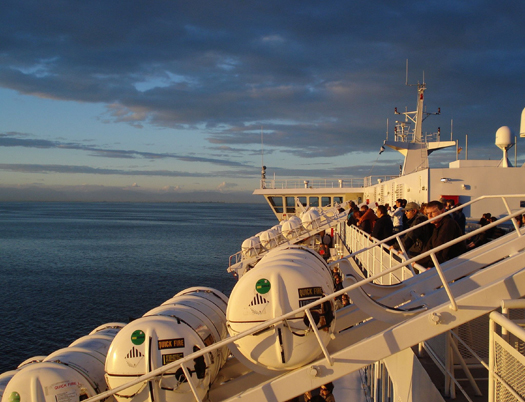
Ferry across Georgia Strait. Photo © JamesZ_Flickr

On a recent trip to Vancouver, a great yellow tongue of dirty air greeted us as the ferry surged into Georgia Strait. Stretching out from Vancouver, the tongue licked at the shores of Galiano and Mayne islands.

“We’re travelling right into it,” Nature Boy said. “Gotta love these temperature inversions.”

For much of January, warm air sat like a pot lid over the south coast, trapping cooler air in valleys and against the mountains. At higher elevations, the warm temperatures messed up the ski hills. Down below, in the Lower Mainland, people stewed in chill, polluted air.

And here, coiling out of the Fraser Valley, the corpse-coloured smog tongue demonstrated, on a small scale, pollution’s potential long reach. Wind, rain and pollution recognize no boundaries, and don’t stop at the shoreline, the farm gate or the border….

Read the rest of this editorial at the Victoria Times Colonist.