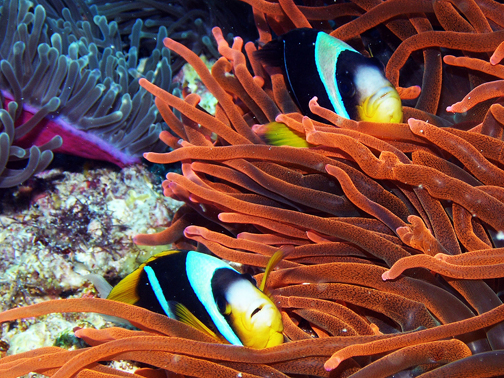
Clown fish. Photo © Rob, bbmexplorer.com, via creative commons and flickr.

When male clown fish lose their female partners, they change their sex and become female themselves. Go, Nemo/Nema.

When it comes to gender equality, researchers find Dad’s actions around the house speak louder than his words. University of British Columbia psychologists recently found that, when a father regularly engages in traditionally female household chores, his school-aged daughters are more likely to aspire to gender-neutral careers—for instance, becoming doctors, lawyers or CEOs.

Which means, guys, if you want your daughters to become highly paid white- or even blue-collared professionals, be sure you change diapers, scrub floors, pick up groceries, drycleaning and dirty socks, and make dinner—often and regularly. For, despite Peter Mackay’s reported emails to his staff, in doing so, you will indeed shape your daughters’ minds and values.

Gender-based divisions of household labour are social constructs. Yet, despite the last 40 years’ advances, women remain the primary caregivers, cooks and cleaners in many households. Some people—including some individuals in influential places—claim the roles naturally come with being the only humans biologically capable of gestating and birthing young.

But imagine if we could switch biological roles, as it were, without complicated surgeries and hormones. Imagine if we could easily adjust the division of reproductive labour. That would be the end of many questionable comments and assumptions.

Some organisms do exactly that….

Read the rest of this editorial at the Victoria Times Colonist….


More to explore:

Battle of the sexes – one gene keeps us either male or female

Dads who do housework have more ambitious daughters

Moms change diapers, Dads form leaders: Justice minister’s emails to staff

Sex change in nature—coral reef fish

Slug love


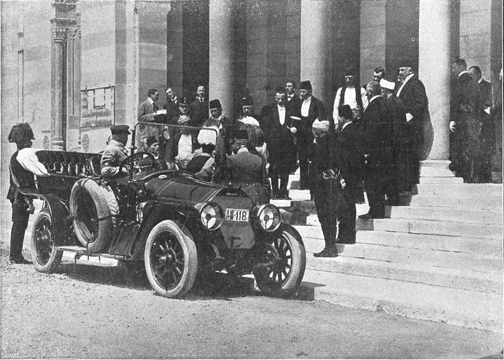
Franz Ferdinand's motorcar, June 28 1914, Sarajevo

One century ago, a sound occurred that continues to ring today. The singular blast was neither broadcast nor recorded. Nevertheless, it echoes through all of our lives today—not as sound waves, but as long, slow swells through our social fabric.

When Bosnian student Gavrilo Princip fired his pistol in the crowded streets of Sarajevo and killed the heir to the throne of the Austro-Hungarian Empire on June 28, 1914, the crack of his gunshots cracked the world apart.

Most people heard the resulting fault lines creak and quake only weeks and months later. By then, millions were dying across Europe, empires marched towards collapse, and the world was changing forever.

Few people were aware of the intricate treaties, ties and obligations that bound one European power to another then. Some of the informed few suspected this simple revolutionary act on the part of a hitherto-unknown student in a small, volatile corner of Europe would lead to war. However, none could have predicted the gunshots signalled a political, economic and social upheaval more widespread and more thorough than any French, American, Glorious or Quiet revolution.

Here in Victoria, we were pretty much oblivious….

Read the rest of this editorial at the Victoria Times Colonist….

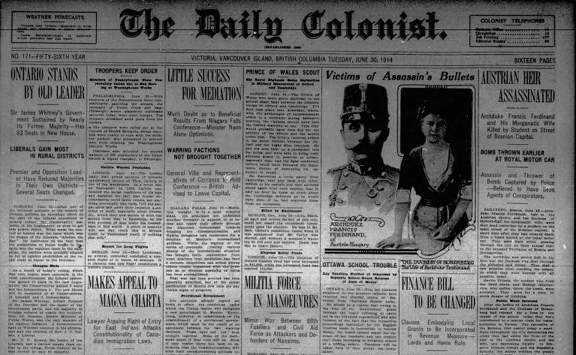
Front page headlines, Daily Colonist, June 30 1914, Victoria, B.C.

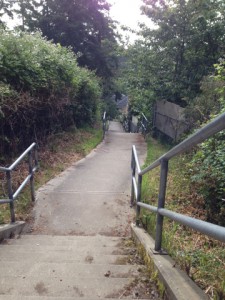
Pathway from Mildred Street to Wilkinson slips between backyards.A little-known network of shortcuts and passageways knits many of the region’s urban areas together.

These connecting pathways—they’re too short to be called trails—pass unobtrusively among municipalities’ houses and yards. They stitch residential streets to other residential streets, quiet parks to formal trail systems, seemingly dead-ends to pedestrian-only exits, and neighbourhoods to crescent beaches or rocky shorelines. They wind through neighbourhoods, linking a person’s travels into lines and loops through local urban geography.

Each of the region’s municipalities treats these access points and rights of way differently. Some, like Saanich, glory in their abundance, and chart their locations like chicken scratchings on trail maps. Some municipalities, like Victoria, make the most of the few no-vehicle passageways that century-old urban planning and decades-old development have left them, and have worked them into formal walking and even lazy-day cycling loops. Some municipalities keep quiet about them, leaving local explorers to scrutinize municipal maps for faint lines and other signs that may—may—indicate the little-used laneways amidst the bolder cartographic connections.

Regardless of whether they’re published or not, most of these passages seem to remain neighbourhood secrets, known primarily to those who live alongside them.

In fact, these rights of passage could be seen as rites of passage….

Read the rest of this editorial at the Victoria Times Colonist….

This slideshow requires JavaScript.

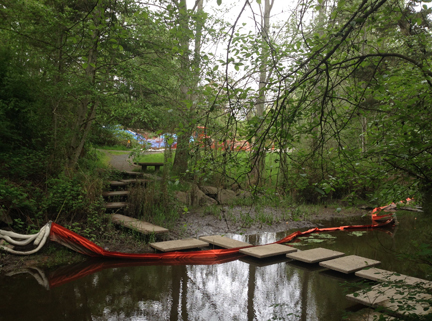
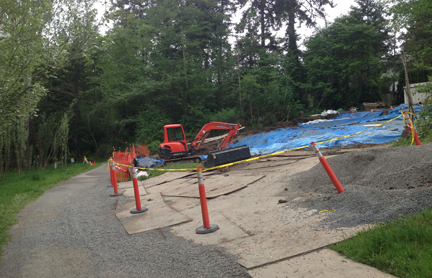
Colquitz Creek home-oil spill containment, May 2014. All rights reserved.

The B.C. government is seeking public comment on a proposed preparation and response system to protect the province’s environment from land-based hazardous spills.

It’s all part of Premier Christy Clark’s five conditions for blessing any new pipeline development through the province. As such, the proposed initiative currently focuses on industrial-scale transportation of heavy oil via pipeline or rail.

However, if fully implemented, the system will benefit B.C. even if the Enbridge and Kinder Morgan pipeline projects do not proceed. The system applies to spills of any hazardous material that could affect terrestrial environments, including lakes, wetlands, creeks, and coastal shorelines, regardless of where the spill originates.

This means it would apply to spills such as those that occur repeatedly along our own urban salmon stream, Colquitz Creek….

Read the rest of this editorial at the Victoria Times Colonist….

Owners of properties that are the source of hazardous spills are responsible for costs of containment, cleanup and remediation. All rights reserved.

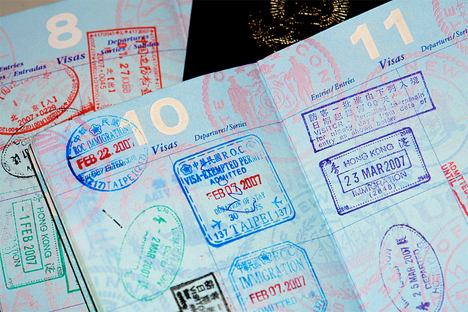
Passport. Photo © J Aaron FarrTheir very name indicates admission or entrance. A passport—from the French passer la porte, or pass through a port—is a document that allows a person to pass from one country to another, from world to another, even from life to another.

We’ve heard of two instances in the last month in which people have tried to use such documents to gain entrance to new countries, new worlds, new lives.  Just days after officials determined that two passengers aboard Malaysian Airlines flight 370 had been traveling under stolen passports, police in London, Ontario, arrested three people for allegedly using fake passports to write exams on behalf of other students.

The incidents are of different orders of magnitude in terms of potential threat, but both events indicate the power of these small documents to open doors and allow passage.

No evidence exists to suggest the two men who boarded flight MH 370 with stolen passports had anything to do with the airplane’s later disappearance. Investigations indicate the Iranians travelling as Christian Kozel of Austria and Luigi Maraldi of Italy had no known links to terrorist organizations, and may have just been trying to get out of Malaysia. Both passports had been listed in INTERPOL’s database of stolen passports. It may be we will never know the truth in this story.

The story of the surrogate students caught using fraudulent passports in Ontario is clearer, however. They were writing English proficiency exams for foreign students applying to attend university in Canada. Canadian colleges and universities use the exams to evaluate prospective students’ ability to read and write in the language of instruction. Students must pass the exams before their applications are accepted….

Read the rest of this editorial at the Victoria Times Colonist….

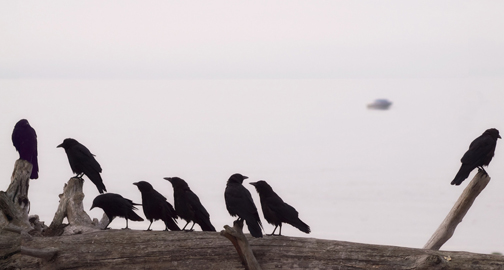
One crow for sorrow; Eight crows for heaven. Photo © Ingrid Taylar @ thewildbeat.com

If this were 2000 years ago, the population may have rioted in the streets.

At the very least, Romans leaders would have put off major undertakings until portents improved. Seers would have watched weather and bird life, listening for the whisperings of Olympian gods in the croak of the crow, the whistle of the eagle or the chirp of the sparrow. They would have looked for signs that the gods had recovered from their most recent bouts of indigestion—side effects of indulging in all that nectar and ambrosia—and were once again smiling favourably on Roman endeavours.

But we live in unsuperstitious times. So, when a major religious figure and a couple of kids in Rome released white doves in a gesture of peace last month, and those very birds were roughed up by their mean-streets feathered brethren, people merely pronounced it a bad omen for events in the Ukraine, for the Olympics, for Syria….

The event and its interpretation presented the pointy-headed crowd with opportunity to roll its eyes and say (I paraphrase), “Hey, those doves are white—the result of generations upon generations of inbreeding. Of course wild birds would attack them. “

White, in Nature, is a statement of nonconformity. And Nature, for the most part, encourages conformity. Being a white animal is Nature’s equivalent of wearing a giant ‘Kick Me’ sign….

Read the rest of this editorial at the Victoria Times Colonist….


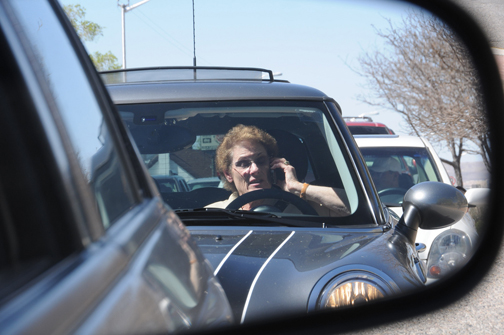
Cellphone driver. Photo © James Legans, Jr., creative commons

A century ago, people who drove automobiles unsafely on city streets were called jay-drivers. Like Toad of Toad Hall from the children’s book, Wind in the Willows, they wandered all over the road, drove too fast or drove too slow, stopped and started unpredictably, and caused mayhem—and consternation—among other road users.

Jay-driver was an insult. “Jay” meant rube, or an uneducated, unsophisticated person, someone so caught up in looking at the sights, they obliviously endangered others.

Today, jay drivers often are DUI or DUD (driving while using devices). And we call them something else altogether other than jay-drivers. Occasionally, we call the cops, too….

Read the rest of this editorial at the Victoria Times Colonist…. 

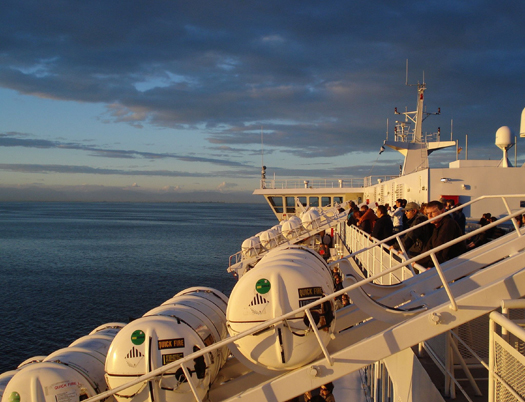
Ferry across Georgia Strait. Photo © JamesZ_Flickr

On a recent trip to Vancouver, a great yellow tongue of dirty air greeted us as the ferry surged into Georgia Strait. Stretching out from Vancouver, the tongue licked at the shores of Galiano and Mayne islands.

“We’re travelling right into it,” Nature Boy said. “Gotta love these temperature inversions.”

For much of January, warm air sat like a pot lid over the south coast, trapping cooler air in valleys and against the mountains. At higher elevations, the warm temperatures messed up the ski hills. Down below, in the Lower Mainland, people stewed in chill, polluted air.

And here, coiling out of the Fraser Valley, the corpse-coloured smog tongue demonstrated, on a small scale, pollution’s potential long reach. Wind, rain and pollution recognize no boundaries, and don’t stop at the shoreline, the farm gate or the border….

Read the rest of this editorial at the Victoria Times Colonist.